Hollywood

Chris Pratt and Ben Sasse discuss family life, faith and Hollywood's idols

Chris Pratt and Ben Sasse discuss family life, faith and Hollywood's idols

Superstar Chris Pratt was enduring a messy, painful time in his life when he was selected to receive the MTV Network's 2018 Generation Award, saluting his impact on popular culture.

Pratt decided to take a leap of faith, during his on-camera remarks.

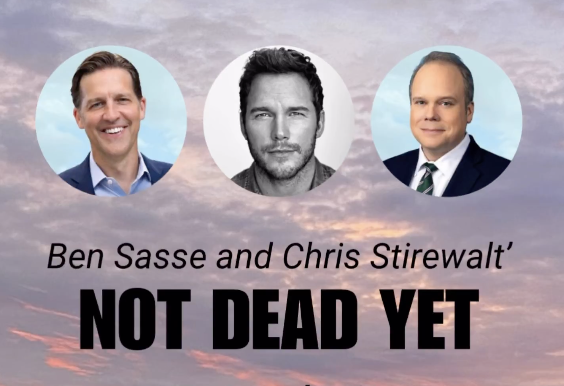
"I'm going to say to this young generation the things that I want to say," he said, in a recent appearance on the "Not Dead Yet" podcast cohosted by former U.S. Sen. Ben Sasse and political analyst Chris Stirewalt. "God has saved me multiple times. I'm gonna put my money where my mouth is and stand on this stage and say this to these folks. And so, I did it."

The star of Guardians of the Galaxy, the Jurassic Park reboots and myriad blockbusters -- grossing more than $14 billion globally -- outed himself as a Christian. His advice included, for example, "Learn to pray. It's easy, and it's so good for your soul" and "God is real. God loves you. God wants the best for you. Believe that. I do."

This immediately fueled speculation about how his faith would affect his cultural clout. Then, in 2020, Pratt started Indivisible Productions, with a nod to the phrase "one nation under God, indivisible" in the Pledge of Allegiance. The company's mission is to "create entertaining content, focusing on themes which will help to bridge the growing divide in our country and world."

Pratt said it's hard to look at American life right now without feeling worried and grateful, at the same time.

"I've got to be careful about this because I love America," he said. "I believe in God's providence that, you know, we have something really extraordinary here. And I love Hollywood as well. I love movies." However, he added: "As human beings, our hearts are designed in such a way that we have a spot reserved in them to be in awe of God."

Truth is, he added: "I work in a business where we create idols. And we worship them. And no one is worthy of worship. And so not only do we create idols to worship, we create idols to burn. … It's not an indictment on the system that they would look at me and say, 'You know what, he said this, so let's burn him.'"

Concerning faith-based rom-coms, horror, fantasy and other niche-movie trends

Concerning faith-based rom-coms, horror, fantasy and other niche-movie trends

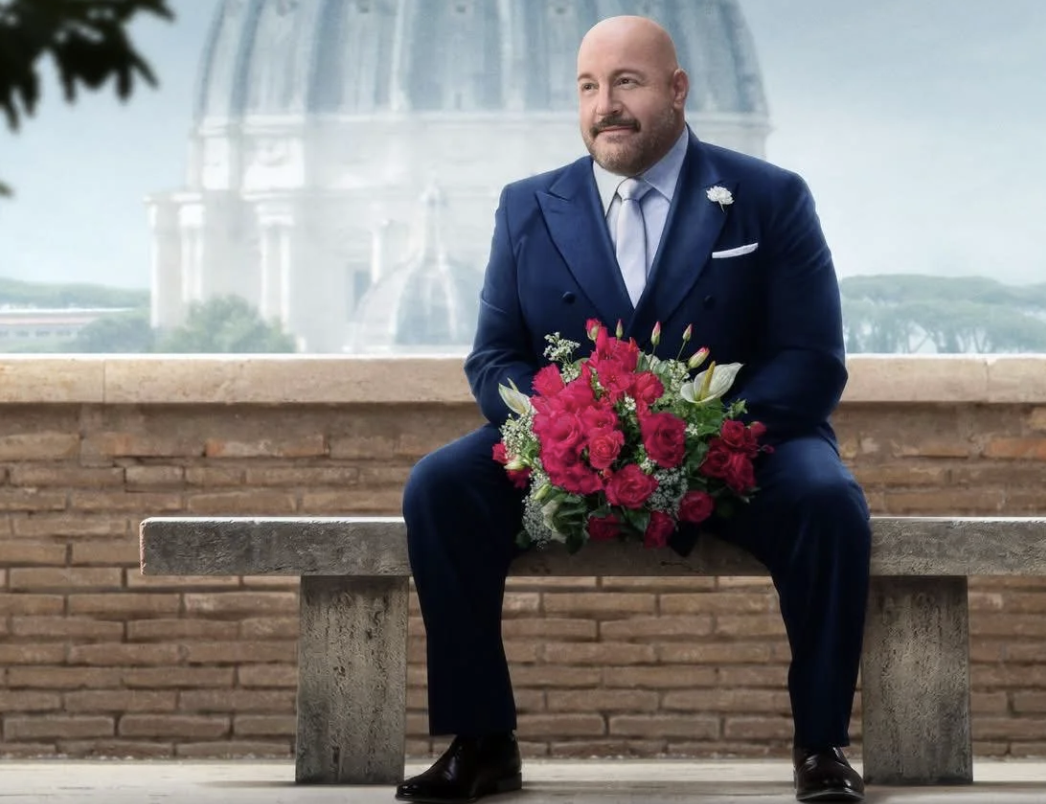
he romantic comedy "Solo Mio" offered a crashed wedding, epic views of Rome, funny sidekicks, an obligatory "meet cute," the lovely vineyards of Tuscany, a final plot twist and the dawn of new love.

It also included priests performing weddings, glimpses of the Vatican and old-school Italians making the sign of the cross with prayers at a family meal. The star was comedian Kevin James, an outspoken Catholic, and there was a prime role for Jonathan Roumie, another outspoken Catholic, who is best known for playing Jesus in "The Chosen" series. And this independent film was released by Angel Studios.

In today's cinematic marketplace, was this a "faith-based" film or merely a flashback to rom-coms from the 1950s?

"I'm all for this. … I never thought I would see, in a romantic comedy, Paul Blart, Jesus and Alexander from 'Sons of Anarchy' on a journey together in Italy," said YouTube critic Joseph Curtis. He was connecting James' hit "Paul Blart: Mall Cop," Roumie's iconic role and the star turn by Kim Coates in a Netflix series about motorcycle gangs.

As for the rom-com label, Curtis added: "It's a formula that has been done before -- to death -- but sometimes it just works."

For those charting the rise of faith-friendly flicks, the important fact about this small film, with a small cast, a small budget and a short release in theaters was that it made money, before heading into Angel's streaming-video vault.

"Making $26 million, with a $4 million budget, means this movie was a gargantuan success, relatively speaking," said Joseph Holmes, a New York City-based critics who writes for Religion Unplugged, World Magazine and other publications. "These days, the people making Marvel and Star Wars movies would be happy with that kind of return on their investments."

Attention all 'Rational Sheep' -- Hollywood is no longer the true church of the masses

Attention all 'Rational Sheep' -- Hollywood is no longer the true church of the masses

As the creator of classics such as "It's a Wonderful Life" and "You Can't Take It with You," director Frank Capra knew how to touch the hearts and souls of moviegoers.

The self-described "Christmas Catholic" took that power seriously. "No saint, no pope, no general, no sultan, has ever had the power that a filmmaker has," he once said. This was the "power to talk to hundreds of millions of people for two hours in the dark."

The power of today's digital media is much more complex than that, said Barbara Nicolosi Harrington, a former Catholic nun turned screenwriter and Hollywood script doctor.

"Hollywood has been the church of the masses, but I don't think that's still true. At least, we cannot say that movie theaters are the sanctuaries they once were for most people, especially for the young," said Harrington, author of "Behind the Screen: Hollywood Insiders on Faith, Film, and Culture."

When she was young, she explained, mainstream entertainment "was everything. Hollywood created the images that told us what was cool and what it meant to be a success and to be loved."

Now, when she talks to young people, they have a completely different relationship with mass media. The voices and images of Hollywood are competing with legions of "influencers" who reach the masses through omnipresent smartphones.

"There are so many competing screens and so much of the content is truly asinine," she said. Young people accept that, but believe that, with their peers, they can decide what is true and what is false in that digital universe. When messages hit home, social-media mavens then connect users with creators, activists or networks linked to the content.

"Kids think they're in control," said Harrington, reached by telephone. "But how can you tell what is right and wrong if it's TikTok and its algorithms that decide what you see? ... You think that you get to decide what is right for you and what voices will guide you. But is that true these days?"

The big question is whether millions of parents, pastors, teachers and counselors realize how much the balance of power has shifted in mass-media and entertainment.

Norman Lear: It's impossible to talk about American life without including faith

Norman Lear: It's impossible to talk about American life without including faith

Early in the premier of Norman Lear's sit-com "Sunday Dinner," the beautiful environmentalist T.T. Fagori raised her eyes to heaven and, with a sigh, entered a spiritual minefield.

"Chief?", she asked God. "You got a minute?"

In addition to praying out loud in prime time, this character offered a theological reverie at dinner while meeting the family of her fiancé, a 56-year-old widower nearly three decades her elder. The problem: His granddaughter heard Fagori mention God during a science lecture.

"You see, I talk about extending 'love thy neighbor' to include animals, plants, stuff like that. I say that the natural world is the largest sacred community to which we all belong," Fagori explained. "I talk about cosmic piety because the same atoms that form the galaxies are in all of us and it's the universe that carries the deep mysteries of our existence within itself.

"You see how all that sounds pretty spiritual. … So, when the kids hear me say these things, some of them think they hear the word 'God,' but they don't. I don't actually mention it. Interesting, huh?"

This 1991 comedy flopped, but it was an important statement from Lear, whose December 5 death at 101 years of age closed his career as lightning rod in popular culture and politics.

For decades, Lear described himself as a cultural Jew who didn't practice any traditional form of faith. He also founded People for the American Way, an old-school liberal advocacy group on church-state issues. But this television icon became more and more intrigued with religious faith, both as a force in American life and as a topic ignored by Hollywood.

During "Sunday Dinner" press events, Lear argued that America was caught in "a deep spiritual malaise, and nobody is addressing it. The Religious Right did for a period and still continues to. But mainline churches don't do that good a job of it. And the media don't deal with it at all."

Dear Hollywood: 'A Christmas Carol' by Charles Dickens is truly a Christmas story

Dear Hollywood: 'A Christmas Carol' by Charles Dickens is truly a Christmas story

On his way to becoming a Hollywood superstar, Bill Murray demonstrated great skill at delivering rants that blurred the line between lunacy and pathos.

In the 1988 flick "Scrooged," he belted out lessons learned from visits with the ghosts of Christmas past, present and future, as well as occupying his own coffin in a crematorium.

"I'm not crazy. It's Christmas Eve. It's the one night when we … share a little more. For a couple of hours, we are the people we always hoped we would be. It's really a miracle because it happens every Christmas Eve," proclaimed Murray's character, a greedy, arrogant TV executive.

"If you waste that miracle, you're gonna burn for it. I know. … There are people that don't have enough to eat and who are cold. You can go and greet these people. Take an old blanket out to them or make a sandwich and say, 'Here!' l get it now. … I believe in it now."

"Scrooged" is a fascinating Tinseltown take on the Charles Dickens novella "A Christmas Carol" because of what the film contains and what it leaves out, said English literature professor Dwight Lindley of Hillsdale College in Michigan.

This dark comedy contains miracles, ghosts, angels, sin, judgment, penance, purgatory, damnation, the Grim Reaper and eternal life. What it lacks is any meaningful role for God or a Holy Babe in a manger.

"Scrooged" is as "far as some people in Hollywood can go with Dickens," by "domesticating his message and making it more comfortable," said Lindley, who is teaching a six-lecture online course about this 1843 text.

The class, he added, was created for "anyone who loves the story, but doesn't know how to dig deeper into it than what they have seen in the somehow superficial versions that are around. … Some people have a sense that there is something deeper, something moving underneath the surface."

For many, watching "A Christmas Carol" on video is a holiday ritual. These movies usually include the basic story, while ignoring the narration in which Dickens frames his parable.

Raquel Welch finally found some peace in with believers in an ordinary church pew

Raquel Welch finally found some peace in with believers in an ordinary church pew

The statuesque film legend didn't call attention to herself as she shared a pew with other conservative Presbyterians in their small church not far from Hollywood.

She was articulate when discussing theology and church matters and, from time to time, would offer advice on finances. She had learned a lot in the movie business.

Raquel Welch wasn't trying to hide, during the later decades of her life when she faithfully attended Calvary Presbyterian Church in Glendale, California. She was simply looking for people she could trust.

"She was careful. … She wasn't going to one of those 2,000-member churches where everyone would look at her. That wasn't her style," said the Rev. Christopher Neiswonger, who grew up in that congregation and attended nearby Fuller Theological Seminary. He now leads Graceview Associate Reformed Presbyterian Church in Southhaven, Mississippi.

"She also wasn't trying to stick her thumb in the eye of a Hollywood culture that she knew would denigrate this kind of faith commitment. … She was Raquel Welch, but she just wanted to be part of our church family."

Welch died on Feb. 15 at the age of 82, inspiring waves of tributes focusing on her iconic beauty in "Fantastic Voyage," "100 Rifles," "The Three Musketeers" and dozens of other movies and television programs. The legendary poster from "One Million Years B.C." framed her as a bombshell babe image for the ages.

In a Facebook tribute shared with other believers, Neiswonger called Welch a "wonderful lady and a fine Christian" whose "faith grew more powerful and practical with age. It's often true that the most important things become the most important to us as we've matured personally."

Why did journalists skip over the inspiring final act of Orson Bean's wild life?

Why did journalists skip over the inspiring final act of Orson Bean's wild life?

Orson Bean answered the same question many times during his crazy ride from Broadway to doing every conceivable kind of work during his decades in Hollywood.

What was this funny guy trying to do, while embracing drugs, edgy politics, sexual healing, hippie communes, experimental forms of therapy and other diversions involving his body, mind and soul?

On one occasion, Bean said he was trying to become the "happiest son of a bitch alive." In another Los Angeles Times interview he added: "I did all this stuff, the drugs, getting my kisser on the tube, because I thought it would make me happy. But it didn't work. I didn't find happiness until I learned to surrender, to give up the crazy pursuit."

Surrender to what? The answer to that question didn't make it into the media tributes after the 91-year-old Bean's death on Feb. 7, when he was hit by two cars while walking in his Venice, Calif., neighborhood. However, the answer has hiding in plain sight in several cable TV interviews, his one-man stage show and an online testimony he wrote entitled "How Orson Bean Found God."

"For most of my life I didn't believe in God," noted Bean. "Who had time? I was too busy with things of this world: getting ahead, getting laid, becoming famous.

"For most of my adult life I've been at least somewhat famous. Not so famous that I had to wear dark glasses to walk down the street, but famous enough that head waiters would give me a good table. I didn't want to be famous for its own sake. I wanted to be famous so as to be happy."

What finally turned Bean's life around was a religious conversion. He went looking for the "Higher Power" in his 12-step program and eventually found peace.

Many Hollywood people who knew Bean were amazed that the final act in his wild life -- from Communist sympathizer to father-in-law of the late conservative raconteur Andrew Breitbart -- didn't make it into news reports.

Hollywood declines to ponder the work of Mister Rogers -- as a pastor

Hollywood declines to ponder the work of Mister Rogers -- as a pastor

During a dozen years of ministry, the Rev. Ted Giese estimates that he has performed 200 funerals and made 1,000 hospital visits to the sick and the dying. He also spends many hours in theaters, working on his movie reviews featured at The Canadian Lutheran website.

Thus, Giese knew exactly what was happening in a crucial scene in "A Beautiful Day in the Neighborhood." In it, PBS legend Fred Rogers -- played by Tom Hanks -- arrives with a pie for the family of a dying father who has been struggling to heal a bitter rift with his journalist son.

Leaning over the deathbed, Mister Rogers whispers into the man's ear. Moments later, the son asks what he said and Rogers replies: "I asked him to pray for me. Anyone who's going through what he's going through must be very close to God."

Anyone who has served as a pastor, said Giese, will immediately recognize what happened in this encounter.

"That was a pastoral call," he said. "I don't usually bring an apple pie with me when I make this kind of visit, but I know what that scene is all about. I know what that feels like as a pastor. It's like you're part of the family, but you are also there to provide the kind of care that people count on pastors to provide."

This scene may have seemed strange for many moviegoers. The film makes it clear that Rogers is a deeply spiritual, even saintly man. He reads scripture and begins his day on his knees, praying -- by name -- for people he has met while doing his work.

But here's the strange part. This movie never mentions that Mister Rogers was also the Rev. Fred Rogers, an ordained Presbyterian minister. It never notes that Rogers went to seminary seeking the theological depth that he believed he needed to address tough issues -- life, death, disease, divorce, war, poverty, racism, loneliness -- in child-friendly words and images.

For Rogers, "neighbor" for was not a random word that, for 33 years, he inserted into television scripts. He was, show after show, making a personal statement that affirmed a kind of love demonstrated in the biblical parable of the Good Samaritan and its haunting question, "Who is my neighbor?"

The mass-media holy wars surrounding that 'Unplanned' movie about abortion

The mass-media holy wars surrounding that 'Unplanned' movie about abortion

If "Unplanned" was an ordinary movie, its creators would be busy right now studying second-week box office numbers while starting negotiations with the digital giants that stream products to the masses.

But this has never been an ordinary movie, which is why it's an important test case for religious believers trying to bend Hollywood's unwritten rules about religion and hot-button moral issues.

Backed by a company called Pure Flix, "Unplanned" was filmed in secret in Oklahoma, using the code name "Redeemed" in an attempt to postpone controversy. The filmmakers behind "God's Not Dead" and similar Christian-market projects had a $6 million budget for their take on the story of Abby Johnson, a young Planned Parenthood executive who in 2009 quit to join the protestors outside her own clinic in Bryan, Texas.

Mainstream entertainment's powers that be have made it clear that the images and themes in "Unplanned" are not acceptable, said Cary Solomon, who wrote and directed the film with Chuck Konzelman.

"We offered them money for TV advertising and they turned us down. Now Netflix doesn't want us," said Solomon, earlier this week. "We've made a good movie and people want to see it. … We'll be getting close to $20 million at the box office in another week or so. Why won't some of these companies let people see our movie?"

Most of the "Unplanned" press coverage has focused on the marketplace controversies swirling around the film, as opposed to the film itself. One of the best summaries of the fine details in the drama about this drama ran as a column in The Washington Post.

"They gave the movie an "R" rating -- which meant the trailer could only run before R-rated movies and no one younger than 17 under could see it without a parent's permission," noted Marc Thiessen, former speechwriter for President George W. Bush. "A half-dozen major music labels refused producers' requests to license music for the film. Many major television networks except Fox News and the Christian Broadcasting Network refused to run ads promoting it. Then, curiously, the movie's Twitter account was suspended through no fault of its own during opening weekend. … Tens of thousands of users (myself included) mysteriously found themselves involuntarily removed from the account's followers and/or unable to follow it in the first place.

"Get the feeling someone doesn't want you to see Unplanned?"