
C.S. Lewis

Stalking all of those fake C.S. Lewis quotes online (and the new AI pope)

Stalking all of those fake C.S. Lewis quotes online (and the new AI pope)

Late in the movie "Shadowlands," the C.S. Lewis character describes the role that books can play in real life.

The famous Oxford don and author, played by Anthony Hopkins, notes: "We read books to know that we are not alone."

Lewis never wrote those memorable words -- they came from screenwriter William Nicholson, noted William O'Flaherty, author of "The Misquotable C.S. Lewis: What He Didn't Say, What He Actually Said, and Why It Matters." Nevertheless, that quote is frequently attributed to Lewis on websites and in social media.

Further complicating matters, "the movie character Lewis -- when he does say it, while the real Lewis never said it -- is quoting a student who is saying that his father said it," noted O'Flaherty, via Zoom. Many who spread this quote appear to want people to "think the real Lewis went around repeating things from others" while taking credit for them.

It doesn't help that many readers who circulate fake Lewis quotes do so because they admire the author's Christian faith expressed in 30-plus books -- fiction and nonfiction -- which sell millions of copies a year, long after his death in 1963.

Lewis is not an isolated case. In his book, O'Flaherty noted that Albert Einstein never said, "God does not play dice," Mark Twain didn't proclaim "There are three kinds of lies: lies, damn lies, and statistics" and Ernest Hemingway "never claimed he could write a short story with just six words." Conan Doyle never had Sherlock Holmes say "Elementary, my dear Watson."

The basic problem: "Too many people have a bumper sticker attention span. And typically, they love quotes because quotes give them the 'sound bite' that confirms something they ALREADY believe."

In the past, some readers simply "misremembered" quotes they heard in lectures, sermons and speeches and passed them on. Misquotes have even appeared in books or major periodicals. With some authors, movies and television based on their writings have added to the confusion. Finally, issues with misquotes kicked into high gear with the Internet and powerful social-media platforms such as Facebook, Instagram and X. How will AI affect all of this?

The fellowship of J.R.R. Tolkien and C.S. Lewis, shaped by reality in World War I

The fellowship of J.R.R. Tolkien and C.S. Lewis, shaped by reality in World War I

A British soldier began writing "The Fall of Gondolin" while in a hospital bed, stricken by "trench disease" from the lethal front lines of World War I.

A German soldier later bemoaned the "lice, rats, barbed wire, fleas, shells, bombs, underground caves, corpses, blood, liquor, mice, cats, artillery, filth, bullets, mortars, fire, steel." Add poison gas to that ordeal.

Young J.R.R. Tolkien wrote: "The fume of the burning, and the steam of the fair fountains of Gondolin withering on the flame of the dragons of the north, fell upon the vale of Tumladen in mournful mists." The battlefields were "cold and terrible."

This was a vision of war from a man who had been there, said Joseph Loconte, author of "A Hobbit, a Wardrobe and a Great War." The book explores the many ways that World War I shaped Tolkien and C.S. Lewis.

"Tolkien wasn't writing escapist fantasy," said Loconte, reached by telephone. "If this is about escape, it's the writings of a prisoner who has escaped the world of cells, bars and keys. This kind of escapism … helps us realize that our prisons have windows and we can use them to see better things."

Tolkien later wrote that he began creating his Middle Earth mythology -- the foundation for the future "The Lord of the Rings" -- while "in grimy canteens, at lectures in cold fogs, in huts full of blasphemy and smut, or by candlelight in bell-tents, even some down in dugouts under shell fire."

Yes, the man who survived days huddled in shell craters and trenches in France would later write, in a blank page in an Oxford student's exam book, these famous words: "In a hole in the ground there lived a Hobbit."

Tolkien and Lewis remain stunningly popular -- in print and on digital screens.

When did Stephen Colbert's satire, with it's Catholic grace, veer into ridicule and rage?

When did Stephen Colbert's satire, with it's Catholic grace, veer into ridicule and rage?

Soon after Stephen Colbert landed "The Late Show" he welcomed tycoon Donald Trump as a guest and did something shocking — he apologized.

"I said a few things about you over the years that, that are, you know, in polite company, perhaps, are unforgivable," Colbert said, in 2015.

"Accepted," said Trump, smiling.

That encounter was light years from what happened after Trump celebrated the recent CBS decision to cancel "The Late Show."

On social media, the president said Colbert's "talent was even less than his ratings."

Colbert fired back in his monologue: "Would an untalented man be able to compose the following satirical witticism? Go f*** yourself."

While Colbert retains a faithful congregation, some fans who loved his sly blend of satire and progressive Catholicism mourn his decision to preach to only half of America, said media scholar Terry Lindvall, author of "God Mocks: A History of Religious Satire from the Hebrew Prophets to Stephen Colbert," published in 2015.

"He made you laugh and think," said Lindvall, reached by telephone. "When he turned on the rage, he turned mean. He turned bitter. He acted like he was a prophet, not a jester." Sadly, Lindvall added, the Trump era turned Colbert into "a liberal fundamentalist. … He drank the Kool-Aid."

The goal, in "God Mocks," was to offer a "bumpy tour through Rome, Jerusalem and Lilliput," arriving at Comedy Central. Lindvall praised Colbert's early work on "The Colbert Report," in which he pretended to be a blow-hard conservative pundit, creating an upside-down persona who could mock secular progressives and atheists, as well as thinkers on the right. Conservative guests, especially Catholics, were often treated with respect.

That was satire, wrote Lindvall, recognizing "a moral discrepancy between what is proclaimed and what is practiced. … The biblical satirist shares in the blame and shame of his defendants.

The golf world is still dissecting Scottie Scheffler's heart, mind and soul

The golf world is still dissecting Scottie Scheffler's heart, mind and soul

When Scottie Scheffler celebrated his recent victory at the British Open, it was hard to tell who drew the loudest cheers -- the world's No. 1 golfer or his toddler son.

Nike captured the family vibe with a viral advertisement showing Scheffler and Bennett, with the caption, "You've already won," before adding, "But another major never hurt."

After the win, Scheffler added fire to the week's hot story, which was his candid remarks about why he isn't obsessed with winning trophies week after week.

"My faith and my family is what's most important to me," he told reporters. "Those come first for me. … Golf is third in that order."

The key words were "in that order," noted Daniel Darling, director of the Land Center for Cultural Engagement at Southwestern Baptist Seminary. "Scottie Scheffler doesn't see golf as a god. He's thankful that God has given him the abilities that he has." However, he also "knows the challenge in life is to keep things in the right order, to focus on what really matters."

The firestorm began earlier that week, when the 29-year-old superstar drew nervous laughter by stressing: "I'm not here to inspire somebody else to be the best player in the world, because what's the point? … This is not a fulfilling life. It's fulfilling from a sense of accomplishment, but it's not fulfilling from a sense of the deepest places of your heart.

"There's a lot of people that make it to what they thought was going to fulfill them in life. And then you get there, then all of a sudden you get to No. 1 in the world, and they're like, what's the point? … That's something that I wrestle with on a daily basis."

Scheffler's remarks revealed a "human side we too often don't get to see," noted Shane Ryan, writing for Golf Digest. "For those with ears to hear it, there was a deep message at play, and an almost unbearably honest one." Perhaps, Ryan added, if "someone like Scheffler, who has been to the mountaintop of his world, finds spiritual emptiness on that summit, what hope do the rest of us have?"

Dorothy Sayers: It's no mystery that her world was shaped by a classical education

Dorothy Sayers: It's no mystery that her world was shaped by a classical education

As president of the Detection Club, Dorothy L. Sayers led initiation rites featuring ceremonial garb, flickering candles and the spooky presence of Eric, a human skull.

With a flair for the dramatic, Sayers required British mystery writers to take an oath, including: "Do you promise that your detectives shall well and truly detect the crimes presented to them, using those wits which it may please you to bestow upon them and not placing reliance on, or making use of, Divine Revelation, Feminine Intuition, Mumbo-Jumbo, Jiggery-Pokery, Coincidence or the Act of God?"

New members promised "moderation" in -- this is a partial list -- the use of conspiracies, death-rays, ghosts and trapdoors, while "utterly and forever" avoiding "Mysterious Poisons unknown to Science." And of course: "Do you solemnly swear never to conceal a vital clue from the reader?"

The Detection Club was founded in 1930, with G.K. Chesterton as president. Sayers was a founding member and became its third president, followed by Agatha Christie.

Famous for her Lord Peter Wimsey detective novels, Sayers' career defied simple labels. As a young woman, she worked for the S.H. Benson advertising agency in London. Among Christians, she is best known as a colleague of C.S. Lewis, J.R.R. Tolkien and others in the Inklings writers circle in Oxford. Sayers wrote poetry, theological essays and theatrical works for the stage and BBC Radio. She was gifted in multiple languages and spent the final years of her life translating Dante's "The Divine Comedy" into English.

Sayers is also known for a 1947 Oxford presentation -- "The Lost Tools of Learning" -- that has influenced generations of Classical education leaders in the United States, England and elsewhere. As a child, she was educated by her father, an Anglican vicar, who taught choral music and Latin at Oxford.

"Her parents gave her a classical education that allowed her to navigate her world, the tools to support herself. When she struggled and made mistakes, she was able to repent and get back on track," said medieval scholar Lesley-Anne Williams, who lectured on "Dorothy Sayers: Advertising, Murder and Classical Education" during last week's annual Inklings Festival at the ecumenical Eighth Day Institute in Wichita, Kansas.
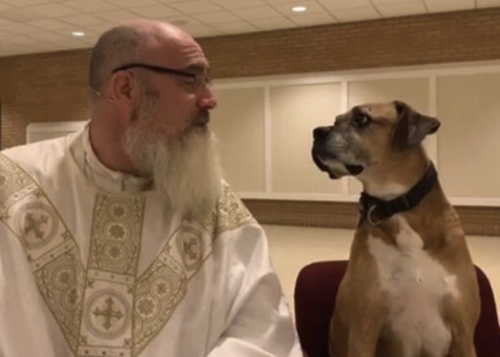
Pets in heaven? Concerning the ministry of Marius Aurelius Spartanicus, the priest's dog

Pets in heaven? Concerning the ministry of Marius Aurelius Spartanicus, the priest's dog

Catholic priests are not used to hearing penitents laughing while lined up for confession.

When Father Joseph Krupp peered out of the booth one day, he saw that his broad-chested, 72-pound Boxer was in a chair and, when the line moved, the dog took the next chair.

Everyone knew this hound had sins to confess, after raiding wedding receptions, opening church fridges and, on one occasion, scarfing down a three-pound roast. Krupp laughs when describing how the latest of his rescue dogs "absolutely murdered" a rabbit -- next to a statue of St. Francis of Assisi, patron saint of all creatures great and small.

The priest said he has intentionally adopted old dogs, hoping to "give them a few happy years. … I always thought that I was trying to heal the dogs. This time, God sent the dog to heal me."

This canine parable began during a tough stretch of the priest's work in a number of Michigan parishes. Krupp has served as chaplain for the Michigan State University football team, led the university Catholic campus ministry and now supervises the state's Northeastern deanery, with 12 parishes and four schools.

The priest went to the Hillsdale Humane Society eight years ago to donate a bed, toys and food after his latest dog died. Then he saw a battered, "broken-hearted" Boxer no one wanted.

"He was found tied to a tree, along with another dog. The other dog had died of starvation, and he was close to it. He had been shot with numerous pellets, his tail was broken, and a lot of his teeth were missing," wrote Krupp, to his many @JoeInBlack readers on X (formerly Twitter).

The dog was hours from death, but shelter workers saved him.

As Krupp arrived, a former student "sent me a message. She told me she was praying for me, and God told her that He was going to give me a remarkable gift that day. I walked in just as they were walking a dog out," he wrote. "He lifted his head, saw me and ran at me so hard and fast that the leash came out of the volunteer's hand. I sat on the floor, and he jumped on me, licking me and pushing me to the ground. I just couldn't quit laughing."

2023: A 'Barbie' Odyssey does raise (wink, wink) moral, cultural and theological issues

2023: A 'Barbie' Odyssey does raise (wink, wink) moral, cultural and theological issues

Hollywood worships big movie franchises, so fans can expect "Barbie" sequels.

One plot proposal quickly emerged from an unlikely source -- Sister Mary Joseph Calore of the Society Devoted to the Sacred Heart of Jesus in St. Cresson, Pennsylvania.

"'Barbie becomes a nun' would be a great sequel," she wrote, on the X platform. Her post contained this pitch to Warner Bros. executives: "Dissatisfied by endless parties and user friends, an eating disorder, spending addictions with clothes and shoes, and cohabitating with the shallow & unemployed playboy Ken, Barbie's sportscar has been parked more and more at an adoration chapel. She is seriously giving thought to draining the pool, putting her condo on the market, cutting her hair and donning the religious habit."

That would be a twist, after a cinematic manifesto arguing that life as a real woman is painful and complicated, but it's better than being an iconic plastic doll.

"This movie should have been silly and fun, but it ended up being preachy and earnest," said Barbara Nicolosi Harrington, a former Catholic nun who became a screenwriter and Hollywood script doctor. "I mean, how far can you go with a story about Barbie?"

Writer-director Greta Gerwig's previous work has been impressive, stressed Harrington, who teaches at Regent University in Virginia Beach, Virginia. With "Little Women," Gerwig showed the ability to offer a fresh take on a familiar story. Now, "Barbie" will draw intense scrutiny, since she will direct at least one movie in the upcoming Netflix take on "The Chronicles of Narnia" novels by the Christian apologist C.S. Lewis.

"Barbie" contains ambitious attempts to mix serious, even if tongue in cheek, social commentary with pop-culture mythology -- such as a shot-for-shot homage to Stanley Kubrick's legendary dawn-of-consciousness scene in "2001: A Space Odyssey."

The big "Barbie" question, noted Other Feminisms writer Leah Libresco Sargeant, is stated in a soundtrack ballad -- "What Was I Made For?"

Why fairy stories still matter, in an age of secular myths and marvels

Why fairy stories still matter, in an age of secular myths and marvels

Demons appear on movie screens all the time, but poet Richard Rohlin is convinced he has actually seen them at work when counseling young people whose search for meaning has driven them deep into experiments with sex, drugs and the occult.

"The stories that I can't tell would curl your toenails," he said, speaking at the Eighth Day Institute in Wichita, Kansas. "If you think that these spiritual realities are not still with us, you are deluding yourself. ... The magic is coming back into the world. Something is happening and it is not an unqualified good."

The young people he works with in Dallas are not interested in sermons and detailed descriptions of why their lives are broken. But they are open to fantasies, myths and tales -- ancient and modern -- about unseen, spiritual realities that interact with their lives.

Millions of Americans know where to find stories about angels, demons, warriors, seers, giants, demigods and heroic kings and queens. They head straight to movie theaters and cable television, where they find entire universes of content offering visions of fantastic worlds. The last place they would seek inspiration of this kind is in churches.

The irony is that some of these works draw inspiration from the fantasy classics celebrated in the ecumenical Eighth Day Institute's annual fall celebration of The Inklings, a mid-20th Century circle of Christian writers in Oxford, England, that included C.S. Lewis, J.R.R. Tolkien and others.

This year's lectures focused on Scottish writer George MacDonald, often called the "grandfather of the Inklings," who is best known for "Phantastes," "The Golden Key," "Lilith" and many other works. The festival included Celtic and folk musicians, along with workshops on topics such as "The Art of Making Mead" and "Publishing for the Moral Imagination."

The goal of MacDonald and The Inklings, noted Rohlin, was to reclaim an older vision of life in which physical realities corresponded to spiritual realities and nothing was considered purely material. The real divide was between "the seen and the unseen," not between the "spiritual and the material."

Lessons from Kansas plains: Hall of Men in Wichita mixes books, beer, prayer and more

Lessons from Kansas plains: Hall of Men in Wichita mixes books, beer, prayer and more

WICHITA, Kan. — The Hall of Men fits the name, with meetings offering beer, cigars, an open bar, some kind of guy food (think pizza) and lots of chatter around a giant wooden table.

But then there are the evening prayers, icons, Bible readings and lectures about authors whose portraits hang in this “Christian speakeasy.” The names include C.S. Lewis, Flannery O’Connor, W.H. Auden, Dorothy Sayers, Fyodor Dostoevsky, J.R.R. Tolkien and many others. Johnny Cash and Bob Dylan are there, as well.

This group has met twice a month for a dozen years and most of the faithful are Orthodox, Catholic and Lutheran, with plenty of evangelicals at special events. The authors honored are selected after an informal process that usually starts during fellowship before and after lectures, with men talking about books that have touched their lives.”

The whole thing is affected by having that bookstore right next door,” said Pastor Geoff Boyle, a Missouri-Synod Lutheran long active in the project. “The man behind the front counter is used to having these conversations and obviously knows all about the books the guys are talking about. The books are right there and, if they’re not, they will be soon.”

“That bookstore” is Eighth Day Books, which draws customers from across the nation to an old three-story house with 46,000 new and used books — 27,000 titles — shelved and stacked anywhere that will hold them, including the basement “Hobbit Hole” packed with children’s literature. The white-haired man behind the counter is owner Warren Farha, an Orthodox believer with family ties to Lebanon.

This isn’t a “Christian bookstore” complete with knick-knacks, inspirational posters and religious self-help books — but “Eighth Day” is a reference to the Resurrection of Jesus.

Farha created the store in 1988 and selects all the books, with the help of an ecumenical network woven into the Eighth Day Institute and its conferences, newsletters, podcasts and groups such as the Hall of Men and the Sisters of Sophia.

“My goal has always been to be fair to the great traditions,” said Farha, in his office in the bookstore’s attic. “We have classics in history, literature, poetry, church history, theology and philosophy — Christian writings through the ages. … I’m always listening to people who GET the template for what we’re doing here.

“Great books from different traditions are on the shelves right next to each other, even if they clash in ways that we need to discuss.”