Gavin Ashenden

King Charles III and the dangers of talking about Easter

King Charles III and the dangers of talking about Easter

In western Christian churches, the highest holy day on the liturgical calendar is Easter -- the Solemnity of the Resurrection of the Lord.

A year ago, King Charles III, in an Easter message that made little news, proclaimed that the love Jesus showed "when he walked the Earth reflected the Jewish ethic of caring for the stranger and those in need, a deep human instinct echoed in Islam and other religious traditions. …

"The abiding message of Easter is that God so loved the world -- the whole world -- that He sent His son to live among us to show us how to love one another, and to lay down His own life for others in a love that proved stronger than death."

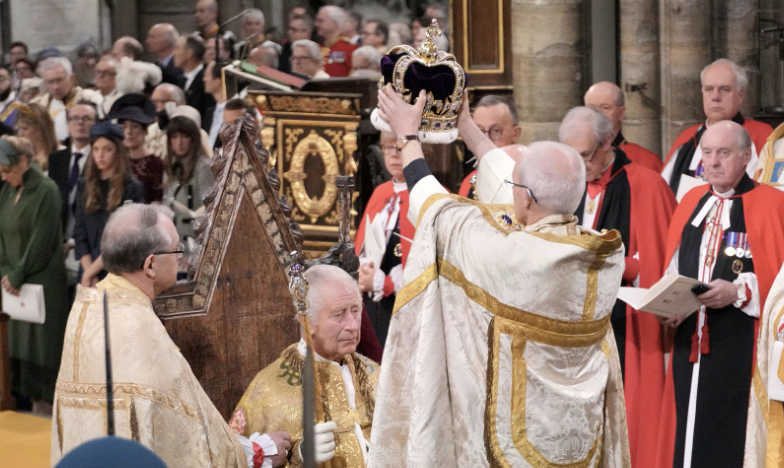
This year, Buckingham Palace made headlines when it confirmed that Charles III, the Supreme Governor of the Church of England, would not release a statement for Holy Week or Easter. While the monarch traditionally addresses the public at Christmas, Easter messages have not been the norm.

This news shocked many Christian leaders, since the king had just offered statements marking the beginning and end of Ramadan, the month of fasting and prayer for Muslims.

Adding fuel to the fire, a protester sprayed "Not our King" in red paint on a wall of the ancient Cathedral of Saints Asaph and Cyndeyrn in Wales before the arrival of King Charles and Queen Camilla for a Maundy Thursday rite during Holy Week.

The Royal Family did release a short Easter message on social media, showing a cross, the message, "Happy Easter. He is risen!" and a caption wishing "a joyous Easter Sunday to Christians celebrating in the UK, the Commonwealth and around the world today."

It's fair to ask how the king expected the public to interpret both his actions and what could be seen as strategic silence, said Gavin Ashenden, a convert to Catholicism who, as a priest in the Church of England, served as chaplain for Queen Elizabeth II from 2008-2017.

It would have been consistent for Charles to issue remarks about Great Lent, as well as Ramadan, since the fasting and prayer themes in these seasons are similar, wrote Ashenden, on his "New English Catholic" website.

Was this news? Global South Anglicans try to cut some Canterbury ties (Part I)

Was this news? Global South Anglicans try to cut some Canterbury ties (Part I)

After a half-century of decline, the U.S. Episcopal Church has 1.5 million members, and its average weekly attendance was just above 500,000 before COVID-19 and 300,000 afterwards.

After decades of explosive growth, the Anglican Church of Nigeria claims about 18 million members (others say 8 million), and the Center for Global Christianity near Boston estimates it has 22 million active participants in worship.

Caught in the middle of these two trends is the Most Reverend Justin Welby, by Divine Providence the 105th Lord Archbishop of Canterbury, Primate of All England and the "first among equals" among bishops in the 42 churches in the Anglican Communion. While his own flock claims 26 million baptized members, about 600,000 attend weekly services.

Now, Global South church leaders -- representing about 75% of Anglicans who frequent pews -- have decided that it's time to start cutting ties between the "Canterbury Communion" and the rest of the Anglican Communion.

“We have no confidence that the Archbishop of Canterbury nor the other Instruments of Communion led by him … are able to provide a godly way forward that will be acceptable to those who are committed to the truthfulness, clarity, sufficiency and authority of Scripture," warned the Global Anglican Future Conference, which met April 17-21 in Kigali, Rwanda. GAFCON IV drew 1,302 delegates from 52 nations, including 315 bishops.

Meeting together, leaders of GAFCON and the Global South Fellowship of Anglican Churches said they "can no longer recognize the Archbishop of Canterbury as an Instrument of Communion, the 'first among equals' of the Primates. The Church of England has chosen to impair her relationship with the orthodox provinces in the Communion."

2022 update: Catholic doctrines on sin, hell, repentance, grace and heaven have changed?

2022 update: Catholic doctrines on sin, hell, repentance, grace and heaven have changed?

For centuries, Irish Catholics heard priests deliver sermons about sin, hell, repentance, grace and heaven.

Times have changed and an 80-year-old priest in County Kerry didn't get the memo.

"How will people know that God wants to forgive them if we don't tell them?", said Father Sean Sheehy, preaching as a substitute priest at St. Mary's Church, Listowel. "How will people who are lost, be found, if we -- as God's people -- don't call them and say, 'Look, God loves you. He has come to call sinners. But he wants you to have life, and to have it to the full'? …That's what he wants. He wants you to live life to the fullest."

The problem was that Sheehy's October 30 sermon stressed ancient Catholic doctrines on behaviors many modern Catholics refuse to call "sins."

This caused a media storm, including this Irish Times headline: "Fr Sheen Sheehy's Listowel sermon was an uncomfortable reminder of who we really were." Also, Kerry Bishop Ray Browne apologized, after 20-plus parishioners walked out of the rite, and barred Sheehy from saying Mass until the parish priest returns to the altar.

During his sermon, Sheehy fiercely condemned core doctrines of the Sexual Revolution, while defending Catholic teachings on marriage and sex.

"What is so sad today is you rarely hear about sin but it's rampant. It's rampant," he said. "We see it, for example, in the legislation of our governments. We see it in the promotion of abortion. We see it in the example of this lunatic approach of transgenderism. We see it, for example, in the promotion of sex between two men and two women.

"That is sinful, that is mortal sin and people don't seem to realize it. … And we need to listen to God about it -- because if we don't, then there is no hope for those people."

Quran in the cathedral: A symbolic window into soul of multicultural England

In Christian tradition, the Epiphany feast marks the end of the 12-day Christmas season and celebrates the revelation -- to the whole world -- that Jesus is the Son of God.

Thus, it was highly symbolic when a Muslim participating in an Epiphany rite at St. Mary's (Episcopal) Cathedral in Glasgow, Scotland, chanted verses from the Quran, Surah 19, in which the infant Jesus proclaims:

"Lo! I am the slave of Allah. He hath given me the Scripture and hath appointed me a Prophet. … Peace is on me the day I was born, and the day I die, and the day I shall be raised alive!" The text then adds: "Such was Jesus, son of Mary: a statement of the truth concerning which they doubt. It befitteth not Allah that He should take unto Himself a son."

Cathedral leaders took to social media to hail this as a lovely moment. But in the Church of England, one of the chaplains of Queen Elizabeth II was dismayed by what many would consider an act of blasphemy -- a reading of this clear Islamic denial of Jesus being the Son of God.

The Glasgow rite was justified as "a way of building bridges and a way of educating people," the Rev. Gavin Ashenden told the BBC.

Nevertheless, he argued that it was wrong to insert such a reading into "the Holy Eucharist and particularly a Eucharist whose main intention is to celebrate Christ the word made flesh come into the world. … To choose the reading they chose doubled the error. Of all passages you might have read likely to cause offence, that was one of the most problematic."

After hearing from Buckingham Palace, Ashenden resigned as one the queen's chaplains. Thus, he surrendered his unique status in a land in which the Church of England has been weakened by almost every cultural trend, yet retains a unique niche in the national psyche.

This was, Ashenden said, a matter of personal principle and ancient doctrine.