
worship

The complicated story of C.S. Lewis becoming a convert -- on screen, in his own words

The complicated story of C.S. Lewis becoming a convert -- on screen, in his own words

While historians argue about what C.S. Lewis did or didn't say, it can be stated with absolute certainty that the Oxford don never patted down his rumbled, professorial tweed jacket before exclaiming, "Where's my phone?"

That line occurs at the start of "The Most Reluctant Convert," as actor Max McLean enters a movie set preparing for the first scene. Seconds later, the camera follows him into the real Oxford, England, where Lewis was a scholar and tutor at Magdalen College.

At first, the famous Christian writer explains how he became an atheist. When he walks into the real White Horse pub, he orders two pints of beer, with one for the viewer. Soon, scenes from his memories spring to life, with Lewis striding through them as a narrator.

"Lewis is in his imagination. He's personified in his thoughts. … I do think that the structure emerged out of the fact that Lewis had a lot to say," said McLean, laughing.

Thus, director Norman Stone -- a BAFTA winner for BBC's "Shadowlands" -- let the "voice of Lewis articulate his struggle, his passion. He is one of those rare individuals where one's intellect, one's emotions and one's spirituality are completely intertwined," said McLean.

All of this is second nature to McLean since the film covers much of the same territory as his own "C.S Lewis Onstage." This was a one-man show at the Fellowship for Performing Arts in New York City, an off-Broadway company McLean founded and guides as artistic director. It has staged other Lewis works, such as "The Screwtape Letters" and "The Great Divorce," drawing warm reviews from The New York Times and other major publications.

The first-person narration, explained McLean, was primarily drawn from Lewis' autobiography, "Surprised by Joy," and the many volumes of his personal letters.

The jump from stage to screen, of course, allowed the film's creators to seek permission to film in some of the most important sites linked to Lewis' life. In addition to the White Horse, viewers follow Lewis into the historic Magdalen College library, a tutor's campus suite and, most importantly, The Kilns -- the home where Lewis lived for decades with his older brother Warren and, briefly, with his cancer-stricken wife, the American poet Joy Davidman.
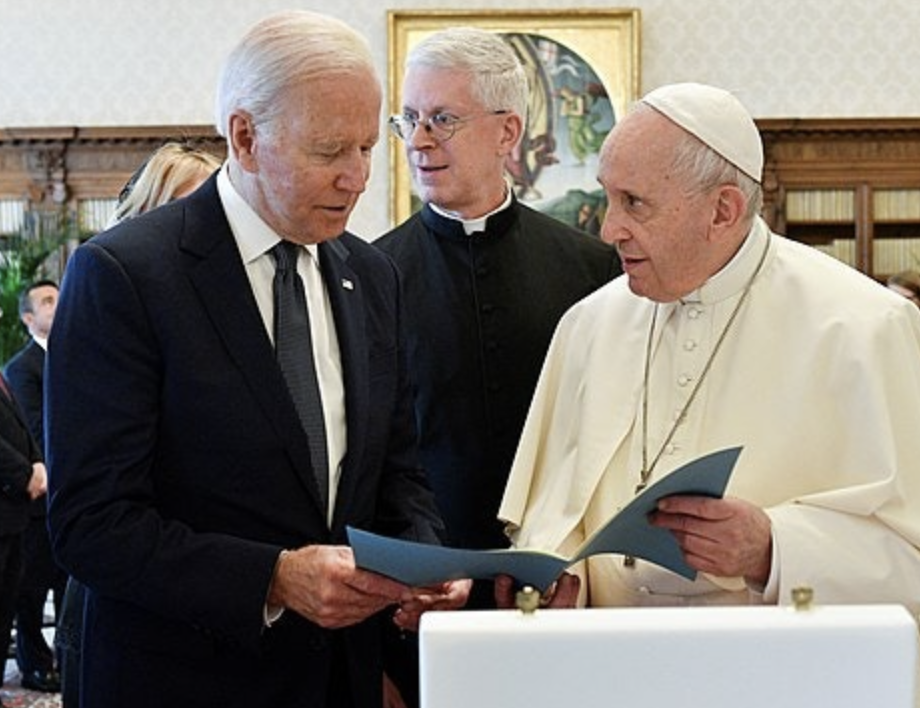
Pope Francis, President Biden and the U.S. Catholic bishops: Who said what to whom?

Pope Francis, President Biden and the U.S. Catholic bishops: Who said what to whom?

Asked if he discussed abortion with Pope Francis during their recent Vatican summit, President Joe Biden said: "No, it didn't. It came up -- we just talked about the fact he was happy that I was a good Catholic, and I should keep receiving Communion."

The next day, the Associated Press noted that Biden received Holy Communion at St. Patrick's Church in Rome.

Asked to validate the president's second-hand quotation, Vatican spokesman Matteo Bruni told reporters: "I would consider it a private conversation."

What do U.S. bishops think? That has remained a hot topic as the United States Conference of Catholic Bishops braces for its fall 2021 meetings next week (Nov. 15-18) in Baltimore -- its first in-person assembly since the start of the coronavirus pandemic.

What is labeled as "draft 24" of a proposed USCCB statement on "Eucharistic coherence" flashes back to an earlier controversy about Catholic politicians, Holy Communion and an atmosphere of "scandal" among the faithful.

"We repeat what the U.S. bishops stated in 2006: 'If a Catholic in his or her personal or professional life were knowingly and obstinately to reject the defined doctrines of the Church, or knowingly and obstinately to repudiate her definitive teaching on moral issues, he or she would seriously diminish his or her communion with the Church," said this draft from late September -- first obtained by The Pillar, a Catholic news website.

The quote continued: " 'Reception of Holy Communion in such a situation would not accord with the nature of the Eucharistic celebration, so that he or she should refrain.' "

As insiders have predicted, this draft of "The Mystery of the Eucharist in the Life of the Church" doesn't mention debates about the sacramental status of Catholic politicians who have consistently served as advocates for abortion rights, such as Biden or House Speaker Nancy Pelosi.

When facing cultural chaos, priests need ancient symbols and truths, not more political talk

When facing cultural chaos, priests need ancient symbols and truths, not more political talk

Chaos is coming, so get ready.

That was the warning that -- four years ago -- iconographer and YouTube maven Jonathan Pageau offered to leaders of the Orthodox Church in America's Diocese of the South.

The French-Canadian artist was reacting to cracks in "cultural cohesion" after Donald Trump's rise to power, with wild reactions on left and right. And corporate leaders, especially in Big Tech, were throwing their "woke" weight around in fights over gender, racism, schools, religious liberty and other topics. Fear and angst were bubbling up in media messages about zombies, fundamentalist handmaidens and angry demands for "safe spaces."

Pageau didn't predict a global pandemic that would lock church doors.

But that's what happened. Thus, he doubled down on his "chaos" message several weeks ago, while addressing the same body of OCA priests and parish leaders.

"If some of you didn't believe me back then, I imagine you are more willing to believe me now," he said.

Pageau focused, in part, on waves of online conspiracy theories that have shaken many flocks and the shepherds who lead them. Wild rumors and questions, he said, often reveal what people are thinking and feeling and, especially, whether they trust authority figures.

"Even the craziest conspiracy nuts, what they are saying is not arbitrary," he said, in Diocese of the South meetings in Miami, which I attended as a delegate from my parish in Oak Ridge, Tenn.

"It's like an alarm bell. It's like an alarm bell that you can hear, and you can understand that the person that's ringing the alarm maybe doesn't understand what is going on. ... They may think that they have an inside track based on what they've heard and think that they know what is going on. But the alarm is not a false alarm, necessarily."

The chaos is real, stressed Pageau. There is chaos in politics, science, schools, technology, economic systems, family structures and many issues linked to sex and gender. It's a time when conspiracy theories about vaccines containing tracking devices echo decades of science-fiction stories, while millions of people navigate daily life with smartphones in their pockets that allow Big Tech leaders to research their every move.

It's an important political question: Are you a believer or a self-identified believer?

It's an important political question: Are you a believer or a self-identified believer?

When political scientists and pollsters discuss faith and politics, one of their biggest challenges is separating the true believers from those who merely say they are believers.

It's kind of like distinguishing between "football fans" and "FOOTBALL FANS," said John C. Green of the University of Akron, who for decades has been a trailblazer in studies of politics, pulpits and pews.

"Lots of people say they're football fans and they like to watch games on television," said Green. "Then there are the people who buy jerseys and get decked out in their team colors. They never miss a home game and everything that goes with that. You can just look at them and know that they're really FOOTBALL FANS."

In terms of faith and politics, oceans of ink have been spilled describing the beliefs and goals of evangelical Protestants, Catholics and members of other religious groups, he said. The problem is that there are "self-identified" evangelicals and then there are truly faithful evangelical Christians. There are plenty of people who tell pollsters they attend worship services every week and that their faith shapes their lives. Then there are those who truly walk that talk.

"All religious communities have lots of highly committed people, and all religious communities have their share of marginal members whose faith isn't all that active," said Green. For pollsters, the challenge is asking questions that help draw lines between "self-identified believers and those who are truly active" in their faith groups, he added.

The American Bible Society, in its "State of the Bible" surveys, has tried to document ways in which beliefs about the Bible, and personal interactions with scripture, separate "practicing Christians" from "self-identified Christians." This matters, in part, because religious groups containing a high percentage of committed believers usually maintain their members, or even make converts, while other groups struggle to survive.

The most recent ABS survey (.pdf here) was completed last January, with data collected from 3,354 online interviews with adults in all 50 states and the District of Columbia. The American Bible Society began studying these kinds of issues as early as 1812.

Big question from COVID-tide: Should church leaders trust Facebook and Big Tech?

Big question from COVID-tide: Should church leaders trust Facebook and Big Tech?

There are 2.4 billion Christians in the world today, according to most estimates.

Then again, nearly 3 billion people have Facebook accounts. Nearly 70% of U.S. adults use this social-media platform, which recently passed $1 trillion in market capitalization.

"I will use Facebook to reach people, because you almost have to do that," Father Andrew Stephen Damick, chief content officer for Ancient Faith Ministries, a 24-hour source for online radio channels, podcasts, weblogs, forums and more. The ministry was born in 2004 and is now part of the North American archdiocese of the ancient Orthodox Patriarchate of Antioch.

Facebook remains, he noted, "the No. 1 social-media platform in the world -- by a lot. You can't ignore all those people. … We knew this before COVID, but the pandemic made it impossible to deny the obvious. Everyone had to go online, one way or another."

Facebook Live became a way to stream worship services online, even if all a pastor could do was mount a smartphone on a stand. Even small congregations began holding online religious-education classes, support groups and leadership meetings.

As for worship, it was one thing for Protestant megachurches to stream TV-friendly services built on pop-rock Christian music and charismatic preaching. The online options were more problematic for faiths in which worship centered on the smells, bells, images and tastes of ancient liturgies.

Then, in early June, images began circulating of a Twitter message introducing "Prayer Posts" allowing Facebook users to "enable group members to ask for and respond to prayers" with a few clicks in a page's control settings. Participation could be as simple as a user clicking an "I prayed" button linked to a prayer.

This isn't a totally new idea. The Facebook "Prayer Warriors" group already has 865,700 active members, a flock larger than the average of 518,000 Episcopalians that attended services on an average Sunday in 2019, according to the denomination's statistics.

Flashback to 'catacomb' Masses after Pope Francis crackdown on the Latin Mass?

Flashback to 'catacomb' Masses after Pope Francis crackdown on the Latin Mass?

It's easy for religious leaders to create new laws, but it's harder to convince believers to follow them.

At least, that's what the Benediction monk Gratian -- a canon law pioneer -- argued in the 12th century: "Laws are established when they are promulgated. … They are confirmed when they have been approved by the long term and reasoned acceptance of those who observe them."

Anyone doubting this wisdom should study Catholic social media, noted Cardinal Walter Brandmuller, the 92-year-old former leader of the Pontifical Committee for Historical Sciences. There has been a "hurricane" in the "blogger scene and other media" in response to Traditionis Custodes ("Guardians of the tradition"), the effort by Pope Francis to bind those who celebrate the traditional Latin Mass.

When confusion surrounds a new "ecclesiastical law" -- as opposed to scripture and "natural law" doctrines -- it's important to remember that its "validity … ultimately depends on the consent of those affected by it," wrote Brandmuller, at Kath.net in Germany.

"The law must serve the good of the community, and not vice versa. … If a law is not observed, or is no longer observed, whether from the beginning or after a time, it loses its binding force and becomes obsolete."

The pope's declaration has unleased waves of grief among supporters of the now retired Pope Benedict XVI and his apostolic letter Summorum Pontificum ("Of the Supreme Pontiffs"), which claimed the post-Vatican II Novus Ordo was the "ordinary form" for the modern Mass, but that the older Tridentine rite was an "extraordinary form" that could be encouraged.

This fight is "not really about rites at all, wrote Father Raymond J. de Souza, at First Things. It's about Catholic life in the age of the Internet. The Mass is the message."

The question is how Pope Francis will apply his ruling that the modern Mass is now the "unique expression" of the Catholic "lex orandi" (the law of what is prayed). Will this affect Byzantine liturgies used by Eastern Rite Catholics or rites approved for former Anglicans?

It's time for reporters to update their mental images of many Southern Baptist churches

It's time for reporters to update their mental images of many Southern Baptist churches

Anyone looking for Baptists should head to Greenville, S.C.

"People here say you can throw a rock in one direction and hit a Southern Baptist church and if you throw a rock in the other direction you'll hit an independent Baptist church," said Nathan A. Finn, provost of North Greenville University.

Finn's school -- with strong Southern Baptist ties -- isn't the only brand of "Baptist" life in town. There's the progressive Furman University, as well as the independent Bob Jones University, known for its rock-ribbed Baptist defense of fundamentalism.

The Baptist world is extremely complex and hard for many outsiders to navigate. Some of this confusion, said Finn, affects life inside the most prominent Baptist flock -- the Southern Baptist Convention -- and perceptions of SBC conflicts.

"Lots of people need to understand that Southern Baptists are far more diverse, ethnically and culturally, than they think we are," he said, in a telephone interview. "At the same time, we're more uniformly conservative that we often appear, especially since we spend so much time fighting with each other over some of the small points of theology on which we differ."

With some of these stereotypes in mind, Finn recently fired off a dozen Twitter messages describing different images of real "Southern Baptist" churches that are common today. The goal, he said, was to create "composites of what different kinds of SBC congregations look like" and he gave them "names that are common with certain types of real churches."

There is, of course, a "First Baptist Church" which Finn described as "a downtown church that runs 500 in worship. The church is affluent, which is reflected in their beautiful building. The worship service is traditional. There are lots of programs & committees" and the congregation is known for big donations to the SBC's shared "Cooperative Program" budget.

Then there is one of the megachurches that have dominated the American religious marketplace in recent decades. While the word "Baptist" is missing in its name, Finn noted: "CrossWay Church is a suburban church that runs 1400 in two services. The 'feel' of each service is laid back & contemporary. CrossWay has excellent recreational facilities" and its leaders are "considering launching a second campus."

These big churches frequently make headlines.

Take that, Benedict XVI: Pope Francis decides Latin Mass is too divisive to embrace

Take that, Benedict XVI: Pope Francis decides Latin Mass is too divisive to embrace

The message to Catholic traditionalists in Southwest England was blunt, yet pointed.

Because of the new Traditionis Custodes ("Guardians of the tradition") document from Pope Francis, and the wishes of Bishop Declan Lang of the Diocese of Clifton, the upcoming "Latin Mass at Glastonbury will be the final Latin Mass here."

The message delivered to another circle of believers there was quite different. As a "Clifton Diocese Initiative," the "LGBT+ Mass" series at a Bristol church would continue because the bishop "wishes to express pastoral care and concern for our Catholic LGBT+ community."

Thus, the Catholic worship wars rage on.

This bolt of liturgical lightning from Pope Francis struck one of his predecessor's signature achievements. In his 2007 apostolic letter Summorum Pontificum ("Of the Supreme Pontiffs"), the now retired Pope Benedict XVI declared that the post-Vatican II rite was the "ordinary form" for the church, but that the older Latin Mass was an "extraordinary form" and could be encouraged when requested by the faithful.

While Benedict said these rites could coexist, Pope Francis argued -- in a letter accompanying Traditionis Custodes -- that the old Latin Mass has become too divisive.

Benedict was "comforted" by his belief that the "two forms of the … Roman Rite would enrich one another," wrote Pope Francis, but some bishops now believe the Latin Mass has been "exploited to widen the gaps, reinforce the divergences, and encourage disagreements that injure the Church."

Thus, Francis declared, bishops must guarantee that any priests and laity they allow to celebrate the old rite have accepted the validity of Vatican II and its "Novus Ordo" Mass. Bishops may "designate one or more locations where the faithful adherents of these groups may gather" for approved Latin Masses, but these services may not be held in "parochial churches" and there should be no new parishes created for the extraordinary rite.

Flowers and the First Amendment: Once again, the Supreme Court elects to punt

Flowers and the First Amendment: Once again, the Supreme Court elects to punt

Florist Barronelle Stutzman and Robert Ingersoll have shared many details from the 2013 conversation that changed their lives and, perhaps, trends in First Amendment law.

For nine years, Ingersoll was a loyal customer at Arlene's Flowers in Richland, Wash., and that included special work Stutzman did for Valentine's Day and anniversaries with his partner Curt Freed. Then, a year after the state legalized same-sex marriages, Ingersoll asked her to design the flower arrangements for his wedding.

Stutzman took his hand, Ingersoll recalled, and said: "You know I love you dearly. I think you are a wonderful person, but my religion doesn't allow me to do this."

In a written statement to the Christian Science Monitor, Ingersoll wrote: "While trying to remain composed, I was … flooded with emotions and disbelief of what just happened." He knew many Christians rejected gay marriage but was stunned to learn this was true for Stutzman.

As stated in recent U.S. Supreme Court documents: "Barronelle Stutzman is a Christian artist who imagines, designs and creates floral art. … She cannot take part in or create custom art that celebrates sacred ceremonies that violate her faith."

This legal drama appears to have ended with Stutzman's second trip to the high court and its July 2 refusal to review a Washington Supreme Court decision the drew a red line between a citizen's right to hold religious beliefs and the right to freely exercise these beliefs in public life. Supreme Court justices Clarence Thomas, Samuel Alito and Neil Gorsuch backed a review, but lacked a fourth vote.

"This was shocking" to religious conservatives "because Barronelle seemed to have so many favorable facts on her side," said Andrew T. Walker, who teaches ethics at Southern Baptist Theological Seminary.

Stutzman is a 76-year-old grandmother and great-grandmother who faces the loss of her small business and her retirement savings. She has employed gay staffers. She helped Ingersoll find another designer for his wedding flowers. In the progressive Northwest, her Southern Baptist faith clearly makes her part of a religious minority.

"Barronelle is a heretic because she has clashed with today's version of progressivism," said Walker.