
doctrine

Good news or bad news, these days, for the church in China?

Pope Francis didn't make global headlines on Aug. 14, 2014, when -- with permission from Communist Party leaders -- Shepherd One flew through Chinese airspace on the way to Seoul, South Korea.

Still, it was a symbolic moment that hinted at progress, after decades of bitter persecution for Chinese Catholics loyal to the Vatican. Then, a year later, Bishop Zhang Yinlin was ordained as bishop of Anyang, after nods of approval from both Rome and Beijing.

So things are looking up for religious freedom in China?

If so, what did it mean when the Rev. Gu Yuese -- leader of the largest Protestant megachurch in China's state-approved Three-Self Patriotic Movement -- was recently jailed after opposing the government's demolition of thousands of crosses in "China's Jerusalem," part of Zhejiang province.

"There may be all kinds of reasons they arrested him, other than that he is famous and his church is huge. It's hard to know what's happening, when you're talking about the Chinese government," said Rodney Stark, co-director of the Institute for Studies of Religion at Baylor University. He is the author or co-author of 36 books on various religious issues, past and present, including "A Star in the East: The Rise of Christianity in China," with sociologist Xiuhua Wang.

"We can say that we haven't seen the Nero effect yet, with the government putting heat on Christians because China's economic numbers are looking bad. … Also, it's important to remember that we've reached the point where many leaders in China now have kids who are Christians. In some villages, you may have a Communist Party leader with a cross on his wall."

The bottom line: There is truth in the popular saying that China is so huge and complex that just about anything someone says about religion in China will be true -- somewhere in China.

At the same time, it's crucial to understand that human-rights trends among the 1.38 billion people in China, even among minority groups, will have a major impact on world affairs.

Father Paul Scalia keeps funeral focus on Jesus of Nazareth and prayers for his father, a sinner

Father Paul Scalia keeps funeral focus on Jesus of Nazareth and prayers for his father, a sinner

Catholics who faithfully go to Confession are unusual these days, with one study linked to Georgetown University noting that a mere 2 percent of American Catholics "regularly" confess their sins to a priest. 

Local odds being what they were, Father Paul Scalia of Arlington, Va., once learned that he had come very close to facing one faithful Catholic whose confession would have -- literally -- hit close to home. That Saturday evening he heard a unique complaint from his father, Justice Antonin Scalia. 

The issue "was not that I'd been hearing confessions, but that he'd found himself in my confessional line. And he quickly departed it," said Father Scalia, during his father's nearly two-hour funeral Mass (video here). "As he put it later, 'Like heck if I'm confessing to you!' The feeling was mutual." 

This anecdote drew laughter in the massive Basilica of the National Shrine of the Immaculate Conception in Washington, D.C. But even this personal story was part of the priest's focus on eternal issues, rather than details of the life and lengthy U.S. Supreme Court career of his famous father.

After all, Antonin Scalia had made his feelings crystal clear -- writing to the Presbyterian minister who performed the 1998 funeral of Justice Lewis F. Powell, Jr. -- that funerals should contain real sermons, not touchy-feely eulogies. 

Pope and patriarch point to the unity found among the modern martyrs

Metropolitan Hilarion of Russia left little room for doubt about his priorities when offered a few moments to speak during the Vatican's tense Synod on the Family.

"Militant secularism" was on the rise, he said last fall. Thus, Catholics and Orthodox Christians should stand united while defending the "traditional Christian understanding of the family," "marriage as a union between a man and a woman" and the "value of human life from conception till natural death."

But most of all, Moscow's top ecumenical diplomat wanted to talk about martyrs -- new martyrs.

Consider Iraq, home to 1.5 million Christians a few years ago. Today, 150,000 remain while the "others were either exterminated or expelled," he said. Then look at Syria, Egypt, Nigeria, Pakistan, Libya and elsewhere.

"We are deeply concerned about the humanitarian catastrophe … unfolding in Syria, where militant Islamists are seeking political power," he said. Wherever jihadists "come to power, Christians are being persecuted or exterminated. Christian communities in Syria and other countries of the Middle East are crying for help, while the mass media in the West largely ignore their cries and the politicians prefer to close their eyes."

It was a foretaste of the historic "airport summit" declaration signed in Cuba by Pope Francis and Patriarch Kirill, leader of the Orthodox Church of Moscow and all Russia.

The passion that loomed over the historic meeting between Rome and Moscow

Like all veteran journalists who cover global religion news, Robert Moynihan of "Inside the Vatican" is used to getting interesting emails from sources in interesting places.

Normally, Moynihan asks the questions. But that wasn't the case in 2006 when he heard from Russian composer Hilarion Alfeyev, who was completing a new Passion According to St. Matthew, based on scripture and prayers from the Orthodox Divine Liturgy.

It's crucial to know that, in 2006, this composer was already a Russian Orthodox bishop. Today he is known as Metropolitan Hilarion and, as chair of his church's Department of External Church Relations, he has long been a key player in behind-the-scenes talks seeking a meeting between the pope of Rome and the patriarch of Moscow.

In that email, the composer said his goal was to premiere the work in Moscow in March of 2007 -- just before Easter in a year in which Catholics (using the Gregorian calendar) and the Orthodox (on the older Julian calendar) would celebrate the Paschal feast on the same day.

Hilarion wondered "if there might be a way for this work to then be performed in Rome and if I could help organize such a concert," said Moynihan. "We both knew this would be incredibly challenging. … But we did it and that night was like a miracle."

The Moscow premiere was on March 27 and, two nights later, the exhausted Russian choir and orchestra were in Rome for a performance attended by several Catholic Cardinals, as well as numerous students, scholars and dignitaries. One Orthodox participant was Metropolitan Kirill -- now the Russian patriarch.

Anyone probing the roots of the historic encounter between Patriarch Kirill and Pope Francis -- the first meeting of this kind between Rome and Moscow -- must study the years of cultural and musical contacts that built a bridge to this moment, said Moynihan, in an interview days before the Cuba summit. In the end, mutual concerns about the slaughter of Christians in Iraq and Syria made such a meeting an urgent necessity.

Facing the Sexual Revolution, even among 'active' believers in conservative pews

When pastors gaze out from their pulpits, they may want to imagine what would happen if they asked their flocks to respond to this statement: "As long as it's between consenting adults, any kind of sex is fine."

If this were a conservative or nondenominational Protestant church, the active, "practicing" members would be sharply divided, according to a new Barna Group survey. Nearly half -- 46 percent -- would affirm this live-and-let-live approach to sex outside of marriage, while 40 percent would disagree "strongly" and 12 percent "somewhat."

There are the active members, not the people who occasionally visit the pews.

"What is surprising is the way that even practicing Christians are beginning to conform to the beliefs and behaviors that are now considered normal in our culture," said Roxanne Stone, editor-in-chief at Barna. "The big story here is that people no longer agree when it comes to the purpose and meaning of sex -- including in our churches. Many no longer connect sex and marriage the way they used to."

When looking at broader trends, this study found the usual evidence that older Americans -- the "Elders" and "Boomers" -- have much more traditional views of sex and marriage than members of the younger "Gen-X" and "Millennial" generations. Rising numbers of young Americans view sex through the lens of self-expression and personal growth, with few ties that bind them to institutions and traditions.

"What people are saying is that sex is about two people loving each other and experiencing intimacy, but you don't really need to have the word 'marriage' involved in this discussion," said Stone, in a telephone interview.

"It's surprising how quickly some of these changes have become part of what is now considered normal. … Normally, these kinds of radical changes in a culture evolve over time. But, sociologically speaking, Woodstock wasn't that long ago."

There's nowhere to turn? When hurting people believe they have to flee the pews

In the not so distant Baptist past, all Sunday services ended with altar calls in which people came forward to make public professions of Christian faith or to become part of a local congregation.

But it was also common, during the "invitation hymn," for church members to come forward and huddle with the minister for a few quiet, discreet minutes. The pastor would announce that they had come forward to "rededicate their life to Christ" and then ask those assembled to offer them hugs and prayers.

"That's something that we've lost, somewhere along the way. We need to regain that confessional part of the faith," said the Rev. Thom Rainer, head of LifeWay Christian Resources at the Southern Baptist Convention's headquarters in Nashville.

"It used to be common for people to go forward, rededicate their lives and get right with the Lord. … It was a chance to tell the pastor you needed help. It was important that our people knew they could do that."

The alternative is much worse, he stressed, in a telephone interview. If believers don't know how to reach out for help, or if they think they will be harshly judged if they do, they usually remain silent before using the exit door, for keeps.

The bottom line is shocking, said Rainer. If most churches could regain just the members who fled over the span of a decade -- for personal or private reasons, as opposed to dying or moving out of town -- worship attendance would triple.

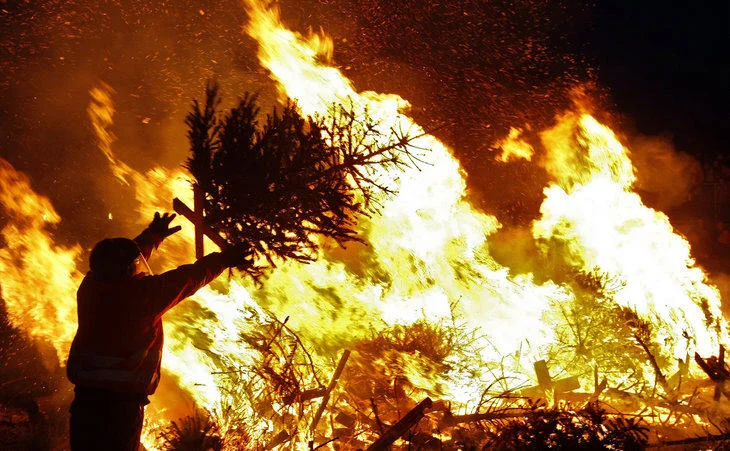
Bright bonfires to mark end of the 12 days of Christmas season

Bright bonfires to mark end of the 12 days of Christmas season

The same thing happens to Father Kendall Harmon every year during the 12 days after the Nativity of Our Lord Jesus Christ.

It happens with newcomers at his home parish, Christ-St. Paul's in Yonges Island, S.C., near Charleston. It often happens when, as Canon Theologian, he visits other parishes in the Episcopal Diocese of South Carolina.

"I greet people and say 'Merry Christmas!' all the way through the 12 days" of the season, he said, laughing. "They look at me like I'm a Martian or I'm someone who is lost. … So many people just don't know there's more Christmas after Christmas Day."

To shine a light on this problem, some churches have embraced an tradition -- primarily among Anglicans and other Protestants -- that provides a spectacular answer to an old question: When do you take down that Christmas tree? The answer: The faithful take their Christmas trees to church and build a bonfire as part of the "Epiphany Service of Lights" on January 6th.

As always, in a rite framed by liturgy, there is a special prayer: "Almighty God our Heavenly Father, whose only Son came down at Christmas to be the light of the world, grant as we burn these trees this Epiphany night, that we, inspired by your Holy Spirit, would follow his example and bear witness to His light throughout the world, through Jesus Christ our Lord, who with you and the Holy Spirit, live and reign in glory everlasting. Amen."

The struggle to observe the 12 days of Christmas is similar to other trials for those who strive to follow the teachings of their faith during the crush of daily life, said Harmon.

2015 and beyond: So much news about religious liberty battles at home and abroad

The goal of The Atlantic Monthly's recent LGBT Summit was to gather a flock of politicos, artists, activists and scribes to discuss the "Unfinished Business" of queer culture, after a historic win for gays at the U.S. Supreme Court.

The summit's final speaker was Andrew Sullivan, the British-born, HIV-positive, occasionally conservative, liberal Catholic whose trailblazing online journalism helped shape so many public debates.

Sullivan ranged from the genius of "South Park" to the impact of smartphone apps on dating, from the positive impact of gay porn to the lingering self-loathing that prevents some gays from embracing drugs that could end AIDS. He attacked Donald Trump and Hillary Clinton, while yearning for another term for President Barack Obama.

Most of all, he stressed that it's time -- after a "tectonic" cultural shift on sexuality -- for professional LGBT activists to end the "whiny victimhood" in which they recite a "you're a bigot, we're oppressed, why do you hate us" litany to Americans who disagreed with them about anything.

Calling himself a "classical liberal," Sullivan stressed that gay leaders must accept that some believers will not surrender the ancient doctrines that define their faith. Thus, it's time for honest conversations between believers, gay and straight.

"The blanket … I would say, yes, bigotry towards large swaths of this country who may disagree with us right now … is not just morally wrong, it's politically counterproductive," he said, drawing screams of outrage on Twitter.

"Religious freedom is an incredibly important freedom. To my mind it is fundamental to this country and I am extremely queasy about any attempt to corral or coerce the religious faith of anybody."

Sullivan's comments captured one of the tensions that dominated the Religion Newswriters Association poll to select the Top 10 religion news events of 2015.

Making the case for a great Christmas comet over Bethlehem

It's hard to imagine Christmas without images of a giant star in the night sky over Bethlehem, with one supernaturally bright beam pointing toward a stable.

For carolers, the key words are in "We Three Kings of Orient Are" where everyone sings: "Star of wonder, star of light, star with royal beauty bright. Westward leading, still proceeding, guide us to thy perfect light."

"The Christmas carols are surprisingly accurate when it comes to the details of what we know" from scripture, said New Testament scholar Colin Nicholl of Coleraine, Northern Ireland. "In many cases where they fill gaps in the biblical narratives, they end up including material that is pretty sound -- at least based on my research."

The problem is that this heavenly object simply does not behave like a star. Thus, in his new book "The Great Christ Comet: Revealing the True Star of Bethlehem," Nicholl blends material from history and science to argue that this phenomenon can best be explained by charting the path of what he calls "undeniably the single greatest comet in recorded history."

The language familiar to most readers is found in Matthew's Gospel, which states: "Now when Jesus was born in Bethlehem of Judaea in the days of Herod the king, behold, there came wise men from the east to Jerusalem, saying, 'Where is he that is born King of the Jews?' for we have seen his star in the east, and are come to worship him."