Godbeat

Memory eternal: Farewell to the sharp pen of Father Paul 'Diogenes' Mankowski

Memory eternal: Farewell to the sharp pen of Father Paul 'Diogenes' Mankowski

For millions of Americans, "The Battle Hymn of the Republic" is as familiar as the national anthem and much easier to sing.

Few would need help with: "Mine eyes have seen the glory of the coming of the Lord. He is trampling out the vintage where the grapes of wrath are stored. He has loosed the fateful lightning of His terrible swift sword. His truth is marching on! Glory, glory, Hallelujah! … His truth is marching on!"

During 1990s fights over updated Catholic liturgies, a Semitic languages professor at Rome's Pontifical Biblical Institute wrote a Battle Hymn for modernists.

This "sanitized" text -- "chanted to no tune in particular" -- declared: "I see God's approach; it is good. God makes wine with God's feet. … Brightness flashes from the decision-making apparatus. God's worldview is currently earning widespread respect. Give honor repeatedly to the god of our tradition. We have owned our values."

Father Paul V. Mankowski put his own name on that First Things piece, since it didn't lance specific institutions or leaders. For decades, Catholics seeking his satirical work learned to look for "Diogenes" at CatholicCulture.org or "Father X" elsewhere.

Mankowski died on September 3 at age 66, felled by a ruptured brain aneurysm. Raised in a middle-class Rust Belt family, he worked in steel mills to pay tuition at the University of Chicago. His advanced degrees included a master's from Oxford and a Harvard University doctorate.

Many researchers, politicos and journalists (like me) knew him through telephone calls and emails, usually seeking documents and statements from nearby Catholic leaders. He was a rarity in the modern age -- a Jesuit conservative -- and his superiors eventually ordered him not to address church controversies. Much of his work was published anonymously or using pen names.

Princeton University's Robert P. George blitzed through years of emails, after hearing about Mankowski's sudden death.

"There are some doozies -- especially the spoofs, send ups and parodies," said George, on Facebook. "His wit was a massive quiver full of poison-dipped arrows, and he was a master archer. … He would not give a pass to fools, frauds, charlatans, hypocrites, rent seekers, time servers, racketeers, manipulators, corrupt scholars, false teachers or weak or craven leaders, especially in the Church."
Anglican debate in 2020 crisis: Can clergy consecrate bread and wine over the Internet?

Anglican debate in 2020 crisis: Can clergy consecrate bread and wine over the Internet?

In the late 1970s, the Episcopal Ad Project began releasing spots taking shots at television preachers and other trends in American evangelicalism.

One image showed a television serving as an altar, holding a priest's stole, a chalice and plate of Eucharistic hosts. The headline asked: "With all due regard to TV Christianity, have you ever seen a Sony that gives Holy Communion?"

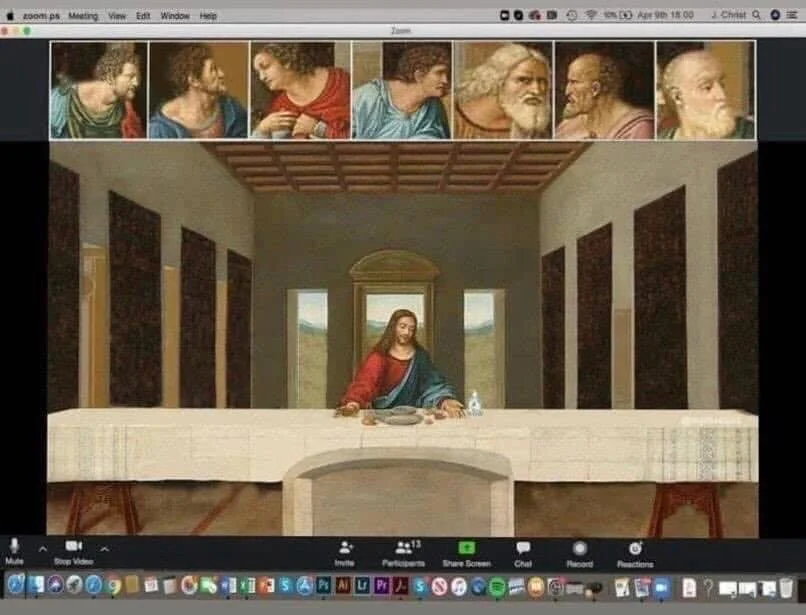
Now some Anglicans are debating whether it's valid -- during the coronavirus crisis -- to celebrate "virtual Eucharists," with computers linking priests at altars and communicants with their own bread and wine at home.

In a recent House of Bishops meeting -- online, of course -- Episcopal Church leaders backed away from allowing what many call "Virtual Holy Eucharist."

Episcopal News Service said bishops met in private small groups to discuss if it's "theologically sound to allow Episcopalians to gather separately and receive Communion that has been consecrated by a priest remotely during an online service."

Experiments had already begun, in some Zip codes. In April, Bishop Jacob Owensby of the Diocese of Western Louisiana encouraged such rites among "Priests who have the technical know-how, the equipment and the inclination" to proceed.

People at home, he wrote, will "provide for themselves bread and wine (bread alone is also permissible) and place it on a table in front of them. The priest's consecration of elements in front of her or him extends to the bread and wine in each … household. The people will consume the consecrated elements."

Days later, after consulting with America's presiding bishop," Bishop Owensby rescinded those instructions. "I understand that virtual consecration of elements at a physical or geographical distance from the Altar exceeds the recognized bounds set by our rubrics and inscribed in our theology of the Eucharist," he wrote.

However, similar debates were already taking place among other Anglicans. In Australia, for example, Archbishop Glenn Davies of Sydney urged priests to be creative during this pandemic, while churches were being forced to shut their doors.

During a live-streamed rite, he wrote, parishioners "could participate in their own homes via the internet consuming their own bread and wine, in accordance with our Lord's command."

Pope John Paul II is a saint -- now some claim that it's time to add 'the great' to his title

Pope John Paul II is a saint -- now some claim that it's time to add 'the great' to his title

As he began his 1979 pilgrimage through Poland, Pope John Paul II preached a soaring sermon that was fiercely Catholic, yet full of affection for his homeland.

For Communist leaders, the fact that the former Archbishop of Cracow linked faith to national pride was pure heresy. The pope joyfully claimed divine authority to challenge atheism and the government's efforts to reshape Polish culture.

"Man cannot be fully understood without Christ," John Paul II told 290,000 at a Mass in Warsaw's Victory Square. "He cannot understand who he is, nor what his true dignity is, nor what his vocation is, nor what his final end is. … Christ cannot be kept out of the history of man in any part of the globe, at any longitude or latitude of geography."

That was bad enough. Then he added: "It is therefore impossible without Christ to understand the history of the Polish nation. … If we reject this key to understanding our nation, we lay ourselves open to a substantial misunderstanding. We no longer understand ourselves."

This was the stuff of sainthood, and John Paul II received that title soon after his 26-year pontificate ended. But the global impact of that 1979 sermon is a perfect example of why many Catholics believe it's time to attach another title to his name -- "the great."

"The informal title 'the great' is not one that is formally granted by the church," explained historian Matthew Bunson, author of "The Pope Encyclopedia: An A to Z of the Holy See."

"Every saint who is also a pope is not hailed as 'the great,' but the popes who have been called 'the great' are all saints. … When you hear that title, you are dealing with both the love of the faithful for this saint and the judgement of history."

In the case of John Paul II, mourners chanted "Santo subito!" (Saint now!) and waved posters with that slogan at his funeral. During a Mass only 13 hours after his death, Cardinal Angelo Sodano spoke of "John Paul, indeed, John Paul the Great."

Believers in an angry age of 'fake news,' conspiracy chatter and the QAnon heresy

Believers in an angry age of 'fake news,' conspiracy chatter and the QAnon heresy

A majority of evangelicals are worried about "fake news" and they also think mainstream journalists are part of the problem.

The question, as pandemic-weary Americans stagger into the 2020 elections, is how many believers in this voting bloc have allowed their anger about "fake news" to push them toward fringe conspiracy theories about the future of their nation.

Some of these theories involve billionaire Bill Gates and global coronavirus vaccine projects, the Antichrist's plans for 5G towers, Democrats in pedophile rings or all those mysterious "QAnon" messages. "Q" is an anonymous scribe whose disciples think is a retired U.S. intelligence leader or maybe even President Donald Trump.

The bitter online arguments sound like this: Are these conspiracies mere "fake news" or is an increasingly politicized American press -- especially on politics and religion -- hiding dangerous truths behind its own brand of "fake news"?

"A reflexive disregard of what are legitimate news sources can feed a penchant for conspiracy theories," said Ed Stetzer, executive director of the Billy Graham Center at Wheaton College.

Many mainstream journalists do a fine job of covering the complex world of evangelicalism, stressed Stetzer, reached by email.

Nevertheless, he added: "I think that the bias of much of mainstream news has to be considered in this conversation. Many evangelicals have seen, over and over, news sources report on them irresponsibly, with bias, and -- at times -- with malice. When you see that enough, about people you know, there is a consequence. Regrettably, I don't think many in the mainstream news world are thinking, 'We should have done better.' "

It doesn't help that Americans disagree about the meaning of "fake news."

Struggling to take sacraments to the people, while honoring social-distancing rules

Struggling to take sacraments to the people, while honoring social-distancing rules

Priests in the Church of England have faced many challenges in recent decades -- from plummeting attendance numbers to fierce debates about marriage and sexuality.

Nevertheless, a coronavirus epistle from Archbishop of Canterbury Justin Welby and Archbishop of York John Sentamu was a shocker -- offering worship guidelines even stricter than those released by the government.

"Our church buildings must now be closed not only for public worship, but for private prayer as well and this includes the priest … offering prayer in church on their own," they wrote. "A notice explaining this should be put on the church door."

Thus, there was quiet defiance in Father Marcus Walker's voice as he stood alone near the altar of St. Bartholomew the Great -- London's oldest surviving church -- on the first Sunday after Easter and said, "I speak in the name of the Living God: Father, Son and Holy Spirit. Amen. And so we're back."

There was no response from his Facebook Live flock, but the priest stressed that he had been listening to his people. The bottom line: There had to be some way to proceed that stressed public safety, while addressing people's spiritual needs.

"Their voices have been loud, insistent and -- so far -- unanimous," he said, in his sermon. "I have received scores of letters and emails, calling on services to be restored here in their church: the church they have upheld and kept up, where they were married, where they buried a partner, saw a child christened, found God, were confirmed.

"This is their church and I am their pastor. I owe them my solidarity. As one said in her letter: 'We don't need you in solidarity at home, we need you in solidarity at the altar of our church.' "

With Easter in the rear-view mirror, members of ancient Christian flocks -- those built on liturgies and sacraments -- are waiting to see how their shepherds will walk a liturgical tightrope between church and state.

The bottom line: It's easier for megachurches to put their dramatic sermons and worship bands on home computer screens than for priests to digitize Holy Communion and rites of confession.

Concerning the coronavirus crisis and these Darwinian days in faith-based higher education

Concerning the coronavirus crisis and these Darwinian days in faith-based higher education

Every week or so, John Mark Reynolds does something that presidents of academic institutions rarely do -- he cleans his office at Saint Constantine School.

This isn't a symbolic gesture in an age of ominous trends, and now a global pandemic, that threaten private education. Reynolds always takes his turn -- with other members of his team -- cleaning administration offices at this classical school in Houston.

"We have no administrators who are just administrators. Everyone teaches. Everyone shares many of the jobs that need to get done," said Reynolds, reached at his "sheltering in place" home office. "We have a maintenance team, but we all help out. The first lady and I plan to water some plants later today. …

"We call this the economy of small."

Saint Constantine is a K-16 Orthodox Christian school, which means it offers four years of college credits. College tuition is $9,000 per year.

"Our whole model was created to survive the collapse of liberal arts education, while striving to preserve the core of liberal arts education through an Oxford-style tutorial system," said Reynolds. "This pandemic is only exposing the weaknesses of what was already a business model fraught with peril."

College educators have long known that painful challenges were coming in 2025, due to falling birth rates and the end of high millennial-generation enrollments.

Now, the coronavirus crisis is forcing students and parents to face troubling realities. A study by McKinsey & Company researchers noted: "Hunkering down at home with a laptop … is a world away from the rich on-campus life that existed in February."

What happens next? The study noted: "In the virus-recurrence and pandemic-escalation scenarios, higher-education institutions could see much less predictable yield rates (the percentage of those admitted who attend) if would-be first-year students decide to take a gap year or attend somewhere closer to home (and less costly) because of the expectation of longer-term financial challenges for their families."

This could crush some schools. In a report entitled "Dawn of the Dead," Forbes found 675 private colleges it labeled "so-called tuition-dependent schools -- meaning they squeak by year-after-year, often losing money or eating into their dwindling endowments."

Where is God in coronavirus crisis? Yes, that ancient question is part of this news story

Where is God in coronavirus crisis? Yes, that ancient question is part of this news story

Queen Elizabeth II has seen more than her share of good and evil during her 68 years on the British throne.

Candles shining in the darkness just before Easter are familiar symbols of the presence of good, even in the hardest of times, said the 92-year-old queen, in a recent address about a single subject affecting her people -- the coronavirus crisis.

"Easter isn't cancelled. Indeed, we need Easter as much as ever," she said. "The discovery of the risen Christ on the first Easter Day gave his followers new hope and fresh purpose, and we can all take heart from this. We know that coronavirus will not overcome us. As dark as death can be -- particularly for those suffering with grief -- light and life are greater."

An ancient question loomed over the queen's remarks: Where is God during this global pandemic that threatens the lives and futures of millions of people?

Theologians have a name -- "theodicy" -- for this puzzle. One website defines this term as "a branch of theology ... that attempts to reconcile the existence of evil in the world with the assumption of a benevolent God."

In his book "God in the Dock," the Christian apologist C.S. Lewis of Oxford University argued that "modern man" now assumes, when evil occurs, that God is on trial. This process "may even end in God's acquittal," he noted. "But the important thing is that Man is on the Bench and God is in the Dock."

This tension can be seen during news coverage of tragedies, wars, disasters and pandemics. Ordinary people involved in these stories often address "theodicy" questions, whether journalists realize it or not. This is a pattern I have observed many times -- since this past week marked my 32nd anniversary writing this national "On Religion" column.

The late Peter Jennings of ABC World News Tonight noted that, whenever news teams cover disasters, reporters often ask questions that sound like this: "How did you get through this terrible experience?" Survivors frequently reply: "I don't know. I just prayed. Without God's help, I don't think I could have made it."

What happens next, Jennings once told me, illustrates the gap that separates many journalists and most Americans. There will be an awkward silence, he said, and then the reporter will say something like: "That's nice. But what REALLY got you through this?"

Here we go again.

Painful choices: Coronavirus lockdowns threaten some familiar Passover traditions

Painful choices: Coronavirus lockdowns threaten some familiar Passover traditions

Passover Seders include one moment that is especially poignant for grandparents.

Early in this ritual meal they look on as one or more of their grandchildren sing or recite the "Ma Nishtana," the "Four Questions" that frame the lessons Israelites learned from their bondage in Egypt and Exodus to freedom.

The first line echoes from generation to generation: "Why is this night different from all other nights?"

This year, Jews everywhere are wrestling with the fact that -- in a world wracked by the coronavirus -- this Passover is radically different from other Passovers.

"There's no way to replace having Passover with your parents, your grandparents, your friends and loved ones," said Rabbi Yaacov Behrman, founder of the Jewish Future Alliance and director of Operation Survival, a drug abuse prevention program in the Crown Heights neighborhood of Brooklyn.

"A grandmother looks forward to seeing her grandchildren at the Seder. Fathers and mothers look forward to seeing their families around that table. … There's no way to ignore the pain of what is happening this year."

Prayers and symbols describing suffering and liberation are at the heart of Haggadah (Hebrew for "telling") texts that guide the Seder meal and interpret the eight-day Passover season, which began this year at sundown on Wednesday, April 8.

Why is matzo the only bread at Passover? Because the Israelites didn't have time to bake leavened bread as they fled Egypt. Why dip bitter herbs into chopped apples, dates, nuts and wine? Because this paste resembles the clay Hebrew slaves used to make bricks. Why dip parsley into salt water? This represents new life, mixed with tears.

One ritual will have special meaning this year, as the leader of the Seder prays: "Blessed are you, Lord our God, King of the universe, who has sanctified us with His commandments, and commanded us concerning the washing of the hands."

Coronavirus crisis creates a legal, doctrinal minefield for priests and their flocks

Coronavirus crisis creates a legal, doctrinal minefield for priests and their flocks

Every now and then, while a priest is traveling or out running errands, a stranger will approach and ask: "Father, will you hear my confession?"

This can happen on a city sidewalk or in a quiet corner of a big-box store. Often the question is urgent -- because something disturbing has shaken someone's faith.

"I've been asked for confession in a taxi. I've been asked while on a train," said Father Fergal O'Duill, part of the Dallas-Fort Worth branch of the Catholic movement Regnum Christi. His name is pronounced "O'Doul" and he is originally from Dublin, Ireland.

These requests happen, he added, because "people see you and they know you're a priest. We're priests no matter where we go."

Hearing confessions is crucial during the penitential season of Lent, which precedes Easter, which is on April 12th this year for Catholics and Protestants (and April 19th for Eastern Orthodox Christians). Centuries of Catholic and Orthodox tradition urge believers to go to confession during Lent, before receiving Holy Communion on Easter.

The irony, right now, is that O'Duill can hear confessions during chance encounters, but not during scheduled times at the school where is serves as a chaplain.

The evolving coronavirus pandemic has turned Lent into a confusing minefield of legal and doctrinal questions for pastors and their flocks. In many communities, but not all, state or local officials have ordered people to "shelter in place" -- staying home unless they have "essential" needs elsewhere. This has raised an obvious question: Is going to confession "essential," even if Catholics are preparing for Holy Week and Easter rites they will have to watch on digital screens at home?

For most of March, O'Duill was one of several priests who heard confessions in a giant parking lot, or in a pair of tents, near the Highlands School in Irving, Texas. Every effort was made to provide enough privacy to maintain the "dignity" of the sacrament, he said, while priests remained a safe distance from the penitents. Priests offered similar "drive-through" confession opportunities in a few other parts of America.

Then, on March 22, Dallas County Judge Clay Jenkins issued a "shelter in place" order effective through April 3 and, perhaps, beyond.

The ground rules changed.