

Godbeat

United Methodist vows, the Sexual Revolution and the fragile doctrinal ties that bind

United Methodist vows, the Sexual Revolution and the fragile doctrinal ties that bind

When the United Methodist Church ordains ministers, the rite includes the kind of vow that religious groups have long used to underline the ties that bind.

In this case, the candidate for ordination is asked to accept the church's "order, liturgy, doctrine, and discipline, defending it against all doctrines contrary to God's Holy Word, and committing yourself to be accountable with those serving with you, and to the bishop and those who are appointed to supervise your ministry?"

The candidate replies: "I will, with the help of God."

These vows may create problems for some clergy -- as noted in a remarkably blunt letter published recently by the independent Methodist Federation for Social Action. The context was the U.S. Supreme Court debate about a Health and Human Services mandate that requires most religious institutions to offer employees health insurance covering sterilizations and all FDA-approved contraceptives.

Currently, actual churches and denominations are exempt. And there's the rub, for the letter's anonymous author.

"I chose to go on birth control because I didn't want to get pregnant and I wanted to have sex. Because I am a clergywoman in The United Methodist Church, and I'm single, that information could get me brought up on charges, and I could lose my ordination," she wrote.
Good news or bad news, these days, for the church in China?

Pope Francis didn't make global headlines on Aug. 14, 2014, when -- with permission from Communist Party leaders -- Shepherd One flew through Chinese airspace on the way to Seoul, South Korea.

Still, it was a symbolic moment that hinted at progress, after decades of bitter persecution for Chinese Catholics loyal to the Vatican. Then, a year later, Bishop Zhang Yinlin was ordained as bishop of Anyang, after nods of approval from both Rome and Beijing.

So things are looking up for religious freedom in China?

If so, what did it mean when the Rev. Gu Yuese -- leader of the largest Protestant megachurch in China's state-approved Three-Self Patriotic Movement -- was recently jailed after opposing the government's demolition of thousands of crosses in "China's Jerusalem," part of Zhejiang province.

"There may be all kinds of reasons they arrested him, other than that he is famous and his church is huge. It's hard to know what's happening, when you're talking about the Chinese government," said Rodney Stark, co-director of the Institute for Studies of Religion at Baylor University. He is the author or co-author of 36 books on various religious issues, past and present, including "A Star in the East: The Rise of Christianity in China," with sociologist Xiuhua Wang.

"We can say that we haven't seen the Nero effect yet, with the government putting heat on Christians because China's economic numbers are looking bad. … Also, it's important to remember that we've reached the point where many leaders in China now have kids who are Christians. In some villages, you may have a Communist Party leader with a cross on his wall."

The bottom line: There is truth in the popular saying that China is so huge and complex that just about anything someone says about religion in China will be true -- somewhere in China.

At the same time, it's crucial to understand that human-rights trends among the 1.38 billion people in China, even among minority groups, will have a major impact on world affairs.

Pope and patriarch point to the unity found among the modern martyrs

Metropolitan Hilarion of Russia left little room for doubt about his priorities when offered a few moments to speak during the Vatican's tense Synod on the Family.

"Militant secularism" was on the rise, he said last fall. Thus, Catholics and Orthodox Christians should stand united while defending the "traditional Christian understanding of the family," "marriage as a union between a man and a woman" and the "value of human life from conception till natural death."

But most of all, Moscow's top ecumenical diplomat wanted to talk about martyrs -- new martyrs.

Consider Iraq, home to 1.5 million Christians a few years ago. Today, 150,000 remain while the "others were either exterminated or expelled," he said. Then look at Syria, Egypt, Nigeria, Pakistan, Libya and elsewhere.

"We are deeply concerned about the humanitarian catastrophe … unfolding in Syria, where militant Islamists are seeking political power," he said. Wherever jihadists "come to power, Christians are being persecuted or exterminated. Christian communities in Syria and other countries of the Middle East are crying for help, while the mass media in the West largely ignore their cries and the politicians prefer to close their eyes."

It was a foretaste of the historic "airport summit" declaration signed in Cuba by Pope Francis and Patriarch Kirill, leader of the Orthodox Church of Moscow and all Russia.

The passion that loomed over the historic meeting between Rome and Moscow

Like all veteran journalists who cover global religion news, Robert Moynihan of "Inside the Vatican" is used to getting interesting emails from sources in interesting places.

Normally, Moynihan asks the questions. But that wasn't the case in 2006 when he heard from Russian composer Hilarion Alfeyev, who was completing a new Passion According to St. Matthew, based on scripture and prayers from the Orthodox Divine Liturgy.

It's crucial to know that, in 2006, this composer was already a Russian Orthodox bishop. Today he is known as Metropolitan Hilarion and, as chair of his church's Department of External Church Relations, he has long been a key player in behind-the-scenes talks seeking a meeting between the pope of Rome and the patriarch of Moscow.

In that email, the composer said his goal was to premiere the work in Moscow in March of 2007 -- just before Easter in a year in which Catholics (using the Gregorian calendar) and the Orthodox (on the older Julian calendar) would celebrate the Paschal feast on the same day.

Hilarion wondered "if there might be a way for this work to then be performed in Rome and if I could help organize such a concert," said Moynihan. "We both knew this would be incredibly challenging. … But we did it and that night was like a miracle."

The Moscow premiere was on March 27 and, two nights later, the exhausted Russian choir and orchestra were in Rome for a performance attended by several Catholic Cardinals, as well as numerous students, scholars and dignitaries. One Orthodox participant was Metropolitan Kirill -- now the Russian patriarch.

Anyone probing the roots of the historic encounter between Patriarch Kirill and Pope Francis -- the first meeting of this kind between Rome and Moscow -- must study the years of cultural and musical contacts that built a bridge to this moment, said Moynihan, in an interview days before the Cuba summit. In the end, mutual concerns about the slaughter of Christians in Iraq and Syria made such a meeting an urgent necessity.

Pope Francis seeking a Year of Mercy, even in the online land of the trolls

Pope Francis has promoted the Extraordinary Jubilee Year of Mercy in many symbolic ways, from spectacular liturgical rites to quiet gestures of forgiveness to sinners who have sought his help.

Now, the social-media star @Pontifex is saying that acts of grace, kindness and mercy should even be attempted by believers whose work and private affairs take them into one of modern life's harshest environments -- cyberspace.

"Emails, text messages, social networks and chats can also be fully human forms of communication. It is not technology which determines whether or not communication is authentic, but rather the human heart," argued Francis, in a statement marking the 50th World Communications Day. It was released at the same time as a private meeting between the pope and Apple CEO Tim Cook.

"Social networks," wrote Francis, "can facilitate relationships and promote the good of society, but they can also lead to further polarization and division. … The digital world is a public square, a meeting-place where we can either encourage or demean one another, engage in a meaningful discussion or unfair attacks. … Access to digital networks entails a responsibility for our neighbor whom we do not see but who is nonetheless real and has a dignity which must be respected."

Believers can stand firm in defending the faith, he said, but "even in those cases where they must firmly condemn evil" it's essential that they not resort to using words and arguments that "try to rupture relationships."

Alas, there's the rub, especially when "trolls" wreck havoc in online communities.

There's nowhere to turn? When hurting people believe they have to flee the pews

In the not so distant Baptist past, all Sunday services ended with altar calls in which people came forward to make public professions of Christian faith or to become part of a local congregation.

But it was also common, during the "invitation hymn," for church members to come forward and huddle with the minister for a few quiet, discreet minutes. The pastor would announce that they had come forward to "rededicate their life to Christ" and then ask those assembled to offer them hugs and prayers.

"That's something that we've lost, somewhere along the way. We need to regain that confessional part of the faith," said the Rev. Thom Rainer, head of LifeWay Christian Resources at the Southern Baptist Convention's headquarters in Nashville.

"It used to be common for people to go forward, rededicate their lives and get right with the Lord. … It was a chance to tell the pastor you needed help. It was important that our people knew they could do that."

The alternative is much worse, he stressed, in a telephone interview. If believers don't know how to reach out for help, or if they think they will be harshly judged if they do, they usually remain silent before using the exit door, for keeps.

The bottom line is shocking, said Rainer. If most churches could regain just the members who fled over the span of a decade -- for personal or private reasons, as opposed to dying or moving out of town -- worship attendance would triple.

Bright bonfires to mark end of the 12 days of Christmas season

Bright bonfires to mark end of the 12 days of Christmas season

The same thing happens to Father Kendall Harmon every year during the 12 days after the Nativity of Our Lord Jesus Christ.

It happens with newcomers at his home parish, Christ-St. Paul's in Yonges Island, S.C., near Charleston. It often happens when, as Canon Theologian, he visits other parishes in the Episcopal Diocese of South Carolina.

"I greet people and say 'Merry Christmas!' all the way through the 12 days" of the season, he said, laughing. "They look at me like I'm a Martian or I'm someone who is lost. … So many people just don't know there's more Christmas after Christmas Day."

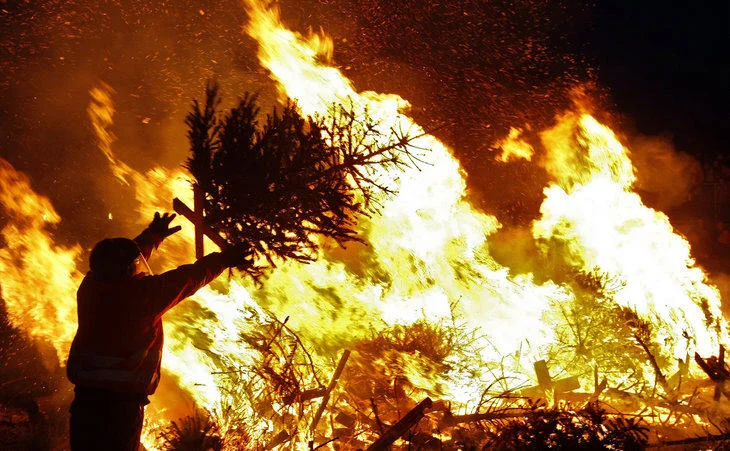
To shine a light on this problem, some churches have embraced an tradition -- primarily among Anglicans and other Protestants -- that provides a spectacular answer to an old question: When do you take down that Christmas tree? The answer: The faithful take their Christmas trees to church and build a bonfire as part of the "Epiphany Service of Lights" on January 6th.

As always, in a rite framed by liturgy, there is a special prayer: "Almighty God our Heavenly Father, whose only Son came down at Christmas to be the light of the world, grant as we burn these trees this Epiphany night, that we, inspired by your Holy Spirit, would follow his example and bear witness to His light throughout the world, through Jesus Christ our Lord, who with you and the Holy Spirit, live and reign in glory everlasting. Amen."

The struggle to observe the 12 days of Christmas is similar to other trials for those who strive to follow the teachings of their faith during the crush of daily life, said Harmon.

2015 and beyond: So much news about religious liberty battles at home and abroad

The goal of The Atlantic Monthly's recent LGBT Summit was to gather a flock of politicos, artists, activists and scribes to discuss the "Unfinished Business" of queer culture, after a historic win for gays at the U.S. Supreme Court.

The summit's final speaker was Andrew Sullivan, the British-born, HIV-positive, occasionally conservative, liberal Catholic whose trailblazing online journalism helped shape so many public debates.

Sullivan ranged from the genius of "South Park" to the impact of smartphone apps on dating, from the positive impact of gay porn to the lingering self-loathing that prevents some gays from embracing drugs that could end AIDS. He attacked Donald Trump and Hillary Clinton, while yearning for another term for President Barack Obama.

Most of all, he stressed that it's time -- after a "tectonic" cultural shift on sexuality -- for professional LGBT activists to end the "whiny victimhood" in which they recite a "you're a bigot, we're oppressed, why do you hate us" litany to Americans who disagreed with them about anything.

Calling himself a "classical liberal," Sullivan stressed that gay leaders must accept that some believers will not surrender the ancient doctrines that define their faith. Thus, it's time for honest conversations between believers, gay and straight.

"The blanket … I would say, yes, bigotry towards large swaths of this country who may disagree with us right now … is not just morally wrong, it's politically counterproductive," he said, drawing screams of outrage on Twitter.

"Religious freedom is an incredibly important freedom. To my mind it is fundamental to this country and I am extremely queasy about any attempt to corral or coerce the religious faith of anybody."

Sullivan's comments captured one of the tensions that dominated the Religion Newswriters Association poll to select the Top 10 religion news events of 2015.

Concerning those British battles about 'Star Wars' and the Lord's Prayer

Imagine this scene in a London movie theater, moments before the archetypal fanfare signaling the Dec. 18 arrival of the new "Star Wars" epic.

Imagine a beautiful, dignified advertisement appearing onscreen in which Muslims -- workers, refugees, artists and imams -- each recite one of the opening phrases of the Quran.

"In the name of Allah, Most Gracious, Most Merciful. Praise be to Allah, the Cherisher and Sustainer of the worlds. Most Gracious, Most Merciful; Master of the Day of Judgment. Thee do we worship, and Thine aid we seek."

How would this be received in modern England, a tense land rocked by decades of debate about multiculturalism and whether it remains "Christian," in any meaningful sense of the word?

That's an intriguing question, after the decision by the dominant managers of British theaters to reject a Church of England advertisement -- targeting throngs at "Star Wars" rites -- in which Archbishop of Canterbury Justin Welby and others recite phrases from The Lord's Prayer. It's important to ponder this comparison, argued theologian Andrew Perriman of London, at a website called "An Evangelical Theology for the Post-Christendom Age."

"Context is everything. It seems to me that the assumption that the Lord's Prayer is culturally and religiously innocuous points to some complacency on the part of the church," wrote Perriman, author of "The Coming of the Son of Man: New Testament Eschatology for an Emerging Church."

The decision to use this symbolic New Testament prayer in this public-square context, he argued, suggests that, "we have not let go of the Christendom mentality that expects everyone in this country to be, deep-down, innately, whether-they-like-it-or-not Christian."