
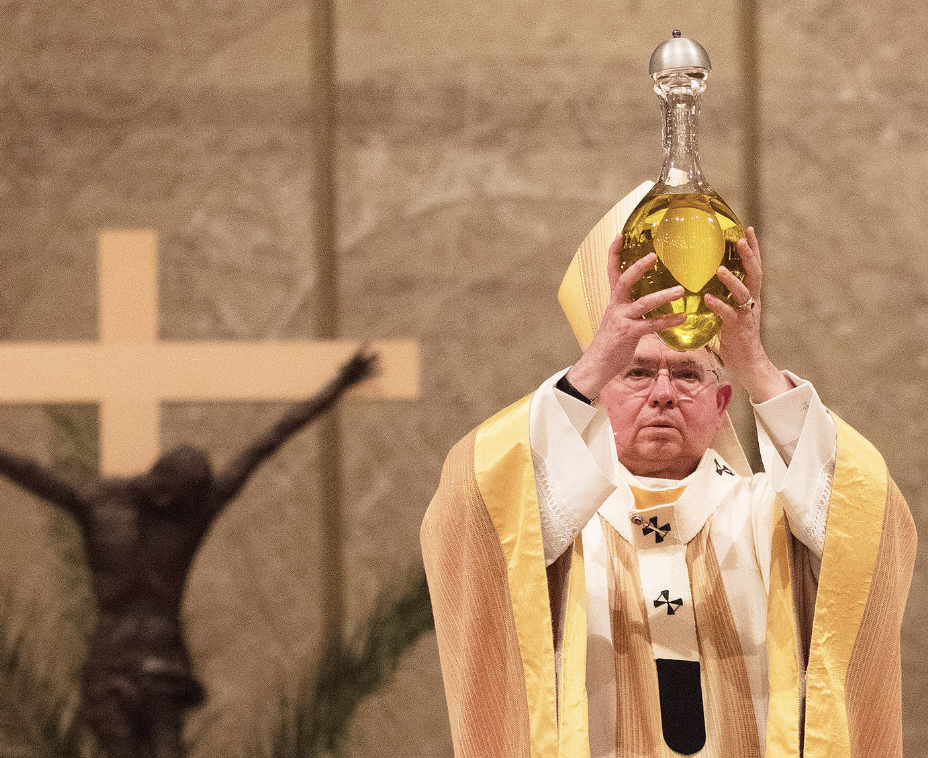
No doubt about it, this Easter was an exciting time for many American Catholics, with quick surveys showing 38% more people converting into the church than the previous year.
The Easter Vigil surge hit dioceses large and small, with a 139% increase in Los Angeles and 145% in Duluth, Minnesota, a 52% rise in Chicago and 96% in Rapid City, South Dakota. A much-sited analysis by Hallow.com found that 38% surge in 140 U.S. dioceses.
The rising numbers almost reached the modest conversion levels that were normal before the COVID-19 pandemic. The rate had been declining for many years before that.
"If you're in a parish that's growing, you look around and see newcomers everywhere. You go to Mass at least 10 minutes early to make sure there's some place to sit. That's your reality," said Brendan Hodge, a contributing editor for The Pillar, reached by telephone.
"If you're in a congregation that's in decline, you aren't surrounded by young families and converts who are excited about the Catholic faith. Your reality is very different."
Gazing ahead, it's hard to know how this surge will affect the future, he said. Is the "big story" that some Catholic parishes are growing or that many others are dying? To answer that question, it's important to study other powerful trends in Catholic life.
The sobering fact is that Catholics leaving the faith far outnumber converts. According to General Social Survey numbers, in 1973, "84% of all those raised Catholic still identified as Catholic when surveyed as adults. In 2002, that figure was 74%. By 2022, it had dropped to 62%," noted Michael Rota and Stephen Bullivant, in the Church Life Journal, published by the University of Notre Dame.
"Perhaps a more salient question is how many of those raised Catholic still participate in Mass every Sunday," they added. "In 1973, about 34% of all those raised Catholic were attending Mass weekly (or more often) when they were surveyed as adults. By 2002, the number had fallen to 20%. By 2022, it had plummeted to 11%."
Meanwhile, the 2024 Religious Landscape Survey from the Pew Research Center confirmed that 6.5 people leave the Catholic faith for each person that converts. Thus, "roughly 13%" of U.S. adults "are former Catholics."
After taking the exit door, about 57% of these ex-Catholics become "religiously unaffiliated," while about a third find other pews, according to surveys charted by Ryan Burge of the John C. Danforth Center on Religion and Politics at Washington University in St. Louis.
"Despite popular online narratives, conversion to Catholicism is rare. Just 3% of evangelicals, 5% of mainliners, and 2% of Black Protestants end up Catholic," he wrote, for his Graphs about Religion website. "The Catholic Church simply does not gain many converts."
Truth is, noted Hodge, a "sustainable Catholic culture" has been declining for decades.
For example, there were around 59,000 U.S. priests in 1970, but only 35,000 by the 2020s. Still, there are trends inside those numbers, he noted. While the number of seminarians continues to decline, some dioceses -- especially in the Midwest and the growing Bible Belt -- produce far more priests than the norm. Rural dioceses consistently outperform urban centers.
Larger families produce more priests, but the Catholic fertility rate remains about 1.9, compared with the U.S. rate of 1.57 children per woman. That Catholic number remains well below the 2.1 population "replacement rate." Also, Catholic weddings have fallen from 426,000 in 1970 to 107,051 in 2024, with 85,171 Catholic rites and 21,880 involving other faiths.
The bottom line: Growing parishes tend to have more infant and adult baptisms, more weddings, more converts and produce more seminarians. They often have thriving schools or large networks of homeschooling families. Dying churches? Exactly the opposite.
"The story of the large number of ex-Catholics is basically the story that the church of 20 years ago, or even 40 years ago, is not the church that we are going to see in another 50 years -- in terms of geography, in terms of numbers, in terms of the practice of the faith," said Hodge.
"If you want to talk about the future, then the big news story is which churches are growing and why they are growing and which churches are dying and why they are dying."
FIRST IMAGE: Uncredited photo from the L.A. Catholic website.