Orthodox

Conspiring to keep some Advent spirit alive, while waiting for the real Christmas

Conspiring to keep some Advent spirit alive, while waiting for the real Christmas

The children kept asking a logical question in Sunday school, one linked to those "Whose birthday is it?" appeals voiced by "Put Christ back in Christmas" activists.

Leaders of Ecclesia Church in Houston were trying to find ways to encourage members to observe the four solemn weeks of Advent (Latin for "toward the coming"), which precede the Christmas season, which begins on Dec. 25 and then lasts for 12 days.

"The children pushed this thing to another level," said the Rev. Chris Seay, pastor of this nondenominational flock in the trendy Montrose neighborhood near downtown. The church, which draws around 3,000 each weekend, was created by a coalition of Baptists, Presbyterians and others.

The question the children asked, he said, was this: " 'If Christmas is Jesus' birthday, then he should get the best gifts. Right?' … Once you ask that, it has to affect what we do as a church and what we do as families. If you start thinking that way, it changes just about everything we do at Christmas."

That shift led to efforts -- part of a national "Advent Conspiracy" campaign -- to raise money to provide safe water for suffering people around the world. The basic equation: If Americans spent $450 billion a year on Christmas, then why can't believers funnel some of this gift-giving into efforts to save others?

Ecclesia, an urban flock that includes poor and rich, is trying to raise about $1 million. That would be 30 percent of its annual budget, noted Seay, a total that will require major changes for many church members. The bottom line: "Advent Conspiracy" pastors are asking people to find ways to use the four weeks of Advent to prepare for Christmas as a holy day, rather than queuing up for America's blitz of holiday shopping, partying and decorating -- starting around Halloween.

This also means paying attention to ancient traditions that have shaped the church calendar, if not the shopping mall calendar.

Methodist theologian Tom Oden and his journey into ancient Christianity

Methodist theologian Tom Oden and his journey into ancient Christianity

It was a blunt, personal comment, the kind of intellectual elbow in the ribs that scholars share in the faculty lounge.

The Jewish sociologist of religion Will Herberg asked his Drew University colleague Tom Oden how he could call himself a theologian if he kept focusing his work on modern trends -- period.

Herberg told Oden that "he was a parasite on the ancient Christian tradition," who had "never taken seriously the great Christian minds of the past," noted theologian Stephen Seamands, who studied under Oden and uses many of his works while teaching at Asbury Theological Seminary in Wilmore, Ky.

This Herberg challenge radically affected Oden's life in the 1970s, as he evolved from backing an edgy liberalism to spreading, in shelves of books, an ecumenical approach to orthodoxy. Oden kept publishing into the final years of his life, until his December 8th death at the age of 85.

"Here was a guy who -- until his mid '40s -- had been a success on that career track in the contemporary academy," said Seamands. Oden had a Yale University doctorate and thrived in an era "built on the idea that new is better and that you looked down on anything old. You were supposed to idealize whatever people called the latest thing. That's how you got ahead."

In the 1950s, Oden embraced Marxism, existentialism and the demythologization of scripture. He was an early leader among Christians supporting abortion rights. In the 1960s he plunged into Transactional Analysis, Gestalt therapy, parapsychology and what, in one of my first encounters with him, he called "mild forms of the occult."

As he dug into early church writings, from the ancient East and West, Oden came to the conclusion that "I had been in love with heresy."

A problem with deep roots: Why so many men think church is for women (Part I)

A problem with deep roots: Why so many men think church is for women (Part I)

It was conventional wisdom, in the Middle Ages, that women were more pious than men and that women went to Confession and took Communion during great church feasts "while few men do," as a Dominican priest observed.

Austrian theologian Johann B. Hafen saw this trend in 1843: "During the year who surrounds most frequently and willingly the confessional? The wives and maidens! Who kneels most devoutly before our altars? Again, the female sex!"

Early YMCA leaders found that one out of 20 young men claimed church membership and that 75 percent of men "never attend church" at all. A Church News study in 1902 found that, in Manhattan, the ratio of Catholic women to men was 3 to 1.

What about today? To see what is happening in Catholic sanctuaries worshippers just have look around.

"You may have noticed that in many Catholic churches everyone in the sanctuary except the priest is female and sometimes the masculinity of the priest is doubtful. I remember a 50-year-old priest with a page-boy haircut," observed author Leon J. Podles, speaking at Mount Calvary Catholic Church in downtown Baltimore.

"Most Catholic pastoral ministers in this country and elsewhere are female, so often there is not a male in sight during Communion services. ... There have been recent changes in some countries in the ratio of women to men in the church, but it has not been a result of more men, but fewer women attending."

Prayers for the Orthodox bishops of Aleppo, even if #BringBackOurBishops didn't go viral

Once again, the Orthodox bishops of Aleppo ventured into the dangerous maze of checkpoints manned by competing forces along Syria's border with Turkey.

The goal, three years ago, was for Metropolitan Paul Yazigi of the Antiochian Orthodox Church and Metropolitan Yohanna Ibrahim of the Syriac Orthodox Church to help negotiate the release of two priests who had been kidnapped weeks earlier. Then, west of Aleppo, a pack of unidentified armed men attacked.

The bishops' driver was killed in the gunfire. A fourth passenger escaped and then testified -- consistent with other reports -- that the kidnappers did not speak Arabic and appeared to from Chechnya.

The bishops simply vanished. According to a new World Council of Arameans report: "No one has ever claimed responsibility for the abduction, neither has there been a clear sign of life of the bishops since April 22, 2013." Later reports were "all based on unverified rumors, hearsay and false reports which often contradicted each other."

This kidnapping never inspired global news coverage. For some reason, tweeting out #BringBackOurBishops never caught on with hashtag activists inside the Washington Beltway or in Hollywood.

But millions of Eastern Orthodox Christians -- especially those with Syrian and Lebanese roots -- are still praying for the bishops of Aleppo. These prayers escalated with the three-year anniversary of the kidnappings and then, this week, with the sobering rites of Holy Week leading to Good Friday, Holy Saturday and, finally, Pascha -- Easter ...

Pope and patriarch point to the unity found among the modern martyrs

Metropolitan Hilarion of Russia left little room for doubt about his priorities when offered a few moments to speak during the Vatican's tense Synod on the Family.

"Militant secularism" was on the rise, he said last fall. Thus, Catholics and Orthodox Christians should stand united while defending the "traditional Christian understanding of the family," "marriage as a union between a man and a woman" and the "value of human life from conception till natural death."

But most of all, Moscow's top ecumenical diplomat wanted to talk about martyrs -- new martyrs.

Consider Iraq, home to 1.5 million Christians a few years ago. Today, 150,000 remain while the "others were either exterminated or expelled," he said. Then look at Syria, Egypt, Nigeria, Pakistan, Libya and elsewhere.

"We are deeply concerned about the humanitarian catastrophe … unfolding in Syria, where militant Islamists are seeking political power," he said. Wherever jihadists "come to power, Christians are being persecuted or exterminated. Christian communities in Syria and other countries of the Middle East are crying for help, while the mass media in the West largely ignore their cries and the politicians prefer to close their eyes."

It was a foretaste of the historic "airport summit" declaration signed in Cuba by Pope Francis and Patriarch Kirill, leader of the Orthodox Church of Moscow and all Russia.

The passion that loomed over the historic meeting between Rome and Moscow

Like all veteran journalists who cover global religion news, Robert Moynihan of "Inside the Vatican" is used to getting interesting emails from sources in interesting places.

Normally, Moynihan asks the questions. But that wasn't the case in 2006 when he heard from Russian composer Hilarion Alfeyev, who was completing a new Passion According to St. Matthew, based on scripture and prayers from the Orthodox Divine Liturgy.

It's crucial to know that, in 2006, this composer was already a Russian Orthodox bishop. Today he is known as Metropolitan Hilarion and, as chair of his church's Department of External Church Relations, he has long been a key player in behind-the-scenes talks seeking a meeting between the pope of Rome and the patriarch of Moscow.

In that email, the composer said his goal was to premiere the work in Moscow in March of 2007 -- just before Easter in a year in which Catholics (using the Gregorian calendar) and the Orthodox (on the older Julian calendar) would celebrate the Paschal feast on the same day.

Hilarion wondered "if there might be a way for this work to then be performed in Rome and if I could help organize such a concert," said Moynihan. "We both knew this would be incredibly challenging. … But we did it and that night was like a miracle."

The Moscow premiere was on March 27 and, two nights later, the exhausted Russian choir and orchestra were in Rome for a performance attended by several Catholic Cardinals, as well as numerous students, scholars and dignitaries. One Orthodox participant was Metropolitan Kirill -- now the Russian patriarch.

Anyone probing the roots of the historic encounter between Patriarch Kirill and Pope Francis -- the first meeting of this kind between Rome and Moscow -- must study the years of cultural and musical contacts that built a bridge to this moment, said Moynihan, in an interview days before the Cuba summit. In the end, mutual concerns about the slaughter of Christians in Iraq and Syria made such a meeting an urgent necessity.

Bright bonfires to mark end of the 12 days of Christmas season

Bright bonfires to mark end of the 12 days of Christmas season

The same thing happens to Father Kendall Harmon every year during the 12 days after the Nativity of Our Lord Jesus Christ.

It happens with newcomers at his home parish, Christ-St. Paul's in Yonges Island, S.C., near Charleston. It often happens when, as Canon Theologian, he visits other parishes in the Episcopal Diocese of South Carolina.

"I greet people and say 'Merry Christmas!' all the way through the 12 days" of the season, he said, laughing. "They look at me like I'm a Martian or I'm someone who is lost. … So many people just don't know there's more Christmas after Christmas Day."

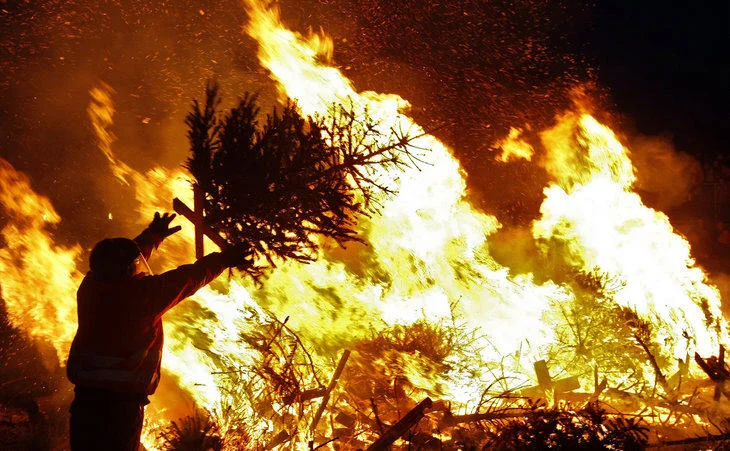
To shine a light on this problem, some churches have embraced an tradition -- primarily among Anglicans and other Protestants -- that provides a spectacular answer to an old question: When do you take down that Christmas tree? The answer: The faithful take their Christmas trees to church and build a bonfire as part of the "Epiphany Service of Lights" on January 6th.

As always, in a rite framed by liturgy, there is a special prayer: "Almighty God our Heavenly Father, whose only Son came down at Christmas to be the light of the world, grant as we burn these trees this Epiphany night, that we, inspired by your Holy Spirit, would follow his example and bear witness to His light throughout the world, through Jesus Christ our Lord, who with you and the Holy Spirit, live and reign in glory everlasting. Amen."

The struggle to observe the 12 days of Christmas is similar to other trials for those who strive to follow the teachings of their faith during the crush of daily life, said Harmon.

Memory eternal, for a quiet giant in American Orthodoxy

FRANKLIN, Tenn. -- It was a typical evangelistic crusade in rural Alabama and, as he ended his sermon, the Rev. Gordon Walker called sinners down to the altar to be born again.

Most Southern towns have a few notorious folks who frequent the back pews during revival meetings, trying to get right with God. On this night, one such scalawag came forward and fell to his knees. 

"Preacher! I've broken all the Ten Commandments except one," he cried, "and the only reason I didn't break that one was that the man I shot didn't die!"

It didn't matter that this man repeated this ritual several times during his troubled life, said Walker, telling the story decades later at Holy Cross Orthodox Church outside Baltimore. Now wearing the golden robes of an Eastern Orthodox priest, Walker smiled and spread his arms wide. The church, he said, has always known that some people need to go to confession more than others. The goal was to keep walking toward the altar.

With his gentle smile and soft Alabama drawl, Walker -- who died on July 23 -- was a key figure in an unusual American story. The former Southern Baptist pastor and Campus Crusade evangelist was part of a circle of evangelical leaders that spent a decade reading church history before starting an Orthodox church for American converts. Then in 1987, the late Metropolitan Philip Saliba accepted more than 2,000 pastors and members of their Evangelical Orthodox Church into the Antiochian Orthodox Christian Archdiocese of North America.

Campolo, Neff signal that an open doctrinal left is emerging in evangelicalism

One moment defined old-school evangelicalism more than any other -- the altar-call ritual in which the Rev. Billy Graham urged sinners to come forward and repent, accept God's forgiveness and be born again. 

For decades, crusade choirs sang "Just As I Am," which proclaims: "Just as I am, and waiting not to rid my soul of one dark blot, to thee, whose blood can cleanse each spot, O Lamb of God, I come, I come." 

So evangelical activist Tony Campolo knew he was grabbing heartstrings as he referenced this gospel hymn when announcing that he had changed his beliefs on marriage and homosexuality. 

"As a social scientist, I have concluded that sexual orientation is almost never a choice," said the 80-year-old Campolo, for decades an influential voice on Christian campuses. "As a Christian, my responsibility is not to condemn or reject gay people, but rather to love and embrace them, and to endeavor to draw them into the fellowship of the Church. 

"When we sing the old invitation hymn, 'Just As I Am,' I want us to mean it." 

With this nod, Campolo underlined crucial questions in heated debates linked to the emerging evangelical left: Since the movement called "evangelicalism" lacks a common structure and hierarchy, who decides what the Bible says about repentance and forgiveness? Who decides when acts cease being sinful and become blessed?