Marriage

Chris Hillman of the Byrds sings (and writes) about faith, fame and musical ties that bind

Chris Hillman of the Byrds sings (and writes) about faith, fame and musical ties that bind

The Byrds' classic "Turn! Turn! Turn!" didn't sound like anything on the radio when it hit No. 1 on the Billboard charts in 1965.

For starters, the lyrics came from the Book of Ecclesiastes, noting "there is a season, and a time for every purpose, under Heaven. A time to be born, a time to die. A time to plant, a time to reap. A time to kill, a time to heal. A time to laugh, a time to weep."

What critics failed to realize, said Byrds co-founder Chris Hillman, was that covering the late Pete Seeger's classic was a logical move for musicians steeped in American roots music. Songs about struggle, glory, sacrifice and faith were common in early '60s folk concerts.

"Where did all of our music come from? Blues and Gospel. … White church, black church, the music all came from church," said Hillman, in a recent interview. "With the Byrds, we went right to that well. We didn't think twice about it. We didn't say, 'We can't do a Christian song.' "

Hillman's musical roots became more obvious as the Byrds ventured into what many started calling "country rock," especially with the landmark "Sweetheart of the Rodeo" album in 1968. Bluegrass, country and Gospel themes played a larger role as Hillman began writing songs for the Byrds and his later bands.

While the Byrds put him in the Rock & Roll Hall of Fame, it was Hillman's grassroots connections that made history, according to the legend who produced his "Bidin' My Time" solo project in 2017. The late Tom Petty said: "Chris was a true innovator -- the man who invented country rock. Every time the Eagles board their private jet, Chris at least paid for the fuel."

That musical and spiritual journey is clear in Hillman's recent autobiography, "Time Between," with its mix of rock lore and personal reflections. Rather than offering a tell-all about sex, drugs and rock 'n' roll, Hillman focuses on lessons he learned along the way and his love for the musicians who, flaws and all, helped him.

U.S. bishops wrestle with 'Eucharistic coherence,' a topic that mixes politics and doctrine

U.S. bishops wrestle with 'Eucharistic coherence,' a topic that mixes politics and doctrine

Archbishop Salvatore Joseph Cordileone leads the Archdiocese of San Francisco, a symbolic city in debates about modern American culture.

But what matters the most, as tensions rise among Catholic leaders, is that Cordileone is House Speaker Nancy Pelosi's hometown bishop. Thus, it's hard for politicos to avoid blunt passages in his new pastoral letter, "Before I Formed You in the Womb I Knew You."

Citing centuries of church doctrine, the archbishop argued that Catholics who "reject the teaching of the Church on the sanctity of human life and those who do not seek to live in accordance with that teaching should not receive the Eucharist. It is fundamentally a question of integrity: to receive the Blessed Sacrament in the Catholic liturgy is to espouse publicly the faith and moral teachings of the Catholic Church, and to desire to live accordingly."

There is, he added, "a great difference between struggling to live according to the teachings of the Church and rejecting those teachings. … In the case of public figures who profess to be Catholic and promote abortion, we are not dealing with a sin committed in human weakness or a moral lapse: this is a matter of persistent, obdurate and public rejection of Catholic teaching. This adds an even greater responsibility to the role of the Church's pastors in caring for the salvation of souls."

Citing a famous example, Cordileone recalled when former New York Mayor Rudolph Giuliani received Holy Communion during a 2008 Mass led by Pope Benedict XVI. This caused scandal and, according to the late Cardinal Edward Egan, violated an agreement that Giuliani would not receive the Sacrament because of his public support for abortion rights and other clashes with doctrine.

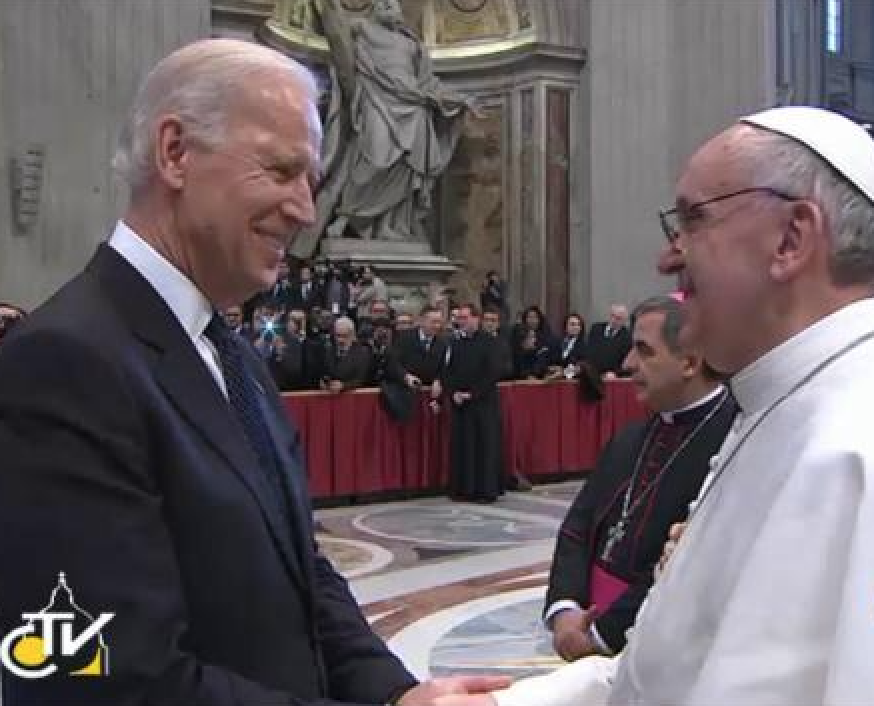
The big issue, as U.S. bishops prepare for June discussions of "Eucharistic coherence," is not how to handle a former New York City mayor. The question is whether bishops can address their own divisions about the status of pro-abortion-rights Catholics such as Pelosi and President Joe Biden. While vice president, Biden also performed two same-sex marriage rites.

San Diego Bishop Robert McElroy, firing back at Cordileone in America magazine, stressed that the "Eucharist must never be instrumentalized for a political end. … But that is precisely what is being done in the effort to exclude Catholic political leaders who oppose the church's teaching on abortion and civil law. The Eucharist is being weaponized and deployed as a tool in political warfare. This must not happen."

Meanwhile, the prefect of the Vatican's Congregation for the Doctrine of the Faith warned the leader of the U.S. Conference of Catholic Bishops that these issues could become a "source of discord rather than unity within the episcopate" and among all American Catholics.

Orthodox Kontakion of the Departed: A hint at the complex faith history of Prince Philip

Orthodox Kontakion of the Departed: A hint at the complex faith history of Prince Philip

The first nun the Bolsheviks threw into the abandoned mineshaft was best known as the Grand Duchess Elizabeth Feodorovna, the sister of the Russian Empress Alexandra.

After the 1905 assassination of her Grand Duke husband, Elizabeth became an Orthodox nun, giving away her wealth to build hospitals and orphanages. She was executed, in 1918, along with others linked to her doomed brother-in-law, Tsar Nicholas II.

When the nuns didn't drown, a soldier used a grenade. He later testified that "we heard talking and a barely audible groan. I threw another grenade. And what do you think -- from beneath the ground we heard singing! … They were singing the prayer: 'Lord, save your people!' "

Finally, there was silence. The body of St. Elizabeth the New Martyr was buried in 1920 at the Church of St. Mary Magdalene on the Mount of Olives in Jerusalem. Her life inspired many, including her grieving niece, the Greek Princess Alice of Battenberg. Alice was the great-granddaughter of Queen Victoria of England and the mother of Prince Philip, Duke of Edinburgh and for 73 years the husband of Queen Elizabeth II.

The complicated history of the royals, past and present, loomed over the short, dignified funeral for Prince Philip in St. George's Chapel, Windsor -- with only 30 mourners due to COVID restrictions. The prince's liturgical choices shaped an Anglican rite that stressed images of service, eternal hope and the beauties of God's creation.

The man many Brits called the "grandfather of the nation," was born on the Greek island of Corfu in 1921, the fifth child and only son of Prince Andrew of Greece and Princess Alice. He was baptized Greek Orthodox, before his life was rocked by wars and revolutions that shattered his family.

Did Pope Francis undercut that Vatican ruling on blessings for same-sex couples?

Did Pope Francis undercut that Vatican ruling on blessings for same-sex couples?

After a media firestorm ignited by a Vatican condemnation of same-sex unions -- because God "cannot bless sin" -- Catholic progressives immediately looked for hope in the words of bishops, President Joe Biden and even Pope Francis.

In his Sunday Angelus address after the March 15 ruling, the pope stressed that modern seekers want to "see Jesus" in acts of love, not persecution.

Catholics must promote "a life that takes upon itself the style of God -- closeness, compassion and tenderness," said the pope. "It means sowing seeds of love, not with fleeting words but through concrete, simple and courageous examples, not with theoretical condemnations, but with gestures of love. Then the Lord, with his grace, makes us bear fruit, even when the soil is dry due to misunderstandings, difficulty or persecution, or claims of legalism or clerical moralism."

While Pope Francis gave "his assent" to this ruling, the Jesuit publication America cited anonymous Vatican sources saying the Angelus remarks suggested that he was "distancing himself" from the work of the Congregation for the Doctrine of the Faith.

That document said God "does not and cannot bless sin: He blesses sinful man, so that he may recognize that he is part of his plan of love and allow himself to be changed." As for same-sex unions, it added: "The presence in such relationships of positive elements … cannot justify these relationships and render them legitimate objects of an ecclesial blessing, since the positive elements exist within the context of a union not ordered to the Creator's plan."

Bishop Johan Bonny of Antwerp -- who represented Belgium at the 2015 Vatican Synod on Marriage and the Family -- said those words left him "ashamed on behalf of my Church. … I want to apologize to all those for whom this 'responsum' is painful and incomprehensible: faithful and committed Catholic homosexual couples, the parents and grandparents of homosexual couples and their children, pastoral workers and counsellors of homosexual couples," he wrote on Facebook.

"I know homosexual couples who are legally married, have children, form a warm and stable family, and moreover, actively participate in parish life. A number of them are employed full-time in pastoral work or ecclesial organizations." Why, he added, deny the "similarity or analogy with heterosexual marriage here?"

Meanwhile, the president of the German bishops' conference, Bishop Georg Bätzing, said he was "not happy" about the Vatican document. Also, a statement from 230 Catholic theologians in Germany called the refusal to bless same-sex unions "paternalistic," "discriminating" and lacking in "theological depth."

The head of St. Peter's Cathedral in Worms went further, saying he "cannot and will not" refuse blessings to anyone. Father Tobias Schäfer told the Deutsche Welle network: "My opinion is: don't take Rome seriously and continue with pastoral care. There are more important things than such stupid papers!"

National Cathedral invites evangelical to preach, triggering fierce storm of protest

National Cathedral invites evangelical to preach, triggering fierce storm of protest

Halfway between Norway and the North Pole, scientists have buried a million seeds and crop samples under a mountain in the Svalbard archipelago -- in case an environmental doomsday comes to pass.

That strategy rings true during "this crazy, chaotic season" when so many are anxious about the coronavirus pandemic, global warming, lost jobs, surging debts and the bitter state of public life, said evangelical megachurch leader Max Lucado, in a recent sermon streamed online by the National Cathedral in Washington, D.C.

“Most of us can't hide out in a bunker, yet threats of calamity may make us try to do so," he said. "If the wrong person pushes the wrong red button -- it's enough to make a person purchase a plane ticket to Svalbard."

But there was a problem. While pre-service publicity stressed that Lucado's books have sold more than 120 million copies and Christianity Today has called him "America's pastor," this invitation alarmed legions of Episcopalians opposed to his history of orthodoxy on sex and marriage. His sermon about God offering comfort in the midst of chaos avoided hot-button topics, but his cathedral appearance triggered an online storm.

Before the event, the Very Rev. Randolph Marshall Hollerith linked the Lucado invitation to the cathedral's history of hosting a variety of religious leaders. This has included evangelicals such the late Billy Graham, Archbishop of Canterbury Justin Welby and megachurch leader Rick Warren of Saddleback Church in Southern California.

"When we only engage with those with whom we agree on every issue, we find ourselves in a dangerous (and lonely) place," wrote the cathedral's dean. "That means this cathedral, and this pulpit, are big enough and strong enough to welcome pastors, rabbis, imams, clergy of every faith. … It does not mean we agree with everything they might believe, but it does mean that we exhibit and inhabit a sense of open handed welcome."

However, Hollerith issued a formal apology in response to the online backlash, noting: "In my straight privilege I failed to see and fully understand the pain he has caused. I failed to appreciate the depth of injury his words have had on many in the LGBTQ community. I failed to see the pain I was continuing. I was wrong."

Years of 'McCarrick doctrine' fights among U.S. bishops go public -- on Inauguration Day

Years of 'McCarrick doctrine' fights among U.S. bishops go public -- on Inauguration Day

Speaking to an Italian family association in 2018, Pope Francis compared the abortion of children with genetic problems to "what the Nazis did to purify the race. Today, we do the same thing but with white gloves."

A year later, Francis bluntly asked a journalist from Mexico if it's "fair to eliminate a human life in order to solve a problem? The answer to which is, 'No.' Second question: Is it fair to pay a sniper to solve a problem? No. Abortion is not a religious problem. … It is a problem of eliminating a human life. Period."

But the pope was careful in his Inauguration Day message to America's second Catholic president, assuring Joe Biden that he would "pray that your decisions will be guided by a concern for building a society marked by authentic justice and freedom, together with unfailing respect for the rights and dignity of every person, especially the poor, the vulnerable and those who have no voice."

The pope's text was examined closely after reports that the Vatican -- on behalf of progressive American bishops -- tried to stop the circulation of a sobering statement from the president of the U.S. Conference of Catholic Bishops. The letter from Archbishop Jose Gomez of Los Angeles addressed the challenge, and blessing, of working with "our first president in 60 years to profess the Catholic faith."

Clearly, Biden's piety had offered "solace in times of darkness and tragedy," said Gomez, leader of America's largest diocese and a crucial voice among Hispanic Catholics. He also praised Biden's "longstanding commitment to the Gospel's priority for the poor."

Nevertheless, Gomez noted that "our new President has pledged to pursue certain policies that would advance moral evils and threaten human life and dignity, most seriously in the areas of abortion, contraception, marriage, and gender. Of deep concern is the … the freedom of believers to live according to their consciences."

Cardinal Blasé Cupich of Chicago fired back on Twitter, attacking this "ill-considered statement on the day of President Biden's inauguration" while claiming "there is seemingly no precedent" for this action by Gomez.

The Pillar, a Catholic news website, reported that the Vatican Secretariat of State intervened to "spike" the statement from the U.S. bishops after objections from Cupich, Cardinal Joseph Tobin of Newark and some other bishops.

Joe Biden and the U.S. Catholic bishops: Tensions remain about Holy Communion

Joe Biden and the U.S. Catholic bishops: Tensions remain about Holy Communion

While doing groundwork for the pivotal South Carolina primary, Democrat Joe Biden went to a local church to do what he does on Sundays -- go to Mass.

What happened next made headlines, raising an issue that looms over the president-elect's personal and political lives. The priest at St. Anthony's Catholic Church in Florence declined to give Biden communion.

"Holy Communion signifies we are one with God, each other and the Church. Our actions should reflect that," said Father Rev. Robert E. Morey, in a press statement. "Any public figure who advocates for abortion places himself or herself outside of Church teaching. As a priest, it is my responsibility to minister to those souls entrusted to my care."

The priest, a former attorney with the Environmental Protection Agency, ended by saying: "I will keep Mr. Biden in my prayers."

Biden told MSNBC: "That's just my personal life and I am not going to get into that at all."

Nevertheless, Biden continued to make his faith -- he is a "devout" Catholic in news reports -- a key element of the campaign, as he has throughout his career. He also pledged to defend Roe v. Wade, to the point of codifying the decision into national law.

Catholic conservatives and liberals remain divided on how the church should respond, a tension demonstrated in a carefully worded statement by Los Angeles Archbishop José H. Gomez, president of the U.S. Conference of Catholic Bishops.

Rabbi Lord Jonathan Sacks offered modern arguments defending an ancient faith

Rabbi Lord Jonathan Sacks offered modern arguments defending an ancient faith

A typical Rabbi Lord Jonathan Sacks speech would open with a self-deprecating jab at long-winded rabbis and then flow into a blend of Hebrew texts, science, law, literature, current events and the scriptures other faiths.

When the former chief rabbi of the United Kingdom died on Nov. 7 at age 72, after battles with cancer that began in his 30s, the Prince of Wales said: "His immense learning spanned the secular and the sacred, and his prophetic voice spoke to our greatest challenges with unfailing insight and boundless compassion. His wise counsel was sought and appreciated by those of all faiths and none."

Most of all, Lord Sacks was known for using modern information and insights to defend ancient truths. One famous address, at a 2014 Vatican conference on marriage, began with fish mating in a Scottish lake 385 million years ago before charting humanity's rise from polygamy to monogamy, including some awkward biblical dramas.

Before this speech ended with a standing ovation, the rabbi explained that his goal was to defend the “most beautiful idea in the history of civilization," the concept of love as the origin of new life.

"What made the traditional family remarkable, a work of high religious art, is what it brought together: sexual drive, physical desire, friendship, companionship, emotional kinship and love, the begetting of children and their protection and care, their early education and induction into an identity and a history," he explained.

“Seldom has any institution woven together so many different drives and desires. … It made sense of the world and gave it a human face -- the face of love. For a whole variety of reasons, some to do with medical developments like birth control, in vitro fertilization and other genetic interventions, some to do with moral change like the idea that we are free to do whatever we like so long as it does not harm others, some to do with a transfer of responsibilities from the individual to the state … almost everything that marriage once brought together has now been split apart. Sex has been divorced from love, love from commitment, marriage from having children and having children from responsibility for their care."

Lord Sacks was part of the Modern Orthodox movement and wrote two dozen prayer books and works about science and spirituality, as well serving as a commentator on BBC Four's "Thought for the Day." He became chief rabbi of the United Hebrew Congregations of the Commonwealth in 1991, holding that post until 2013, Queen Elizabeth knighted him in 2005 and he entered the House of Lords in 2009.

Culture wars are about demographics: Thus, fertility has become a controversial issue

Culture wars are about demographics: Thus, fertility has become a controversial issue

It was one of those happy social-media pictures, only this time the pregnant mother was celebrating with her nine children.

Los Angeles comedian and actor Kai Choyce was not amused and tweeted the photo with this comment: "this is environmental terrorism. … In the year 2020 literally no one should have ten kids."

The result was a long chain of sweet or snarky comments, as well as photos of large families. One tweet quoted a Swedish study claiming that having "one fewer child per family" can save an average of 58.6 tons of "CO2-equivalent emissions per year."

Debates about fertility often veer into fights about religion and other ultimate questions, such as the fate of the planet.

Parents with two-plus children are often making a statement about the role of religious faith in their lives. People on the other side of this debate have frequently rejected traditional forms of religion.

"What we call 'culture wars' are wars about demographics, but we have trouble discussing that," said historian Philip Jenkins, who is best known for decades of research into global religious trends, while teaching at Pennsylvania State and Baylor University. His latest book is "Fertility and Faith: The Demographic Revolution and the Transformation of World Religions."

In the 1970s, researchers thought the link between secularization and falling birth rates was a "Protestant thing" in Europe, but then this trend spread into Catholic cultures in Europe and in Latin America, he said. Fertility rates are now collapsing in Iran and some Islamic cultures. Meanwhile, Orthodox Jews and traditional Catholics continue to have larger families than liberal believers in those ancient faiths.

America's 2019 birth rate fell to 1.71, its lowest level in three decades, and well under the replacement rate of 2.1. This took place before the coronavirus pandemic and the Brookings Institute recently predicted a "COVID baby bust" next year, resulting in up to half a million fewer births.

Researchers frequently argue about which comes first -- secularization or declining fertility.