Thinking the unthinkable: Is the United States of America veering closer to civil war?

Thinking the unthinkable: Is the United States of America veering closer to civil war?

Call it the "Texit" parable.

America's new civil war begins with the Supreme Court overturning Roe v. Wade, creating an abortion-free zone in the Bible Belt and most heartland states.

Enraged Democrats pledge to end the U.S. Senate filibuster and expand the number of high-court justices. After restoring Roe, they seek single-payer health care, strict gun control and sweeping changes in how government agencies approach the First Amendment, with the IRS warning faith groups to evolve -- or else -- on matters of sexual identity. Big Tech begins enforcing the new orthodoxy.

Conservatives rebel and liberals soon realize that most of America's military, including nuclear weapons, are in rebel territory. Then federal agents kill Alabama's pro-life, Black governor -- while trying to arrest him as a traitor. That's too much for Gov. Francisco Gonzalez of Texas, who decides that it's time for a new republic.

David French fine-tuned this "Texit" vision early in 2020, while finishing "Divided We Fall: America's Secession Threat and How to Restore Our Nation." Best-known as a #NeverTrump conservative pundit, most of the Harvard Law graduate's career has focused on old-school First Amendment liberalism -- which in recent decades has meant defending conservative religious believers in religious liberty cases.

The book's first lines are sobering, especially after recent scenes on Capitol Hill.

"It's time for Americans to wake up to a fundamental reality: the continued unity of the United States cannot be guaranteed," wrote French. Right now, "there is not a single important cultural, religious, political, or social force that is pulling Americans together more than it is pulling us apart."

Americans are divided by their choices in news and popular culture. America remains the developing world's most religious nation, yet its increasingly secularized elites occupy one set of zip codes, while most traditional religious believers live in another. In politics, more and more Democrats are Democrats simply because they hate Republicans, and vice versa.

Ironically, cultural conservatives now find themselves hoping that the Supreme Court will protect them, said French, reached by telephone. Conservatives know they have lost Hollywood, academia, America's biggest corporations, the White House and both houses of Congress.

"I constructed the Texit scenario around court packing because that has become their last firewall," said French.
Personality cults and Christianity: That's trouble with a capital 'T,' now and forever ...

Personality cults and Christianity: That's trouble with a capital 'T,' now and forever ...

Year after year, thousands of Americans attend the March for Life, marching past the U.S. Capital on a late January date close to the anniversary of Roe vs. Wade.

Most of the marchers are young and come by bus from Catholic and evangelical schools. While most of the groups present are conservative, there are smaller groups like Secular Pro-Life and Democrats for Life. Most of the banners contain slogans such as, "Abortion Hurts Women," "Love Life, Choose Life" or "We are the Pro-Life Generation."

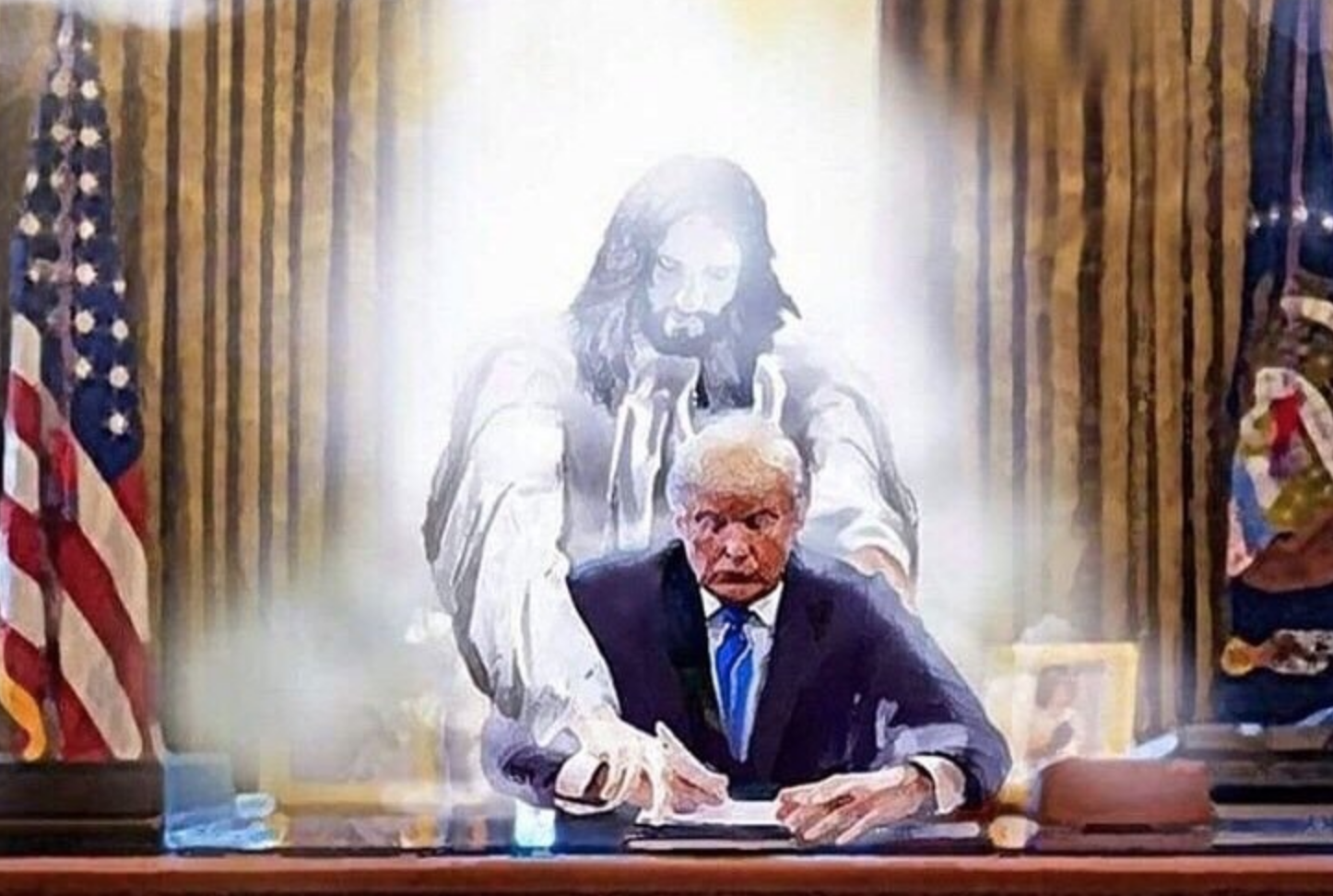
Things were different at the Save America March backing President Donald Trump's efforts to flip the 2020 election. Some banners contained messages like "Jesus is my Savior, Trump is my President." But many more proclaimed "Stand with Trump!" or "Trump 2020: No More Bulls--t."

It's one thing to march for a cause. It is something else to hail a political leader as the key to saving America, said Southern Baptist Seminary President R. Albert Mohler, Jr., a central figure in evangelical debates about Trump.

"The American experiment in ordered liberty is inherently threatened by a cult of personality. And we saw the results of that. … So many of those who were there as protestors explicitly said that they were there in the name of Donald Trump," said Mohler, in a podcast the day after U.S. Capitol riot. "It was Trump that was the name on the banners. They were not making the argument about trying to perpetuate certain political principles or even policies or platforms."

History shows that personality cults -- left or right -- are dangerous, he stressed. After this "American nightmare," Christians should soberly ponder the "way sin works" and its impact on powerful leaders who are tempted to become demagogues.

"Demagoguery simply means that you have a character who comes to power on the basis of emotion, rather than argument, and passion rather than political principles," said Mohler.

It's crucial to know that, in 2016, Mohler was numbered among evangelical leaders who opposed Trump's candidacy. When the New York City billionaire clinched the GOP nomination, Mohler tweeted: "Never. Ever. Period."

But in 2020 he said he would vote for Trump in support of the Republican Party, thus opposing the Democratic Party platform.

It doesn't help when true believers start joining mobs engaged in online combat

It doesn't help when true believers start joining mobs engaged in online combat

It seemed that whenever the Rev. Daniel Darling ventured into social media, he saw the same red flags -- so he posted a commentary on "Christians and Conspiracy Theories."

"Because it's online, doesn't mean it's true," he noted. "Because a story is advanced by someone whose ideology I agree with, doesn't mean it's true. …

"For some reason, we are a people who want to believe there is a big plot behind every single thing that happens. … If you watch enough cable TV, depending on your political persuasion, you will come to think that behind every act in Congress there is a string of connected dots that go back to either George Soros (liberal) or the Koch brothers (conservative)."

This wasn't a hot take on QAnon letters or rumors of shredded Georgia ballots.

Darling wrote those words a decade ago, while leading an evangelical church near Chicago. Now he's a crucial voice for the National Religious Broadcasters and author of a book -- "A Way with Words: Using Our Online Conversations for Good" -- pleading for believers to think twice about their online lives.

"I'm not saying we should run away and hide," said Darling, in a telephone interview. "There's no way to avoid the fact that social media is a crucial part of American life. I don't think Christians have any choice about whether or not to be engaged. …

"What we need to do is be more careful when deciding where to draw lines and take stands. But, unless you're Amish, I don't see anyone sitting this one out."

It's especially important for religious leaders to warn their followers not to join the online "mobs" that are destroying America's ability to have sane public debates. In some cases, digital attacks are also threatening lives and reputations.

Consider, for example, the woke social-media attacks that fueled inaccurate mainstream news reports about Covington Catholic High School students at the 2019 March for Life. Then there were the conservative social-media warriors who embraced #pizzagate conspiracy theory claiming that prominent Democrats were linked to a global child-trafficking ring.

Did Russia steal the White House in 2016? Yes, there were mainstream-news reports. Did China, Cuba, Venezuela or some other evil force steal the 2020 election? Yes, there have been headlines on the other side of America's partisan media wars.

Top religion-beat story of 2020? There were several COVID-19 stories to choose from ...

Top religion-beat story of 2020? There were several COVID-19 stories to choose from ...

There was never any question whether the global coronavirus pandemic would be named the most important religion-news story in 2020.

The question was which faith-driven COVID-19 story -- out of a dozen or so -- would top the Religion News Association's Top 10 list.

According to journalists who cover religion, this was the year's biggest story: "COVID-19 pandemic claims lives of many religious leaders and laity, upends death rituals, ravages congregational finances, spurs charitable responses, forces religious observances to cancel or go online and stirs legal fights over worship shutdowns."

But there was a problem on my ballot. The RNA list included another coronavirus item focusing on religious liberty. In some cities and states, officials created pandemic regulations that claimed many institutions -- from grocery stores to casinos -- provided "essential services." Meanwhile, other institutions -- like churches and synagogues -- were deemed "non-essential."

The U.S. Supreme Court eventually ruled that religious institutions shouldn't face tougher rules than secular groups and activities. It was wrong, for example, to ban masked priests from hearing confessions -- outdoors, 10 feet away from masked penitents -- while consumers were lined up at liquor stores.

These conflicts continued. In a symbolic pre-Christmas press conference, Virginia Governor Ralph Northam explained why he thought religious groups should be willing to move their activities online and stay there -- for now.

"This year we need to think about what is truly the most important thing," Northam explained, in a Richmond press conference. "Is it the worship or the building? For me, God is wherever you are. You don't have to sit in the church pew for God to hear your prayers."

Bishop Robert Barron of the Catholic Archdiocese of Los Angeles was not amused. The problem with this"secularized, Protestant-ized" view of worship, he said, is that it doesn't work for believers with ancient traditions that don't work online, such as offering communicants consecrated bread and wine.

Here we go again: Believers face complicated choices in #2020 COVID-tide

Here we go again: Believers face complicated choices in #2020 COVID-tide

Rather than preparing for a joyous Christmastide, believers are making tough decisions about how to celebrate during a season some call COVID-tide.

What about that beloved Christmas cantata or children's pageant? Government regulations about singing vary nationwide.

All those parties and dinners on the December calendar? Church officials may shut them down or, perhaps, look the other way.

The most emotional question: What about Christmas Eve, with glowing sanctuaries full of families gathered from near and afar dressed in festive holiday attire? In most churches some members will be allowed inside, while others stay home -- as during 2020's Holy Week and Easter -- holding candles while facing computer screens.

No one knows what will happen, especially in Protestant flocks where holiday traditions are more flexible and evolve from year to year.

Nevertheless, about 50% of American adults who typically go to church at Christmas hope to do so, according to a study by LifeWay Research in Nashville. In fact, another 15% of participants in the online survey said they were more likely to attend a service this year. However, 35% of typical churchgoers said they're more likely to stay home.

"About 50% of America are saying, 'We're going to do what we're going to do,' " said Tim McConnell, LifeWay's executive director. Since this survey was done before the recent coronavirus spike, "that makes things even more unpredictable" than they were already.

The survey results seem deceptively ordinary, but tensions emerge in key details. The survey focused on believers, and the unchurched, but included an oversample of self-identified evangelical Protestants.

"It's easy to look at these numbers and see that half the people say they will be having Christmas as usual. Then there's another group of people who say they plan to do even more," he said. "Then you look at the bigger picture and there's that other third that's missing. That's probably the large group of Americans who are older and at higher risk. …

Groundhog Day for Episcopalians: Brutal report says pews may be empty by 2050

Groundhog Day for Episcopalians: Brutal report says pews may be empty by 2050

With America facing a bitterly divisive election, Episcopal Church leaders did what they do in tense times — they held a National Cathedral service rallying the Washington, D.C., establishment.

This online "Holding onto Hope" service featured a Sikh filmmaker, a female rabbi from Chicago, the Islamic Society of North America's former interfaith relations director, the female presiding bishop of the Evangelical Lutheran Church in America, a Jesuit priest known for promoting LGBTQ tolerance and former Secretary of State Condoleezza Rice.

"Our ideals, values, principles and dreams of beloved community matter," said Episcopal Presiding Bishop Michael Curry, the church's first African-American leader. "They matter to our life as a nation and as a world. Our values matter!"

This was the kind of rite -- think National Public Radio at prayer -- a church can offer when its history includes 11 U.S. presidents and countless legislators and judges from coast to coast. Episcopal leaders also know President-elect Joe Biden is a liberal Catholic whose convictions mesh with their own.

That's the good news. Episcopalians have also been hearing plenty of bad news about their future.

For example, Curry became a media superstar after his soaring sermon at Prince Harry and Meghan Markle's wedding. But wedding trends in his own flock have been pretty bleak. Ditto for baptisms.

A stunning 2019 report from Episcopal parishes showed 6,484 weddings (down 11.2%). Baptism rites for children fell to 19,716 (down 6.5%) and adult baptisms dropped to 3,866 (down 6.7%). Baptisms are down 50% since 2003.

Office of the General Convention statistics reported 1,637,945 members (down 2.29%) and average attendance fell to 518,411 (down 2.25%). Median attendance dropped from 53 worshippers to 51, while 61% of parishes saw attendance declines of 10% or more.

All of these statistics predate the coronavirus pandemic.

Episcopal News Service offered these blunt words from the Rev. Dwight Zscheile, an expert on church renewal and decline: "The overall picture is dire -- not one of decline as much as demise within the next generation. … At this rate, there will be no one in worship by around 2050 in the entire denomination."

Episcopal Church membership peaked at 3.4 million in the 1960s, a pattern seen in other mainline Protestant bodies. This decline has accelerated, with membership falling 17.4% in the past 10 years.

As a rule, the crisis is worse in the Northeast and the Midwest, while losses have been slower in the Sunbelt and some parts of the West. In terms of worse-case scenarios, the Diocese of Northern Michigan remains open for business, but reported an average attendance of 385 in 2019. That's the whole diocese.

Thanksgiving 2020: Prayers from Russian Gulag ring true during COVID pandemic

Thanksgiving 2020: Prayers from Russian Gulag ring true during COVID pandemic

There was no way Thanksgiving could be "normal" this year.

This was certainly true wherever Orthodox Christians gathered for what is becoming a Thanksgiving tradition in America, sharing a litany of poetic Russian prayers created during hellish persecution by the Bolsheviks.

Under coronavirus protocols, many sang the "Glory to God in All Things" prayers in outdoor services or in candle-lit sanctuaries containing fewer worshippers than usual. There was no way to ignore the pain of 2020.

Early in the service, a priest chants from the English translation: "Thou hast brought me into life as into an enchanted paradise. We have seen the sky like a chalice of deepest blue, wherein the azure heights the birds are singing. We have listened to the soothing murmur of the forest and the melodious music of the streams. We have tasted fruit of fine flavor and the sweet-scented honey. We can live very well on Thine earth. It is a pleasure to be Thy guest."

Worshippers respond: "Glory to Thee for the new life each day brings."

Imagine chanting those words in Soviet Gulag cells.

Only 25 people could attend at St. Anne Orthodox Church in Corvallis, Ore., but others watched online, said Laura Fear Archer. This was on Thanksgiving morning, before whatever feasts participants could have this year.

"I love this service, particularly for its depth of thanksgiving in the midst of extreme suffering," she said, in an Orthodox Facebook group. "In the midst of our far lesser but still painful suffering this pandemic year, it is a good reminder to give thanks always."

In Russia, some believers connect these prayers with birthdays. But in America the Orthodox know this service as "The Akathist of Thanksgiving," since its themes mesh with this uniquely American holiday. An "akathist" is a service honoring a saint, a holy season or the Holy Trinity.

Many trace this akathist to the scholarly Metropolitan Tryphon, a well-known spiritual father at the height of the persecution. The version of the service used today was found in the personal effects of Father Gregory Petrov, who died in 1940 in a concentration camp.

Joe Biden and the U.S. Catholic bishops: Tensions remain about Holy Communion

Joe Biden and the U.S. Catholic bishops: Tensions remain about Holy Communion

While doing groundwork for the pivotal South Carolina primary, Democrat Joe Biden went to a local church to do what he does on Sundays -- go to Mass.

What happened next made headlines, raising an issue that looms over the president-elect's personal and political lives. The priest at St. Anthony's Catholic Church in Florence declined to give Biden communion.

"Holy Communion signifies we are one with God, each other and the Church. Our actions should reflect that," said Father Rev. Robert E. Morey, in a press statement. "Any public figure who advocates for abortion places himself or herself outside of Church teaching. As a priest, it is my responsibility to minister to those souls entrusted to my care."

The priest, a former attorney with the Environmental Protection Agency, ended by saying: "I will keep Mr. Biden in my prayers."

Biden told MSNBC: "That's just my personal life and I am not going to get into that at all."

Nevertheless, Biden continued to make his faith -- he is a "devout" Catholic in news reports -- a key element of the campaign, as he has throughout his career. He also pledged to defend Roe v. Wade, to the point of codifying the decision into national law.

Catholic conservatives and liberals remain divided on how the church should respond, a tension demonstrated in a carefully worded statement by Los Angeles Archbishop José H. Gomez, president of the U.S. Conference of Catholic Bishops.

Justice Alito: If you're worried about religious liberty, follow news in higher education

Justice Alito: If you're worried about religious liberty, follow news in higher education

Almost a half century ago, comedian George Carlin recorded his controversial "Seven Words You Can Never Say on Television" monologue.

That was then.

"Today, it would be easy to create a new list entitled, 'Things you can't say if you are a student or a professor at a college of university or an employee of many big corporations.' And there wouldn't be just seven items on that list -- 70 times seven would be closer to the mark," said U.S. Supreme Court Justice Samuel Alito, via Zoom, addressing the recent Federalist Society National Lawyers Convention.

Discussing religious beliefs, he argued, has become especially dangerous.

"You can't say that marriage is the union between one man and one woman," he noted. "Until very recently, that's what the vast majority of Americans thought. Now it's considered bigotry."

Consider, for example, the case of Jack Denton, a Florida State University political science major whose long-range plans include law school.

In June, he participated in a Catholic Student Union online chat in which, after the death of George Floyd, someone promoted a fundraising project supporting BlackLivesMatter.com, the American Civil Liberties Union and similar groups. Denton criticized ACLU support for wider access to abortion and the BLM group's "What We Believe" website page that, at that time, pledged support for LGBTQ rights and efforts to disrupt "nuclear family" traditions.

"As a Catholic speaking to other Catholics," he said, "I felt compelled to point out the discrepancy between what these groups stand for and what the Catholic Church teaches. So, I did."

Denton didn't expect this private discussion to affect his work as president of the FSU Student Senate. However, an outraged student took screenshots of his texts and sent them to the Student Senate. That led to petitions claiming that he was unfit to serve, a painful six-hour special meeting and his forced exit.

Backed by the Alliance Defending Freedom, Denton sued the university for violating his First Amendment rights, as well as campus policies against discrimination against religious believers. A student court returned him, briefly, to office in late October, after a federal judge ruled that FSU should pay him lost wages. Denton graduates in December.

"This whole experience has certainly perked my interest in studying constitutional law and First Amendment rights, in particular," said Denton, reached by telephone.