
worship

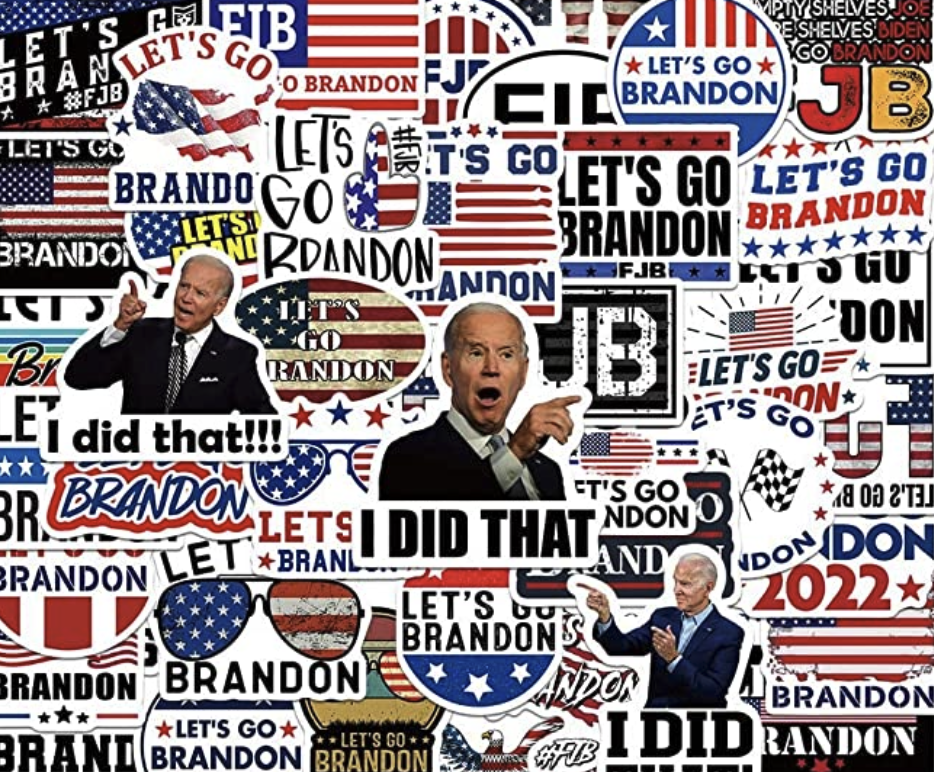
Which is a more 'Christian' chant: 'Let's go Brandon!' or 'Pray for Biden!'

Which is a more 'Christian' chant: 'Let's go Brandon!' or 'Pray for Biden!'

In the beginning, there was an obscene chant at the Talladega Superspeedway that NBC producers urgently needed to ignore during a live broadcast.

Interviewing winner Brandon Brown, reporter Kelli Stavast pretended the NASCAR crowd was chanting, "Let's go Brandon!" -- not cursing President Joe Biden.

The rest is history, as the wink-wink slogan soaked into political jargon and mass media. What shocked the Rev. Seth Carter -- a young Southern Baptist pastor in Kentucky -- was when church people began baptizing "Let's go Brandon!" into common speech.

"To be clear, I am no supporter of our president's actions or policies. In no way do I feel support for him welling up inside of me," he wrote, in a Baptist Press commentary.

"However, I recognize that my feelings can never be the proper guide of the attitude I am to have toward him. As a Christian and a believer in the inspired, inerrant and infallible Word of God contained in the Bible, the truth of God's Word is what ought to guide my attitude toward President Biden (or any other leader for that matter)."

Christians could try chanting, "Pray for Biden," he said. They need to see Biden the way the apostles Peter and Paul viewed "the evil emperor of their day, Nero."

Carter noted this First Peter passage: "Submit yourselves for the Lord's sake to every human institution, whether to a king as the one in authority, or to governors as sent by him for the punishment of evildoers and the praise of those who do right." Writing to the Colossians, Paul said: "Walk in wisdom toward outsiders, making the best use of the time. Let your speech always be gracious, seasoned with salt."

In response, the conservative Capstone Report website published an editorial claiming that "Baptist Pravda, err, Press" had demanded "submission to regime's lies."

After the fall: Many religious believers in Afghanistan are in hiding, with good cause

After the fall: Many religious believers in Afghanistan are in hiding, with good cause

There's a logical reason that Taliban forces have not been accused of destroying any churches in Afghanistan.

"That's the dirty little secret. There were no churches before the Taliban returned to power," said Nina Shea, director of the Hudson Institute's Center for Religious Freedom and a human-rights activist for 30 years. "Christians were already underground because of the constant threats to their lives, so they didn't have any church buildings to blow up."

Everyone remembers the shocking videos when desperate Afghans chased a U.S. military plane on a Kabul runway, pleading to be among those evacuated. At least two people fell to their deaths after clinging to a plane during takeoff.

Ever since, there have been reports about the dangers faced by those left behind, especially Afghans with ties to the U.S. military, the fallen government or workers in secular or religious non-profit groups that remained behind to continue humanitarian work.

Christians, Hindus, Sikhs, Ahmadis, Shia Muslims and members of other religious minorities are also living in fear.

"They are all on the run. They are all in hiding," said Shea, reached by telephone. "People are being hunted down and beaten and are threatened with death if they don't betray members of their families who are considered apostates" by the Taliban.

It's impossible not to discuss religious freedom during this crisis, she added. "Everything the Taliban does is about religion. Religion is involved when they hang people for violating their approach to Islamic law or when they attack women and girls who want to go to school. For the Taliban, this is all connected."

'Climate change' in pews: Can Anglicans adapt, after decades of declining numbers?

'Climate change' in pews: Can Anglicans adapt, after decades of declining numbers?

Journalist Michael Kinsley famously added a twist to American politics when he redefined a "gaffe" as when "a politician tells the truth -- some obvious truth he isn't supposed to say."

As the Rev. Neil Elliot of the Anglican Church of Canada discovered, this term also applies to religious leaders.

After seeing 2018 General Synod reports, the denomination's research and statistics expert produced an analysis that included this: "Projections from our data indicate that there will be no members, attenders or givers in the Anglican Church of Canada by approximately 2040."

Reactions to his candor varied, to say the least.

"I think of it very much like … people's responses to climate change," said Elliot, updating his earlier remarks in a video posted by Global News in Canada.

Signs of church "climate" change? In the early 1960s, Anglican parishes in Canada had nearly 1.4 million members. But that 2018 report found 357,123 members, with an average Sunday attendance of 97,421. The church had 1,997 new members that year, while holding 9,074 burials or funerals.

Canada's national statistics agency reported that 10.4% of all Canadians were Anglicans in 1996, but that number fell to 3.8% in 2019.

People have one of three reactions when faced with these kinds of numbers. The first "is denial. People are saying, 'We're, we're … It's not happening,' " said Elliot, while counting the options on one hand. "Then there's people who say, 'We can stop it.' And then there's people who say, 'We can adapt.'

"The adapt language is much more rare and I'm only starting to hear it on the media in the last few months. … That's what I'm trying to get us to do within the Anglican church. It's, 'How do we adapt to it?' not, 'How do we stop it?' or … people burying their heads in the sand."

The decline is real and cannot be denied, said Elliot.

Jokes and big questions: The Babylon Bee meets with Elon Musk and learns a few things

Jokes and big questions: The Babylon Bee meets with Elon Musk and learns a few things

At the end of each podcast, Babylon Bee leaders ask guests the same 10 questions, including this stumper: "Calvinist or Arminian?"

That caught Elon Musk by surprise, and he needed clarification on the difference between Arminian believers and persons from Armenia. After some background on Protestant history, he said: "My mind would say 'determinism' and my heart says, 'free will.' "

Why was the mastermind behind Tesla and SpaceX -- a man worth $278 billion at the end of 2021-- talking to a Christian satire website? The answer: Musk has 69.7 million Twitter followers, and he frequently responds, even if it's a U.S. senator questioning his taxes.

"You know, he engages with our content from time to time," Bee CEO Seth Dillon told Fox News. After email exchanges about a meeting, Musk said: "Fly to me and we'll do it."

The result was 100-plus minutes of conversation in Austin, Texas, ranging from satire to science, from politics to pop culture. Topics included why entrepreneurs are fleeing California, sustainable energy, superheroes (Musk would choose to be "Irony Man"), the physics of reusable rockets, cyborgs, how "wokeness" threatens humor, CNN morality and the future of a planet near an expanding sun.

Musk discussed his journey from South Africa to America, including his days as a manual laborer while struggling to pay student loans. Then he dove into computer coding and online commerce, making millions of dollars that led to Tesla. The rest is history.

On celebrity websites, Musk is often described as an atheist or agnostic. Asked if he prays, Musk once replied: "I didn't even pray when I almost died of malaria." But after the success of the first manned Falcon rocket mission, Musk said, in his public remarks: "You know, I'm not very religious but I prayed for this one."

Farewell to the Prayer to St. Michael the Archangel: Yes, the Latin Mass wars are escalating

Farewell to the Prayer to St. Michael the Archangel: Yes, the Latin Mass wars are escalating

Since the late 19th Century, Catholics have recited the Prayer to St. Michael when facing disease, disaster and despair.

It proclaims, in part: "St. Michael the Archangel, defend us in battle. … O Prince of the heavenly hosts, by the power of God, thrust into hell Satan, and all the evil spirits, who prowl about the world seeking the ruin of souls."

Before Vatican II, this prayer was often recited after Mass, although it wasn't in the rubrics. In 1994, St. Pope John Paul II urged Catholics to embrace it -- while preaching on threats to the unborn.

The faithful at St. Joseph's Parish in Libertyville, Ill., stopped reciting the Prayer to St. Michael aloud after Masses this past summer. While debate continues about what the Archdiocese of Chicago instructed, livestreamed remarks by the associate pastor went viral, during a worship wars surge in modern Catholicism.

"What I'm going to say, I'm going to say this with a lot of respect. Following the directive of Cardinal Cupich, we want to remind everyone that the Prayer of St. Michael is not to be said publicly following Mass," said Father Emanuel Torres-Fuentes. "As a priest, I have to obey, and I obey this at peace."

While Cardinal Blase Cupich's actions have made news, this drama opened in July with a Pope Francis apostolic letter entitled "Traditionis Custodes (Guardians of the tradition)." It restricted use of the old Latin Mass, thus undercutting "Summorum Pontificum (Of the Supreme Pontiffs)" by the retired Pope Benedict XVI. That document said the post-Vatican II Novus Ordo was the "ordinary form" for the Mass, but the Tridentine rite was an "extraordinary form" that could be encouraged.

The Pope Francis letter appeared to give local bishops some freedom to control use of the old Latin Mass. Then the Vatican's Congregation for Divine Worship released guidelines on Dec. 18, explaining the pope's edict.

Many bishops, for example, had granted dispensations allowing some diocesan parishes to use the Latin Mass. But Rome's new guidelines said this was not permitted -- only the Vatican could grant exceptions. Also, any parish allowed to celebrate the Tridentine Mass could not list this service in printed or online Mass schedules.

What's a 'Christmas movie'? Many struggle with more serious questions about Christmas

What's a 'Christmas movie'? Many struggle with more serious questions about Christmas

This question rocks the Internet year after year: Is "Die Hard" a "Christmas movie"?

How about "Frosty the Snowman," "Home Alone," "Elf" or "A Bad Moms Christmas"? Is "A Christmas Story" really a "Christmas" story? What about those Hallmark Channel visions of romance, complicated families and wall-to-wall holiday decorations?

The answer to these questions, and many others, hinges on how Americans answer another question: What is "Christmas"?

Ask that question to an iPhone and Siri will quote Wikipedia: "Christmas is an annual festival commemorating the birth of Jesus Christ, observed primarily on December 25 as a religious and cultural celebration among billions of people around the world."

Most people know that much of the story, according to a new survey by Lifeway Research in Nashville. Nearly 75% of Americans say Jesus was born more than 2,000 years ago in Bethlehem and even more believe that Jesus is the Son of God the Father.

After that, things get fuzzy.

"Lots of people celebrate Christmas, but some have no interest in celebrating the birth of Jesus Christ," said Scott McConnell, executive director of Lifeway. "But even some of the people who do take the Christmas message seriously don't understand what it means. …

"This is a story that hasn't changed for 2,000 years, yet many people struggle to tell the story and get the details right. Many don't know why Jesus was born."

Nine of out 10 adult Americans celebrate Christmas, including many non-Christians, according to this September survey of 1,005 Americans, with participants selected to balance gender, age, region, ethnicity, education and religion. This finding matches earlier research.

While Catholics (99%) and Protestants (97%) are the most likely to celebrate Christmas, 82% of religiously unaffiliated Americans also take part, along with 74% of believers in other religious faiths.

Lessons learned about Christmas past -- by watching classic movies of 1940s

Lessons learned about Christmas past -- by watching classic movies of 1940s

It's a black-and-white movie Christmas, with snow falling as joyful families mingle on city sidewalks while window-shopping -- buying food, presents, decorations and fresh-cut trees for festivities that are only two days away.

For Americans, this scene represents the ghost of Christmas past, long before suburban malls, big-box scrums and Amazon.com. And as "The Bishop's Wife" opens, an angel -- a graceful Cary Grant -- enters this 1947 tableau, smiling at carolers and children and helping the needy and lost.

"Christmas is always in danger in Christmas movies -- we'd have no reason to make such movies otherwise," wrote critic Titus Techera, executive director of the American Cinema Foundation. In this classic movie, "we have a remarkable concentration of problems in one household: A man's faith, his family, community and church … are all tied together."

It isn't unusual to find miracles, tight-knit communities, glowing churches and parables about human choices, temptation, sin and redemption in old Christmas films, said Techera, contacted by Zoom while visiting Bucharest.

That's why Techera -- a native of Romania, before his work brought him to America -- has written four online essays about the lessons learned from watching '40s movies that were remade in the '90s. The other films in this Acton Institute series are "The Shop Around the Corner," "Miracle on 34th Street" and "Christmas in Connecticut."

There's a reason many modern Americans keep watching these movies, he said. Some yearn for a time before most Americans became so isolated, separated by jobs far from extended families, sprawling suburban neighborhoods and all the paradoxes built into digital networks that were supposed to keep people connected.

"What we see in these movies is a time when Christmas was a far less commercial celebration and there was quite a bit of continuity with traditions from the past. … For many, the church was part of that," he said. "Christmas was a family thing. It was a community thing. … Commerce was more subservient to ordinary life. Commerce had not taken over all of life, including Christmas."

This is good for Judaism? Tis the season for lots and lots of Hanukkah junk

This is good for Judaism? Tis the season for lots and lots of Hanukkah junk

It's hard to do justice to ancient holy days in throw-pillow slogans.

Consider the Zazzle item offering a menorah with an un-orthodox number of candles, along with: "Imagine if your cellphone was at 10% but lasted 8 days. Now you understand Hanukkah."

Maybe not. Or how about the Bed, Bath & Beyond pillow stating: "Why is this night different from all other nights? Happy Hanukkah."

Actually, that's the most famous question from rites during a Passover Seder dinner.

"There's no quality control with any of this stuff. No one's being careful with decisions about what's good and what's bad," said journalist Mira Fox of the Forward, a progressive Jewish website. "The point is to sell stuff. It doesn't need to be good stuff. It's just stuff.

"Basically, it's a lot of people saying, 'We can find a way to sell stuff to Jews during the holidays, along with selling lots of stuff to everybody else.' "

Hanukkah began rather early this year, starting at sundown this past Sunday (November 28) and extending for eight days. This placed the "Festival of Lights" closer to Thanksgiving -- near the start of the merchandizing frenzy known as The Holidays.

The story at the heart of this home-centered season dates to 165 B.C., when Jews, led by the Maccabee family, defeated Greek and Syrian oppressors. When the victors reentered their temple, only one container of ritually pure oil could be found for its eternal flame. Tradition says this one-day supply burned for eight days. Thus, Jews light menorah candles during Hanukkah, one on the first night, increasing to eight.

"It's not a biblical holiday. Hanukkah is not in the Hebrew Bible. … God is not a huge part of this story," said Fox. "Honestly, I don't think a lot of people understand what this holiday is about."

That's certainly true in the American marketplace.

Queen preaches to England's bishops, with a call for mere Christianity in troubled age

Queen preaches to England's bishops, with a call for mere Christianity in troubled age

Close watchers of the British Monarchy have recently become concerned about two words describing life in Windsor Castle -- "new stage."

First there was Queen Elizabeth II's unexplained overnight hospital stay in October for "tests." Then the 95-year-old monarch missed the recent National Day of Remembrance service for Britain's war dead. She did, however, attend christening rites at All Saints Chapel for her two newest great-grandsons.

All of this represents a "new stage" in her very public life.

"She's alright, thank you very much," said Prince Charles, responding to a Sky News enquiry. "Once you get to 95, it's not quite as easy as it used to be."

The Queen has not, however, been silent. Her recent message to Church of England's General Synod -- her first absence from this gathering -- was strong and personal. It was read by her youngest son, Prince Edward, the Earl of Wessex, who rarely seeks the public spotlight.

"It is hard to believe that it is over 50 years since Prince Philip and I attended the very first meeting of the General Synod," said the prince, reading the Queen's words. "None of us can slow the passage of time; and while we often focus on all that has changed in the intervening years, much remains unchanged, including the Gospel of Christ and his teachings.

"The list of tasks facing that first General Synod may sound familiar to many of you -- Christian education, Christian unity, the better distribution of the ordained ministry. … But one stands out supreme: 'To bring the people of this country to the knowledge and the love of God.' "

It's significant that Queen Elizabeth was most concerned with matters of doctrine and spiritual life -- not the church's role in politics and various cultural disputes, noted theologian Adrian Hilton, a former adviser to the Secretary of State for Education.