books

The challenging task of passing on a Bible story that's bigger than witty vegetables

The challenging task of passing on a Bible story that's bigger than witty vegetables

It's easy to capture a kid's attention with cartoons about Noah and the Ark, Joshua's laps around the walls of Jericho and other colorful stories from scripture.

Phil Vischer ought to know, since for millions of Americans under the age of 25 he is best known as Bob the Tomato and the brain behind the original VeggieTales videos. But over time, he realized that he faced a bigger challenge as a storyteller, one symbolized by the sign on his 1990s office wall that proclaimed: "We will not portray Jesus as a vegetable."

At some point, he said, children need to learn the whole story of faith -- including the hard parts. This has to happen quickly in a culture that barrages them with competing signals as soon as they leave their cribs.

"You have to have the big story of what our faith is all about," said Vischer, in a telephone interview. "Our moral beliefs are like ornaments we hang on a tree. The problem is that we've thrown out the tree and we expect the ornaments to keep hanging in the air on their own.

"You can't just tell kids, 'Behave! Because I told you so!' … Without a big spiritual narrative, some larger worldview, you have nothing to hang moral behavior on."

That was the challenge at the heart of Vischer's talk -- "Beyond VeggieTales: Forming the Moral Imagination of Your Kids" -- during a recent Nashville conference on parenting held by the Southern Baptist Convention's Ethics and Religious Liberty Commission. Speaker after speaker mentioned a media culture that feeds children clashing concepts of good and evil, success and failure, before they enter kindergarten. Digital screens are everywhere, packed with compelling stories.

Country music and the emotional ties that bind Saturday night and Sunday morning

Country music and the emotional ties that bind Saturday night and Sunday morning

Anyone looking for the late Johnny Cash will find him in the Country Music Hall of Fame, the Rock and Roll Hall of Fame, the Gospel Music Hall of Fame, the Folk Music Hall of Fame and many other American music honor rolls.

 But when asked to describe his musical values, Cash preached country gospel: "I love songs about horses, railroads, land, judgment day, family, hard times, whiskey, courtship, marriage, adultery, separation, murder, war, prison, rambling, damnation, home, salvation, death, pride, humor, piety, rebellion, patriotism, larceny, determination, tragedy, rowdiness, heartbreak and love. And mother. And God."

That's the kind of raw, tear-jerking storytelling that country fans embrace, according to author Malcolm Gladwell, in a recent Revisionist History podcast called "The King of Tears." That emotional worldview may be one reason people in different regions and social classes have trouble understanding each other.

"I'm talking about the bright line that divides American society -- not the color line, or the ideological lines. I'm talking about the sad song line," said Gladwell, best known for his work in The New Yorker and bestsellers like "The Tipping Point."

Contrast the worldviews of rock and country, he said. Anyone who studies Rolling Stone Magazine's top 50 rock songs will mainly hear "songs about wanting to have sex, songs about having sex, songs about getting high, presumably after having sex. ... In all of those 50 songs, nobody dies after a long illness, no marriage disintegrates, nobody's killed on a battlefield, no mother grieves for a son."

In terms of raw country emotions, said Gladwell, it's hard to top the epic memorial service after the death of superstar George Jones in 2013. At one point, Vince Gill sobbed his way through the heart of his classic "Go Rest High on that Mountain," with Patty Loveless singing a harmony line alone. That song was inspired by the death of Gill's brother, as well as the death of country star Keith Whitley.

Pastors must help suffering people wrestle with broken bodies, minds and spirits

Pastors must help suffering people wrestle with broken bodies, minds and spirits

There was good news and bad news in LifeWay research that probed whether Protestant churches in America were ready to minister to people suffering from mental illness.

Good news? Only 21 percent of people who attended worship services once a week disagreed with this statement: "If I had a mental health issue, I believe most churches would welcome me." Alas, 55 percent of those who never went to church disagreed.

More bad news? Nearly half of self-identified born-again and evangelical Protestants said prayer and Bible study alone could defeat schizophrenia, depression, bipolar disorder and other serious mental illnesses.

To suffering people that sounds like, "Take two Bible passages and call me in the morning," according to the Rev. Todd Peperkorn, author of "I Trust When Dark My Road: A Lutheran View of Depression."

Many pastors and counselors still think mental illnesses are spiritual problems caused by "sinful choices" alone, instead of complex puzzles of brokenness in body, mind and spirit, he said, at a Lutheran Public Radio conference earlier this summer in Collinsville, Ill. 

Thus, they believe mental illness is the "result of a lack of obedience. And so, if you could only manage to obey God a little more, a little better, then any mental illness that you had would magically go away." This leads to a blunt prescription: "Sin less! Got that? All of your problems are going to go away if you would just stop sinning. So get on with that. … You kind of turn Christianity into Weight Watchers."

Peperkorn stressed that he has seen this hellish struggle from both sides -- as a pastor and as a patient with clinical depression. Just over a decade ago, he said, he found himself working his way through Holy Week to Easter, while also pondering the end of all things -- as in suicide.

Rabbi Lord Sacks: Religious believers face harrowing choices in these tense times

Rabbi Lord Sacks: Religious believers face harrowing choices in these tense times

As long as there have been chase scenes -- think Keystone Kops or Indiana Jones -- movie heroes have been caught straddling danger while trying to get from one vehicle to another.

Inevitably, the road splits and the hero has to make a decision.

Religious believers now face a similar challenge after decades of bitter conflict in the postmodern world, said Rabbi Lord Jonathan Sacks, in a recent lecture at the Chautauqua Institution in southwestern New York State.

For a long time, "we were able to have our feet in society and our head in religion, or the other way around. … But today the two cars are diverging and they can't be held together any longer," said Sacks, who was knighted by Queen Elizabeth in 2005 and made a life peer in the House of Lords.

It's an agonizing dilemma that reminded the rabbi of a classic Woody Allen quote: "More than any other time in history, mankind faces a crossroads. One path leads to despair and utter hopelessness; the other to total extinction. Let us pray we have the wisdom to choose correctly."

Truth is, there's no way to escape the Internet, which Sacks called the greatest economic, political and social revolution since the invention of the printing press.

"I sum it up in a single phrase -- cultural climate change," said Sacks, who from 1991-2013 led the United Hebrew Congregations of the Commonwealth. "It's not so much a matter of more religion or less religion, because the truth is that both are happening at once. … The result is a series of storms in the West and even more elsewhere in the Middle East, in Asia and Africa."

For four centuries, European and American elites wrongly assumed the world would get more and more secular.

Wrestling with the complex Gospel according to Bob Dylan, once again

Wrestling with the complex Gospel according to Bob Dylan, once again

When Bob Dylan tells the story of Bob Dylan, he often starts at a concert by rock 'n' roll pioneer Buddy Holly in the winter of 1959.

At least, that's where he started in his recent Nobel Prize for Literature lecture.

Something mysterious about Holly "filled me with conviction," said Dylan. "He looked me right straight dead in the eye and he transmitted something. Something, I didn't know what. And it gave me the chills."

Days later, Holly died in a plane crash. Right after that, someone gave Dylan a recording of "Cotton Fields" by folk legend Leadbelly. It was "like I'd been walking in darkness and all of the sudden the darkness was illuminated. It was like somebody laid hands on me," said Dylan.

That story probably sounded "rather strange to lots of people," said Scott Marshall, author of the new book "Bob Dylan: A Spiritual Life."

"What happens when somebody lays hands on you? If people don't know the Bible, then who knows what they'll think that means? … Dylan is saying he felt called to some new work, like he was being ordained. That's just the way Dylan talks. That's who he is."

For millions of true believers, Dylan was a prophetic voice of the 1960s and all that followed. Then his intense embrace of Christianity in the late 1970s infuriated many fans and critics. Ever since, Dylan has been surrounded by arguments -- often heated -- about the state of his soul.

The facts reveal that Dylan had God on his mind long before his gospel-rock trilogy, "Slow Train Coming," "Saved" and "Shot of Love."

One civil rights activist, the Rev. Bert Cartwright, catalogued all the religious references in Dylan's 1961-78 works, before the "born-again" years. In all, 89 out of 246 Dylan songs or liner notes -- 36 percent -- contained Bible references. Cartwright found 190 Hebrew Bible allusions and 197 to Christian scriptures.

Old-school journalism values ended up leading Lee Strobel to God

Old-school journalism values ended up leading Lee Strobel to God

Reporter Lee Strobel was investigating the story of his life and he knew it.

As legal-affairs editor at The Chicago Tribune, he had covered plenty of hot-button issues -- like abortion rights -- that required him to wrestle with the views of people on the "other side." Strobel knew what he believed, as an atheist committed to abortion rights and other liberal causes. But he knew -- as a journalist -- that he had a job to do.

"I grew up in the era of old-school journalism, when you really had to try be balanced and fair and accurate. You had to listen to what other people had to say," he said. "Besides, I knew that if I turned in a story with holes in it my editor would come down on me. He'd bounce that thing right back."

But this story was different. The person on the other side of this Strobel investigation was his formerly agnostic wife, Leslie, whose 1979 conversion to Christianity rocked the foundations of their marriage. Suddenly, their home contained a new set of expectations when it came to anger, alcohol, ego and workaholism.

"I was mad and I wanted my wife back," Strobel said. "I decided that the Resurrection was the key to this whole thing and I set out to prove it was all nonsense."

The result was 19 months of research and interviews with experts on both sides of centuries of arguments about the claims of Christianity. As a graduate of the famous University of Missouri journalism program, followed by a Yale Law School degree, Strobel worked through a library of classic texts by atheist and Christian scholars.

The result was Strobel's own conversion, a career shift into ministry and, in 1998, the first of his many books, "The Case For Christ." This year, that book evolved into a movie built on a screenplay by Hollywood veteran Brian Bird -- a former reporter. The indie film made a modest $15 million at the box office. Here is the surprise: It drew an A-plus rating from CinemaScore and 79 percent of Rotten Tomatoes ratings by critics were positive.

The key to many reviews was that journalism remained front and center in the story, creating what Variety film critic Joe Leydon called a cross between an a basic "investigative-journalism drama" and a "theological detective story."

Some serious shopping tips for Catholic parents (and others) seeking traditional schools

Some serious shopping tips for Catholic parents (and others) seeking traditional schools

Buried inside the websites of colleges and universities are the calendars covering the nitty-gritty details of academic and student life.

That's a great place for research by parents considering places for their children to spend some of the most formative years of their lives, according to a Catholic scholar involved in fierce debates about postmodern trends in education.

Anthony Esolen thinks parents should pay special attention to student-life offerings on Friday and Saturday nights.

"You aren't just looking to see what kinds of things they're doing, you're looking for what is missing," said Esolen, best known for his translation of Dante's "The Divine Comedy." He has also written "The Politically Incorrect Guide to Western Civilization," "Ten Ways to Destroy the Imagination of Your Child" and other books on hot-button subjects.

For example, Esolen once noticed that calendars at Benedictine College in Atchison, Kan., contained lots of dancing -- swing dancing, to be precise. That sounded fun, but it didn't sound like business as usual in this day and age.

"What you're trying to find out," he explained, "is whether campus leaders are making serious attempts to build some wholesome community life. You're looking for chances for young men and women to get together in settings that tend to reinforce what a Catholic college is all about. … Otherwise, the weekend is just the weekend and we know what that means."

This topic may not sound controversial, said Esolen, but it is because of cultural issues looming in the background -- the defense of ancient doctrines on sexuality, gender and marriage. What happens in classrooms is important, but so are the expectations campus leaders establish for campus life, especially in their dormitories.

"Like it or not, parents have to learn whether a school is or is not on board with the whole Sexual Revolution," he said. If a school "has capitulated on that front" then traditional Catholic parents, or serious religious believers in other flocks, "have to run away and not look back. You can't compromise on that, right now."

The irony is that these kinds of doctrinal issues are critically important to both liberal and conservative Catholics. The bottom line: They are seeking different answers to the same questions.

Can clergy help modern parents struggle with technology issues in their homes?

Can clergy help modern parents struggle with technology issues in their homes?

The evidence keeps growing that families need help controlling technology in their homes, but this is a subject most megachurch pastors would have trouble addressing with a straight face.

"Talking about this subject in many of our churches would be … controversial for reasons that are rather ironic," said author Andy Crouch, senior communication strategist for the John Templeton Foundation in Philadelphia. "Pastors would be preaching in churches dominated by giant video screens and lots of them now ask their people to tweet sermon feedback right there in the service. The technology is everywhere."

It's hard to talk about controlling today's digital-screens culture without being accused of advocating a semi-Amish retreat. But at some point, he said, parents who care about faith, morality and character will have to develop some strategies. For starters, their children will need to hear, over and over: "Our family is different."

Clergy could help parents face this task. But that would require them to address hot-button issues ranging from online porn to whether parents should give children smartphones. It would also require saying, "Our church is different."

Crouch doesn't have easy answers for any of these questions. His new book, "The Tech-Wise Family," includes "Crouch Family Reality Check" pages detailing the struggles behind the principles he recommends. While his family uses candles at its screens-free dinners, Crouch admits that his home's number of Apple devices is in double digits.

Obviously, it's hard to observe any kind of "digital Sabbath" in which all these screens go dark for an hour, a day or even a week, said Crouch. Nevertheless, trying to control this digital lifestyle is a subject religious leaders should discuss with their flocks.

"If we don't have some rhythm with these things -- in terms of when we use them and when we don't -- then they're using us, instead of us using them," he said. But it's crucial to remember that, "we're not saying all this technology is bad. It's good, when used as part of a Christian family culture. That's what takes planning and commitment.

Saith Peggy Noonan: Pick up the Book and change your world

Saith Peggy Noonan: Pick up the Book and change your world

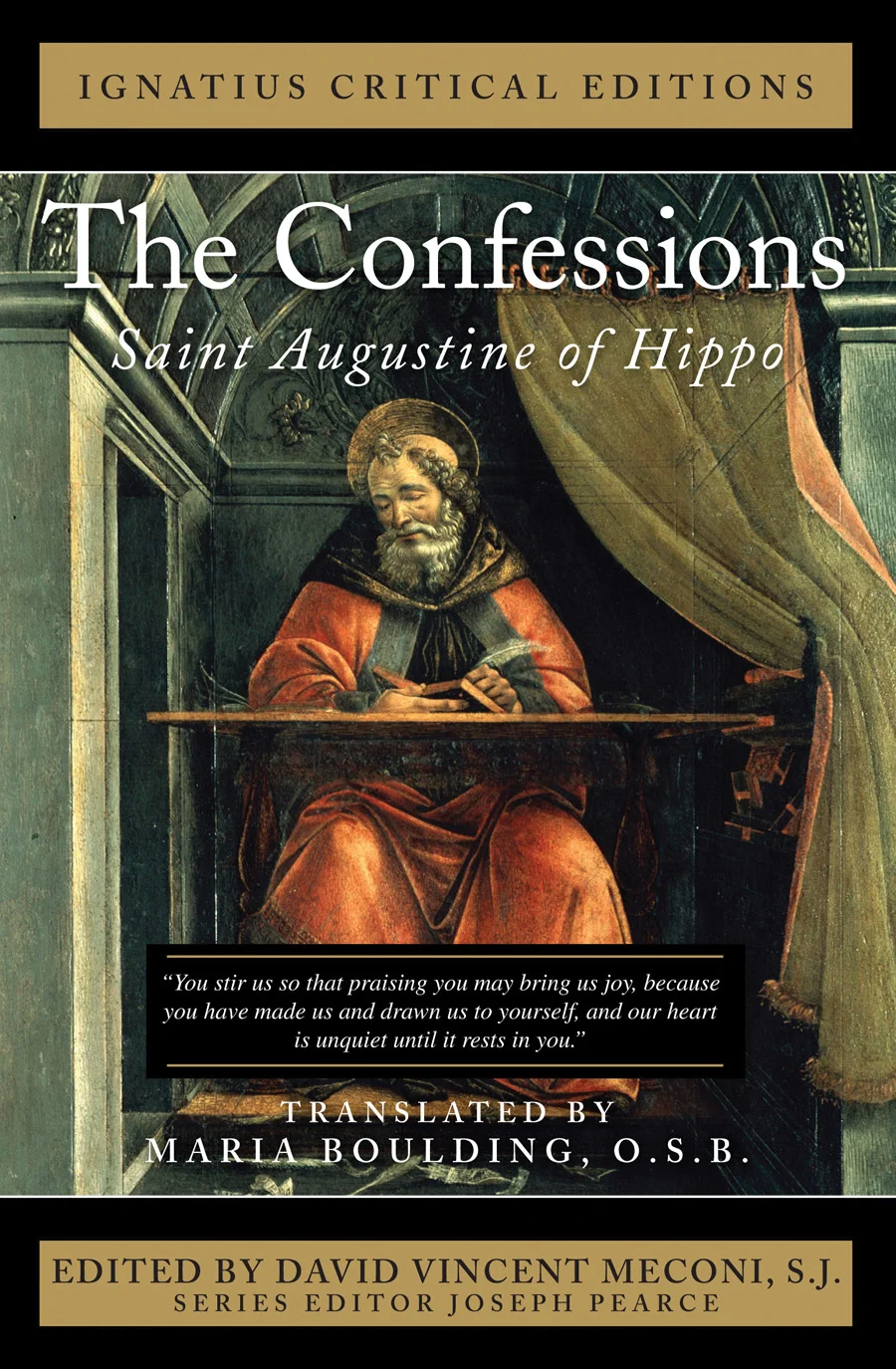
Any history of Catholic thought, and the rise of Western culture, has to mention the turning point in the conversion story of Aurelius Augustinus.

During a time of inner torment, the young man from North Africa withdrew into a garden. As Pope Benedict XVI told the story in 2008, he "suddenly heard a child's voice chanting a rhyme never heard before: tolle, lege, tolle, lege -- pick up and read, pick up and read. He … returned to the Pauline codex that he had recently read, opened it, and his glance fell on the passage of the Epistle to the Romans where the Apostle exhorts to abandon the works of the flesh and to be clothed with Christ."

The man who became St. Augustine picked up that book and, thus, he "changed himself and changed our world," said journalist Peggy Noonan, in her May 13 commencement address at the Catholic University of America.

That was the punch line in her urgent appeal for the graduates to grasp that there is much more to life than the fleeting contents of the glowing, omnipresent screens that dominate their days and nights.

Instead, the winner of the 2017 Pulitzer Prize for commentary urged them to "embark on a lifelong relationship with a faithful companion who will always help you and sometimes delight you -- who will never desert you, who will make you smarter, and wiser, who will always be by your side and enlighten you all the days of your life.

"I am talking about -- books. You must not stop reading books. That's all. If you seek a happy and interesting life, one of depth, meaning and accomplishment, you must read books."

Noonan said she certainly couldn't tell her own story without referencing one book after another, from biographies she read as a child to "Saints for Sinners: Nine Desolate Souls Made Strong by God," which as an adult "helped me understand that I was a Catholic and believed it all." Her love of history, which helped shaped her speechwriting for presidents Ronald Reagan and George H.W. Bush, came from shelves of books.

The closest Noonan came to talking politics -- she made only two passing references to the current president -- was to note the degree to which the story of 2016 was told by journalists raised in cyberspace.