
LGBTQ

Say what? Cardinal with strong Pope Francis ties says Catholic LGBTQ stance is wrong

Say what? Cardinal with strong Pope Francis ties says Catholic LGBTQ stance is wrong

It isn't every day that a prince of the Roman Catholic Church, and a strategic Jesuit ally of the pope, openly rejects centuries of Christian teachings that clash with core doctrines of the Sexual Revolution.

"The Church's positions on homosexual relationships as sinful are wrong," said Cardinal Jean-Claude Hollerich of Luxembourg, in a recent interview with KDA, a German Catholic news agency. "I believe that the sociological and scientific foundation of this doctrine is no longer correct. It is time for a fundamental revision of Church teaching, and the way in which Pope Francis has spoken of homosexuality could lead to a change in doctrine. …

"In our archdiocese, in Luxembourg, no one is fired for being homosexual, or divorced and remarried. I can't toss them out, they would become unemployed, and how can such a thing be Christian? As for homosexual priests, there are many of these, and it would be good if they could talk about this with their bishop without his condemning them."

The latest unorthodox proclamations by Cardinal Hollerich commanded attention because he leads the Commission of the Bishops' Conferences of the European Union, as well as being the pope's choice as "relator general" for the October 2023 global Synod of Bishops, helping shape its work to weigh the church's future.

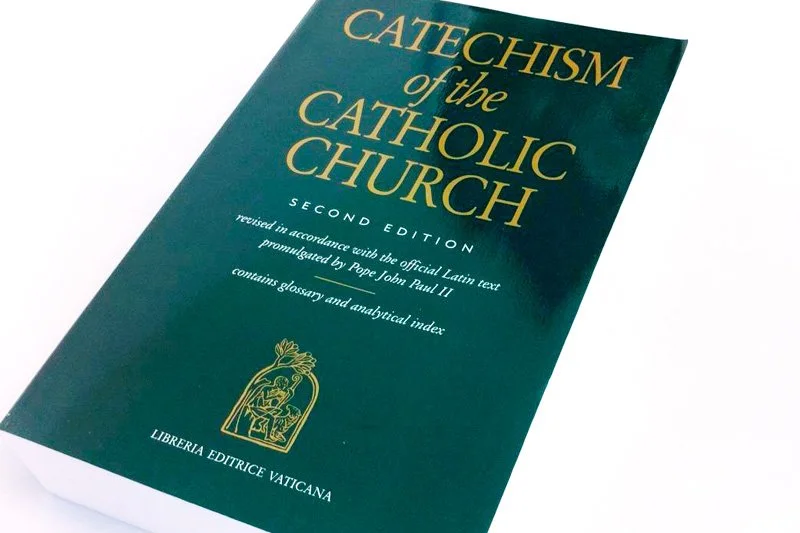
"This Cardinal seems to be claiming a private revelation which is contrary to scripture & the Catechism of the Catholic Church," tweeted Bishop Joseph Strickland, an outspoken conservative who is Bishop of Tyler, Texas. "Any private revelation that contradicts public revelation must be condemned."

However, the recent "Synodal Way" meetings of German Catholic leaders voted to approve draft texts that affirmed some of Cardinal Hollerich's beliefs, including overwhelming approval for a document entitled "Blessing celebrations for couples who love each other." Support was just as strong for a "Magisterial reassessment of homosexuality" text stating that official church teachings on chastity and homosexuality "should be revised."

The Catechism states that persons experiencing same-sex attraction "must be accepted with respect, compassion, and sensitivity. Every sign of unjust discrimination in their regard should be avoided." However, citing scripture and church tradition, it also teaches that "homosexual acts are intrinsically disordered" and thus "contrary to the natural law. …Under no circumstances can they be approved."

The crucial question: Was Cardinal Hollerich attempting to steer Pope Francis toward change or airing views he already knew had support inside the Vatican?

'Climate change' in pews: Can Anglicans adapt, after decades of declining numbers?

'Climate change' in pews: Can Anglicans adapt, after decades of declining numbers?

Journalist Michael Kinsley famously added a twist to American politics when he redefined a "gaffe" as when "a politician tells the truth -- some obvious truth he isn't supposed to say."

As the Rev. Neil Elliot of the Anglican Church of Canada discovered, this term also applies to religious leaders.

After seeing 2018 General Synod reports, the denomination's research and statistics expert produced an analysis that included this: "Projections from our data indicate that there will be no members, attenders or givers in the Anglican Church of Canada by approximately 2040."

Reactions to his candor varied, to say the least.

"I think of it very much like … people's responses to climate change," said Elliot, updating his earlier remarks in a video posted by Global News in Canada.

Signs of church "climate" change? In the early 1960s, Anglican parishes in Canada had nearly 1.4 million members. But that 2018 report found 357,123 members, with an average Sunday attendance of 97,421. The church had 1,997 new members that year, while holding 9,074 burials or funerals.

Canada's national statistics agency reported that 10.4% of all Canadians were Anglicans in 1996, but that number fell to 3.8% in 2019.

People have one of three reactions when faced with these kinds of numbers. The first "is denial. People are saying, 'We're, we're … It's not happening,' " said Elliot, while counting the options on one hand. "Then there's people who say, 'We can stop it.' And then there's people who say, 'We can adapt.'

"The adapt language is much more rare and I'm only starting to hear it on the media in the last few months. … That's what I'm trying to get us to do within the Anglican church. It's, 'How do we adapt to it?' not, 'How do we stop it?' or … people burying their heads in the sand."

The decline is real and cannot be denied, said Elliot.

Pope Francis, President Biden and the U.S. Catholic bishops: Who said what to whom?

Pope Francis, President Biden and the U.S. Catholic bishops: Who said what to whom?

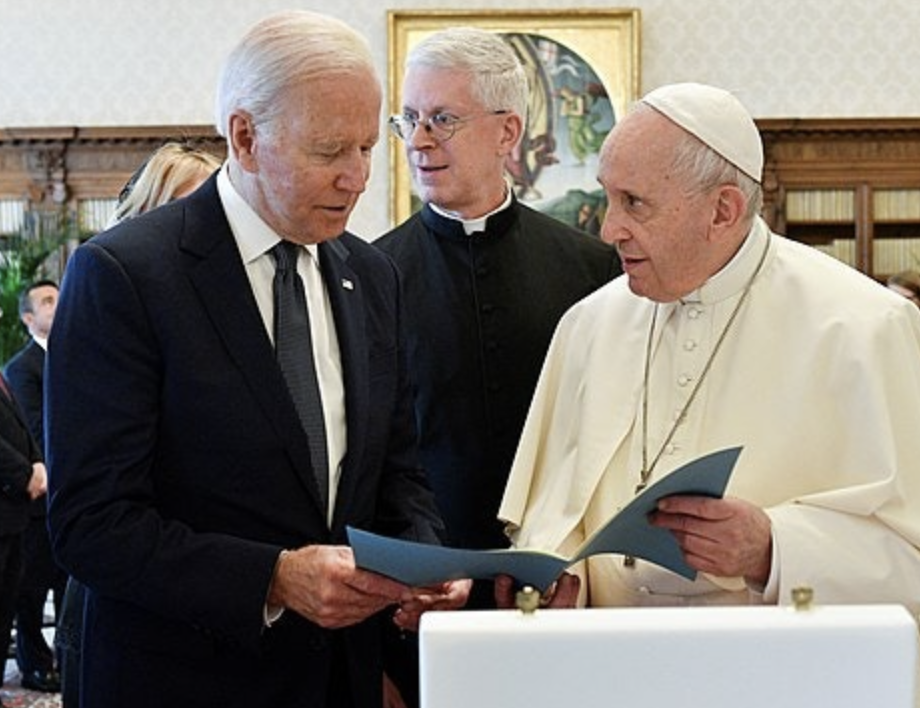
Asked if he discussed abortion with Pope Francis during their recent Vatican summit, President Joe Biden said: "No, it didn't. It came up -- we just talked about the fact he was happy that I was a good Catholic, and I should keep receiving Communion."

The next day, the Associated Press noted that Biden received Holy Communion at St. Patrick's Church in Rome.

Asked to validate the president's second-hand quotation, Vatican spokesman Matteo Bruni told reporters: "I would consider it a private conversation."

What do U.S. bishops think? That has remained a hot topic as the United States Conference of Catholic Bishops braces for its fall 2021 meetings next week (Nov. 15-18) in Baltimore -- its first in-person assembly since the start of the coronavirus pandemic.

What is labeled as "draft 24" of a proposed USCCB statement on "Eucharistic coherence" flashes back to an earlier controversy about Catholic politicians, Holy Communion and an atmosphere of "scandal" among the faithful.

"We repeat what the U.S. bishops stated in 2006: 'If a Catholic in his or her personal or professional life were knowingly and obstinately to reject the defined doctrines of the Church, or knowingly and obstinately to repudiate her definitive teaching on moral issues, he or she would seriously diminish his or her communion with the Church," said this draft from late September -- first obtained by The Pillar, a Catholic news website.

The quote continued: " 'Reception of Holy Communion in such a situation would not accord with the nature of the Eucharistic celebration, so that he or she should refrain.' "

As insiders have predicted, this draft of "The Mystery of the Eucharist in the Life of the Church" doesn't mention debates about the sacramental status of Catholic politicians who have consistently served as advocates for abortion rights, such as Biden or House Speaker Nancy Pelosi.

When facing cultural chaos, priests need ancient symbols and truths, not more political talk

When facing cultural chaos, priests need ancient symbols and truths, not more political talk

Chaos is coming, so get ready.

That was the warning that -- four years ago -- iconographer and YouTube maven Jonathan Pageau offered to leaders of the Orthodox Church in America's Diocese of the South.

The French-Canadian artist was reacting to cracks in "cultural cohesion" after Donald Trump's rise to power, with wild reactions on left and right. And corporate leaders, especially in Big Tech, were throwing their "woke" weight around in fights over gender, racism, schools, religious liberty and other topics. Fear and angst were bubbling up in media messages about zombies, fundamentalist handmaidens and angry demands for "safe spaces."

Pageau didn't predict a global pandemic that would lock church doors.

But that's what happened. Thus, he doubled down on his "chaos" message several weeks ago, while addressing the same body of OCA priests and parish leaders.

"If some of you didn't believe me back then, I imagine you are more willing to believe me now," he said.

Pageau focused, in part, on waves of online conspiracy theories that have shaken many flocks and the shepherds who lead them. Wild rumors and questions, he said, often reveal what people are thinking and feeling and, especially, whether they trust authority figures.

"Even the craziest conspiracy nuts, what they are saying is not arbitrary," he said, in Diocese of the South meetings in Miami, which I attended as a delegate from my parish in Oak Ridge, Tenn.

"It's like an alarm bell. It's like an alarm bell that you can hear, and you can understand that the person that's ringing the alarm maybe doesn't understand what is going on. ... They may think that they have an inside track based on what they've heard and think that they know what is going on. But the alarm is not a false alarm, necessarily."

The chaos is real, stressed Pageau. There is chaos in politics, science, schools, technology, economic systems, family structures and many issues linked to sex and gender. It's a time when conspiracy theories about vaccines containing tracking devices echo decades of science-fiction stories, while millions of people navigate daily life with smartphones in their pockets that allow Big Tech leaders to research their every move.

Why did a lion among Church of England evangelicals swim the Tiber to Rome?

Why did a lion among Church of England evangelicals swim the Tiber to Rome?

As always, rumors swirled around the favorites in the 2002 race to become the 104th Archbishop of Canterbury.

Efforts to derail Bishop Michael Nariz-Ali of Rochester were different, in part because he was born in Pakistan -- fluent in Urdu and Farsi -- and was poised to become the first non-white leader of the Church of England. Others noted that he attended Catholic schools as a boy and practiced that faith.

Progressives warned that Nazir-Ali was too conservative on issues dividing Anglicans. He opposed the ordination of noncelibate gays and lesbians, while defending ancient teachings on marriage. He was a fierce critic of Sharia law and "radical Islam," while defending persecuted Christians around the world Most of all, critics noted that he was a strong evangelical leader in the global Anglican Communion.

Nazir-Ali insisted that he was "evangelical and Catholic," even as he lost his shot at the Throne of Canterbury.

That's the same label that he used when he stunned the Anglican world by announcing that he was returning to Roman Catholicism. He is expected to be ordained as a Catholic priest this Sunday (Oct. 30), serving in the Ordinariate of Our Lady of Walsingham, a canonical structure established in 2011 by Pope Benedict XVI that allows Anglicans to enter Catholicism while retaining many Anglican rites and traditions. The 72-year-old Nazir-Ali is married and has two children.

This move was necessary "because I believe that the traditional Anglican desire to adhere to the fullness of apostolic, patristic and conciliar teaching can now best be maintained in this way," the former bishop announced.

Writing in The Daily Mail, he called the decision a "bittersweet moment."

The gospel according to post-theist Episcopal Bishop John Shelby Spong

The gospel according to post-theist Episcopal Bishop John Shelby Spong

Newark Bishop John Shelby Spong never stuck "Why Christianity Must Change or Die" on the doors of Canterbury Cathedral, since it was easier to post a talking-points version of his manifesto on the Internet.

"Theism, as a way of defining God is dead," he proclaimed, in 1998. "Since God can no longer be conceived in theistic terms, it becomes nonsensical to seek to understand Jesus as the incarnation of the theistic deity."

Lacking a personal God, he added, it was logical to add: "Prayer cannot be a request made to a theistic deity to act in human history in a particular way."

Spong's 12-point take on post-theism faith emerged after spending years on the road, giving hundreds of speeches and appearing on broadcasts such as "The Oprah Winfrey Show" and "Larry King Live." While leading the Episcopal Diocese of Newark, within shouting range of New York City, he did everything he could to become the news-media face of liberal Christianity.

By the time of his death at the age of 90, on Sept. 12 at his home in Richmond, Va., Spong had seen many of his once-heretical beliefs -- especially on sex and marriage -- normalized in most Episcopal pulpits and institutions. However, his doctrinal approach was too blunt for many in the mainline establishment, where a quieter "spiritual but not religious" approach has become the norm.

Spong called himself a "doubting believer" and said he had no problem reciting traditional rites and creeds because, in his own mind, he had already redefined the words and images to fit his own doctrines. He also knew when to be cautious, such as during Denver visit in the late 1980s -- an era in which the Diocese of Colorado remained a center for evangelical and charismatic Episcopalians.

After a lecture at the liberal St. Thomas Episcopal Church, I asked Spong if he believed the resurrection of Jesus was an "historic event that took place in real time."

"I don't think that I can say what the disciples believed they experienced. I'll have to think about that some more," he said, moving on to another question.

The bishop answered a decade later, in his memo calling for a new Reformation:

United Methodist divorce nears, while denomination's left wing Zooms to the left

United Methodist divorce nears, while denomination's left wing Zooms to the left

As one of the founders of the United Methodist Centrist Movement, the Rev. Doug Damron spend years hiding his rejection of his church's rule that the "practice of homosexuality is incompatible with Christian teaching."

Centrists used a "perfectly delicious" theological platform defined by words such as "unity," "peace" and "moderate," he said, during a recent guest sermon at the historic Broad Church United Methodist Church in Columbus, Ohio. After decades of fighting about sex, many hoped "traditionalists" and "progressives" could keep "United" attached to "Methodist."

The goal was "compromise," he said, a "sweet word" that hid a "status quo of oppression." But there was "an institution to protect" and many clergy feared being honest. Thus, they didn't openly attack the denomination's Book of Discipline.

"By nature, I am a rule follower," he said. "I knew that such defiance may have cost me my clergy credentials."

Now it's time for candor and courage, said Damron. When United Methodists finally split, conservatives will build a church defined "by who they will exclude today and who they will exclude tomorrow." The question is whether progressives will act on their convictions.

"It is time to speak into existence, following the Spirit's leading, a church which fully welcomes, includes, affirms not only God's beloved gay and lesbian ones, but a host of other folks who have found the door of the church closed," he said. This would include embracing and ordaining "trans folks, bi folks, kink folks, poly folk, gender-fluid folk and others."

The United Methodist clock kept ticking this summer, even as COVID-19 realities delayed -- again -- votes on the "Protocol of Reconciliation and Grace Through Separation" negotiated by activists on the left and right. The General Conference will not meet until August 2022, since the UMC establishment has declined to take actions in virtual forums.

Take that, Benedict XVI: Pope Francis decides Latin Mass is too divisive to embrace

Take that, Benedict XVI: Pope Francis decides Latin Mass is too divisive to embrace

The message to Catholic traditionalists in Southwest England was blunt, yet pointed.

Because of the new Traditionis Custodes ("Guardians of the tradition") document from Pope Francis, and the wishes of Bishop Declan Lang of the Diocese of Clifton, the upcoming "Latin Mass at Glastonbury will be the final Latin Mass here."

The message delivered to another circle of believers there was quite different. As a "Clifton Diocese Initiative," the "LGBT+ Mass" series at a Bristol church would continue because the bishop "wishes to express pastoral care and concern for our Catholic LGBT+ community."

Thus, the Catholic worship wars rage on.

This bolt of liturgical lightning from Pope Francis struck one of his predecessor's signature achievements. In his 2007 apostolic letter Summorum Pontificum ("Of the Supreme Pontiffs"), the now retired Pope Benedict XVI declared that the post-Vatican II rite was the "ordinary form" for the church, but that the older Latin Mass was an "extraordinary form" and could be encouraged when requested by the faithful.

While Benedict said these rites could coexist, Pope Francis argued -- in a letter accompanying Traditionis Custodes -- that the old Latin Mass has become too divisive.

Benedict was "comforted" by his belief that the "two forms of the … Roman Rite would enrich one another," wrote Pope Francis, but some bishops now believe the Latin Mass has been "exploited to widen the gaps, reinforce the divergences, and encourage disagreements that injure the Church."

Thus, Francis declared, bishops must guarantee that any priests and laity they allow to celebrate the old rite have accepted the validity of Vatican II and its "Novus Ordo" Mass. Bishops may "designate one or more locations where the faithful adherents of these groups may gather" for approved Latin Masses, but these services may not be held in "parochial churches" and there should be no new parishes created for the extraordinary rite.

Flowers and the First Amendment: Once again, the Supreme Court elects to punt

Flowers and the First Amendment: Once again, the Supreme Court elects to punt

Florist Barronelle Stutzman and Robert Ingersoll have shared many details from the 2013 conversation that changed their lives and, perhaps, trends in First Amendment law.

For nine years, Ingersoll was a loyal customer at Arlene's Flowers in Richland, Wash., and that included special work Stutzman did for Valentine's Day and anniversaries with his partner Curt Freed. Then, a year after the state legalized same-sex marriages, Ingersoll asked her to design the flower arrangements for his wedding.

Stutzman took his hand, Ingersoll recalled, and said: "You know I love you dearly. I think you are a wonderful person, but my religion doesn't allow me to do this."

In a written statement to the Christian Science Monitor, Ingersoll wrote: "While trying to remain composed, I was … flooded with emotions and disbelief of what just happened." He knew many Christians rejected gay marriage but was stunned to learn this was true for Stutzman.

As stated in recent U.S. Supreme Court documents: "Barronelle Stutzman is a Christian artist who imagines, designs and creates floral art. … She cannot take part in or create custom art that celebrates sacred ceremonies that violate her faith."

This legal drama appears to have ended with Stutzman's second trip to the high court and its July 2 refusal to review a Washington Supreme Court decision the drew a red line between a citizen's right to hold religious beliefs and the right to freely exercise these beliefs in public life. Supreme Court justices Clarence Thomas, Samuel Alito and Neil Gorsuch backed a review, but lacked a fourth vote.

"This was shocking" to religious conservatives "because Barronelle seemed to have so many favorable facts on her side," said Andrew T. Walker, who teaches ethics at Southern Baptist Theological Seminary.

Stutzman is a 76-year-old grandmother and great-grandmother who faces the loss of her small business and her retirement savings. She has employed gay staffers. She helped Ingersoll find another designer for his wedding flowers. In the progressive Northwest, her Southern Baptist faith clearly makes her part of a religious minority.

"Barronelle is a heretic because she has clashed with today's version of progressivism," said Walker.