
worship

There's nowhere to turn? When hurting people believe they have to flee the pews

In the not so distant Baptist past, all Sunday services ended with altar calls in which people came forward to make public professions of Christian faith or to become part of a local congregation.

But it was also common, during the "invitation hymn," for church members to come forward and huddle with the minister for a few quiet, discreet minutes. The pastor would announce that they had come forward to "rededicate their life to Christ" and then ask those assembled to offer them hugs and prayers.

"That's something that we've lost, somewhere along the way. We need to regain that confessional part of the faith," said the Rev. Thom Rainer, head of LifeWay Christian Resources at the Southern Baptist Convention's headquarters in Nashville.

"It used to be common for people to go forward, rededicate their lives and get right with the Lord. … It was a chance to tell the pastor you needed help. It was important that our people knew they could do that."

The alternative is much worse, he stressed, in a telephone interview. If believers don't know how to reach out for help, or if they think they will be harshly judged if they do, they usually remain silent before using the exit door, for keeps.

The bottom line is shocking, said Rainer. If most churches could regain just the members who fled over the span of a decade -- for personal or private reasons, as opposed to dying or moving out of town -- worship attendance would triple.
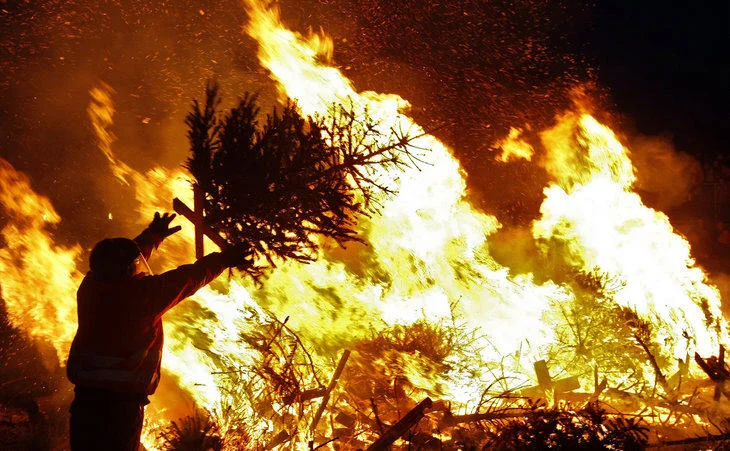
Bright bonfires to mark end of the 12 days of Christmas season

Bright bonfires to mark end of the 12 days of Christmas season

The same thing happens to Father Kendall Harmon every year during the 12 days after the Nativity of Our Lord Jesus Christ.

It happens with newcomers at his home parish, Christ-St. Paul's in Yonges Island, S.C., near Charleston. It often happens when, as Canon Theologian, he visits other parishes in the Episcopal Diocese of South Carolina.

"I greet people and say 'Merry Christmas!' all the way through the 12 days" of the season, he said, laughing. "They look at me like I'm a Martian or I'm someone who is lost. … So many people just don't know there's more Christmas after Christmas Day."

To shine a light on this problem, some churches have embraced an tradition -- primarily among Anglicans and other Protestants -- that provides a spectacular answer to an old question: When do you take down that Christmas tree? The answer: The faithful take their Christmas trees to church and build a bonfire as part of the "Epiphany Service of Lights" on January 6th.

As always, in a rite framed by liturgy, there is a special prayer: "Almighty God our Heavenly Father, whose only Son came down at Christmas to be the light of the world, grant as we burn these trees this Epiphany night, that we, inspired by your Holy Spirit, would follow his example and bear witness to His light throughout the world, through Jesus Christ our Lord, who with you and the Holy Spirit, live and reign in glory everlasting. Amen."

The struggle to observe the 12 days of Christmas is similar to other trials for those who strive to follow the teachings of their faith during the crush of daily life, said Harmon.

Last sermon from the police officer/pastor in Colorado Springs -- Time is short

As he began his last sermon, Hope Chapel co-pastor Garrett Swasey told newcomers that if they wanted to understand his point of view they needed to know that he was also a police officer in Colorado Springs. 

Thus, he was used to being surrounded by lots of distractions while trying to focus on life-and-death issues -- like spotting threats to public safety. In this multitasking age, he said, it's easy to let the clutter of daily life hide what really matters. 

"I have been quoted on a number of occasions and I never seem to get quoted on the things that I would like to be quoted on, and I'm quoted on the things that I don't really prefer to be quoted on," said the 44-year-old Swasey, one of several ordained elders at this small evangelical congregation. 

"One of those things -- you've all heard me say this before -- is, 'Give me three seconds and I'll forget the Gospel.' Right? It's like I have some kind of spiritual ADD." 

The congregation laughed as Swasey led them on a witty tour of his own mind, where serious thoughts about sin and forgiveness -- "Focus on the Gospel, focus on the Gospel, focus on the Gospel" -- crash into, "How the heck did Denver lose to Indy?" or visions from Three Stooges movies or nagging concerns about a superstar quarterback in New England improperly deflating footballs. 

It's hard to focus on the eternal, he stressed, again and again. But it's crucial to try, because the clock is running and no one knows how much time they have left. 

Two weeks later, the congregation gathered in mourning after Swasey -- on duty at the University of Colorado at Colorado Springs -- was killed after he voluntarily responded to calls for help at the nearby Planned Parenthood facility. 

Concerning sex, marriage, babies, pews and the rise of the 'nones'

Researchers studying religion in America have long observed a kind of faith-based law of gravity: While young people often stray, most return to the pews after they get married and have children.

But something new is happening, especially among the "nones" -- the growing ranks of individuals who declare themselves "unaffiliated," when it comes to religious life. While researchers have dissected their political views, now it's time to focus on their actions linked to marriage and children.

"We have always known that family size is related to religiosity. The more devout people are the more likely they are to get married and have a higher number of children," said John Green of the University of Akron, a veteran researcher on faith and public life.

But Americans born after the 1960s have been shaped by storms of change linked to sexuality and marriage. For them, noted Green, contraception and abortion are normal parts of the American way of life. Cohabitation rates keep rising and people tend to marry later than in the past. Thus, they are older if and when they choose to have children.

It's time to probe the impact of these trends on religion, said Green, in a telephone interview. He was reacting to the Pew Research Center's massive 2014 U.S. Religious Landscape Study, released on Nov. 3.

"You used to be able to say that the young would drift away from the faith of their youth, but then they would get married and have kids and that would pull them back … or maybe they would choose some other faith," he said. "The assumption was that marriage and family change people and they get more religious as they get older.

"Maybe what we're seeing now is that it's the faith component that is actually driving the actions of the young people who are choosing to get married and to have children in the first place. …

Dark Halloween nights vs. bright All Hallows' Eve rites

It's Halloween in suburbia and most of the houses are decorated and glowing, waiting to serve treats to Disney princesses, superheroes, movie pirates, zombies. Minions and tiny people disguised as puppies, pumpkins or other innocent options.

But a few houses are dark because, for reasons of safety or theology, their inhabitants have made the countercultural decision to avoid contact with a season they believe has grown too dark and dangerous. Others believe "pagan," evil influences have shaped Halloween, deep into its roots.

"It's hard to know precisely what people mean when they use a word like 'pagan.' For many people it means anything that's ungodly or disturbing. … That's what some Americans think Halloween has become -- a clash between good and evil," said Scott McConnell, vice president of LifeWay Research.

A recent LifeWay telephone survey, he said, found that 21 percent of Americans have decided to avoid Halloween altogether, while another 14 percent specifically try to avoid "pagan" elements of the festivities. Nearly 60 percent said Halloween is "all in good fun," while 6 percent of survey participants were "not sure" what they thought.

While some people are worried about ghosts, goblins, devils and other images of death and decay, Americans are much more likely to see Hollywood symbols of "good and evil" arrive at their doors shouting "trick or treat."

A case for having some doctrines affecting smartphone use in pews

It's a typical Mass in an American parish in which the kneelers contain a mix of teens, single adults, young families and church stalwarts with gray hair.

Near the end of a sermon about family life, during this hypothetical Mass, the priest makes a pithy observation that is both poignant and slightly ironic.

A young-ish parish council member smiles and posts the quote to Twitter, since he is already using his smartphone to follow Mass prayers in a popular Catholic app. This infuriates a nearby grandmother, who is already upset that her daughter is letting her kids play videogames in church, to keep them quiet.

The Twitter user, of course, thought he was paying the priest a compliment by tweeting the sermon quote while, perhaps, engaging in a bit of social-media evangelism to prompt discussions with friends at work. But this gesture also infuriated a nearby worshipper and destroyed her sense of sacred space.

"Everyone used to know the worship rules and now we don't. It's that simple, which means that things are getting more complex," said Lee Rainie, director of Internet, science and technology research at the Pew Research Center. He is also the co-author of the book "Networked: The New Social Operating System."

Every venue in public life "has its own context and you can't write a set of social-media rules that will apply in all venues," he said. "Using technology to enrich our own spiritual experiences is one thing, while interrupting corporate worship is another. … People are going to have to ask if that phone is pulling them deeper into worship services or if they're using it to disengage and pull out of the experience."

This storm has been building in the pews for more than a decade and religious leaders will not be able to avoid it, according to fine details in new work by the Pew Research Center's American Trends Panel.

Soli Deo gloria -- The true legacy of a church musician

NEW YORK -- When choirmaster John Scott looked into the future he saw a spectacular addition to St. Thomas Episcopal Church on Fifth Avenue, a new organ at the heart of worship services, concerts and expanding efforts to train young musicians.

The 100-stop organ would blend past and present, preserving the delicately carved 1913 cabinet and some of it distinctive pipes, but as part of an expanded design that would add both grandeur and gentleness, as well as many new tones.

"We are eager to hear our gallery horizontal trumpet put into first-class condition and just as excited that it will be joined by a new stentorian Tuba Mirabilis of imperial strength. These two stops will allow majestic fanfares to dialogue east and west," said Scott, in an enthusiastic May 31 update about the $11 million project.

"So, to sum up -- 2018 cannot come soon enough."

But Manhattan's famous Anglo-Catholic parish was stunned on August 12 when the 59-year-old Scott died of a heart attack, hours after returning from a European concert tour. Scott and his wife Lily were awaiting the birth of their first child in September.

Church leaders held a requiem Mass -- with no music -- the next day and began planning for a solemn funeral Mass on Sept. 12, allowing more people to travel to New York City for the rites. Many would come to honor an artist hailed by The New York Times and other prestigious publications, a man known for his recordings, compositions and concert-hall performances.

But people in the pews are mourning the loss of a fellow believer whose most cherished duty was to help lead others in worship, while teaching the faith and its musical heritage to their children, said the Rev. Canon Carl Turner.

True confessions about the urgent need for Catholic campus ministries

Nearly a decade ago, leaders of the St. Mary's Catholic Center next to the giant Texas A&M University campus began having an unusual problem -- they had too many students coming to Confession.

The priests were offering what was, in this day and age, a rather robust schedule for the Sacrament of Penance and Reconciliation, with 60 minutes or more time on Wednesday nights and Saturdays before Mass.

Students were queuing up and waiting. So a young priest suggested offering daily Confession, with two priests available for an hour-plus or one priest for two or three hours. But that wasn't enough, either. Now this parish dedicated to campus ministry -- with 50 full-time and part-time staffers -- offers Confession at least 10 times every week, plus by appointment.

"We still have some lines and sometimes, most days even, our priests don't have time to hear all the confessions," said Marcel LeJeune, the parish's assistant campus ministry director. "The priests don't have time to chat. … It seems that whenever we offer more opportunities for Confession, we have more people show up."

Parish leaders know all about modern campus trends with alcohol, pornography and "hooking up." They know the Centers for Disease Control and Prevention has found that the average age at which young Americans lose their virginities is 17 and that, between ages 20 and 24, 86 percent of males and 88 percent of females are sexually active, to varying degrees.

But the statistic LeJeune stresses is that nearly 80 percent of Catholics who leave the church do so by age 23. In other words, he thinks that if Catholics are serious about influencing young people before they join the growing ranks of the so-called "Nones" -- the religiously unaffiliated -- they must invest more time and resources into campus ministries.

Memory eternal, for a quiet giant in American Orthodoxy

FRANKLIN, Tenn. -- It was a typical evangelistic crusade in rural Alabama and, as he ended his sermon, the Rev. Gordon Walker called sinners down to the altar to be born again.

Most Southern towns have a few notorious folks who frequent the back pews during revival meetings, trying to get right with God. On this night, one such scalawag came forward and fell to his knees. 

"Preacher! I've broken all the Ten Commandments except one," he cried, "and the only reason I didn't break that one was that the man I shot didn't die!"

It didn't matter that this man repeated this ritual several times during his troubled life, said Walker, telling the story decades later at Holy Cross Orthodox Church outside Baltimore. Now wearing the golden robes of an Eastern Orthodox priest, Walker smiled and spread his arms wide. The church, he said, has always known that some people need to go to confession more than others. The goal was to keep walking toward the altar.

With his gentle smile and soft Alabama drawl, Walker -- who died on July 23 -- was a key figure in an unusual American story. The former Southern Baptist pastor and Campus Crusade evangelist was part of a circle of evangelical leaders that spent a decade reading church history before starting an Orthodox church for American converts. Then in 1987, the late Metropolitan Philip Saliba accepted more than 2,000 pastors and members of their Evangelical Orthodox Church into the Antiochian Orthodox Christian Archdiocese of North America.