
family life

Listening to Naomi Judd: She tried to be honest about her angels and her demons

Listening to Naomi Judd: She tried to be honest about her angels and her demons

Naomi Judd thought she understood the ties that bind country-music stars and their audience -- then one aggressive fan went and joined the Pentecostal church the Judd family called home.

"It really burdened me," said Judd, after signing hundreds of her "Love Can Build a Bridge" memoir back in 1993. "I just don't sign autographs at church. The best way I can explain it to children … is to say, 'Honey, Jesus is the star.' "

After a year of this tense standoff, Judd became concerned and wrote the fan. "I said, 'I want you to really get away by yourself and read this letter and answer this question honestly: Do you come to church to see The Judds or do you come to church to see God?' She never came back to church. But she was in the autograph line today."

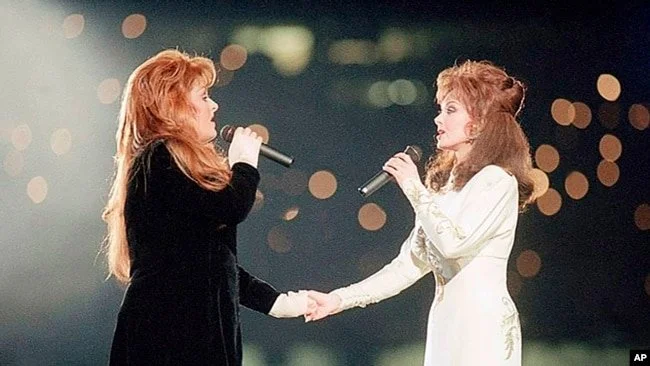
Through it all, Judd and her brash daughter Wynonna have talked openly about their triumphs and their struggles. Many fans identified with their failures just as much as the messages about faith and family.

At the time of that 1993 interview, Naomi Judd had battled through waves of anxiety attacks to address some dark realities -- such as rape, crisis pregnancy and her deadly battle with hepatitis C that retired the The Judds.

What she hadn't discussed was the sexual abuse in her childhood that led to treatment-resistant depression. Judd's April 30th death, at age 76, focused new attention on blunt passages in her 2016 book "River of Time," in which she said had been tempted by suicide. "I wanted to be completely honest that if someone took out a gun and killed me on stage, they would be doing me a favor," she wrote.

The Judds were inducted into the Country Music Hall of Fame the day after Naomi's death and her shaken daughter Ashley Judd told the crowd, "I'm sorry that she couldn't hang on until today."

Life and death challenges have tested the faith of Phoenix Suns coach Monty Williams

Life and death challenges have tested the faith of Phoenix Suns coach Monty Williams

A reporter tossed a standard question at coach Monty Williams after the Phoenix Suns won the Western Conference finals, asking how he managed to be a tough NBA coach and a sympathetic mentor.

"I tell every new player … that the essence of my coaching is to serve," said Williams, the National Basketball Coaches Association's 2021 coach of the year. "As a believer in Christ, that's what I'm here for. … I tell them all the time, if I get on you, I'm not calling you out -- I'm calling you up."

That message meshes well with what superstar Chris Paul writes on his sneakers game after game: "Can't Give Up Now." That's a popular Gospel song with this chorus: "I just can't give up now. I've come too far from where I started from. Nobody told me the road would be easy and I don't believe He's brought me this far to leave me."

Williams and Paul have known each other for a decade, with professional and personal ties strengthened by pain and frustration. While Paul's on-court struggles are well documented, it's impossible to understand their bond without knowing the details of his coach's life as a Christian, husband and father of five children.

"The real reason to watch" the playoffs this year, said former ESPN commentator Jason Whitlock, in his "Fearless" podcast, is "that God has placed a messenger inside the NBA's secular madness. Monty Williams might be the most important man in sports. The 49-year-old former Notre Dame and NBA player is the leader and example that America needs right now."

The coach's story, he added, "belongs in a new Bible. Five years ago, a 52-year-old White woman high on meth drove her car headfirst into the car driven by Williams' wife Ingrid. Three of Williams' children were also in the car. The White woman died at the scene. … Ingrid Williams died a day later. Williams' children survived."

Williams was a promising Notre Dame freshman when Ingrid -- before their marriage -- stood by him after doctors said he had hypertrophic cardiomyopathy. Long before experts cleared him to play, Ingrid kept praying and offered this message: "Jesus can heal your heart."

COVID-19 and 2020: When clergy stress zoomed to higher levels than ever

COVID-19 and 2020: When clergy stress zoomed to higher levels than ever

When training pastors and chaplains, educators frequently stress the need for "boundaries" between work and home.

Clergy need -- somehow -- to find "personal" time, along with face-to-face contact with loved ones. That challenge became more difficult in the age of smartphones, texting and emails, noted Marlon C. Robinson, pastoral care director at AdventHealth in Manchester, Ky., and a specialist in marriage and family therapy.

Then came the COVID-19 lockdowns and the pressures on clergy zoomed to a whole new level.

"Everything came home, all at once," said Robinson, reached by telephone. "Pastors were spending more and more time with their families -- jammed into one space. But this wasn't quality time. Everyone was at home, but they were staring at their own phones and computer screens. There was no intimacy, and all the pressures of ministry grew even more intense."

To make matters worse, the usual struggles with church leadership and finances were complicated by political warfare and conspiracy theories that, literally, began to shape how congregations handled worship, pastoral care, education and even efforts to keep sanctuaries clean and safe.

Instead of arguing -- to cite church clichés -- about the color of new carpet or outdated hymnals, the faithful were fighting about whether masks were necessary to save lives or merely "politically correct" virtue signals.

Meanwhile, people were sick, and some died, with their pastors and families on the other side of locked hospital or nursing-home doors. And it was illegal to have funerals? Attendance dropped, along with offerings. More than a few members vanished.

Ministers "are inundated with phone calls, emails, text and WhatsApp messages, and communications through a host of other platforms," wrote Robinson, in Ministry Magazine.

Lessons for the modern church, in the pages of 'I Love Jesus, But I Want to Die'

Lessons for the modern church, in the pages of 'I Love Jesus, But I Want to Die'

The first time Sarah J. Robinson tried to kill herself was eight months after she became a born-again Christian.

She had struggled with suicidal thoughts since elementary school. She would imagine jumping into highway traffic or fill her hand with pills and consider swallowing them. But her depression only deepened after she was baptized as a teen and poured herself into Bible studies and upbeat youth-group projects.

She felt like a failure. Finally, she pressed a knife harder and harder into her skin -- but she couldn't force herself to end it all on the kitchen floor. Looking back, she wrote: "I didn't want my family to find me there, so I got up and put the knife away. I climbed into bed, put on a worship CD, cursed God and went to sleep."

Robinson kept stacks of journals and they provided crucial material for "I Love Jesus, But I Want to Die," a book written during three years of struggle and research. Her battles with depression have continued, even during her years working as a youth minister.

Images of handwritten pages appear in the book, including this 2007 plea: "Lord, I'm struggling. I need your help. This week has been really rough -- I've been sad & lonely & angry & numb. I cut myself and berated myself, wished for the end, tried so hard to hide it. I'm not just empty -- I've become a vacuum, taking on more and more of the absence of your presence. … God, please don't let me be lost."

It was hard to be that vulnerable, said Robinson, reached by telephone in Nashville. But including actual journal pages "seemed like a no-brainer" if the goal was to "let other people who are hurting know they are not alone. I wanted them to know that I've been there -- in that kind of midnight."

Among secular researchers, it's common to find two views of mental-health issues, said Robinson, citing the work of Stanford University researcher Carol Dweck. The first is a "fixed mindset" that assumes these conditions are predetermined and unchangeable. Thus, "setbacks and failures reveal who we really are and will always be," said Robinson." The second is a "growth mindset" that says individuals can adapt and change.

In pews and pulpits, many believers simply assume all mental-health struggles represent a lack of faith. Strugglers will be healed if they dedicate themselves to Bible study and prayer, while turning away from their sins. Church-based "pastoral counseling" is an option.

"The idea is that if I put the right things into the spiritual vending machine, then I'll get the right things out," said Robinson.

Did Pope Francis undercut that Vatican ruling on blessings for same-sex couples?

Did Pope Francis undercut that Vatican ruling on blessings for same-sex couples?

After a media firestorm ignited by a Vatican condemnation of same-sex unions -- because God "cannot bless sin" -- Catholic progressives immediately looked for hope in the words of bishops, President Joe Biden and even Pope Francis.

In his Sunday Angelus address after the March 15 ruling, the pope stressed that modern seekers want to "see Jesus" in acts of love, not persecution.

Catholics must promote "a life that takes upon itself the style of God -- closeness, compassion and tenderness," said the pope. "It means sowing seeds of love, not with fleeting words but through concrete, simple and courageous examples, not with theoretical condemnations, but with gestures of love. Then the Lord, with his grace, makes us bear fruit, even when the soil is dry due to misunderstandings, difficulty or persecution, or claims of legalism or clerical moralism."

While Pope Francis gave "his assent" to this ruling, the Jesuit publication America cited anonymous Vatican sources saying the Angelus remarks suggested that he was "distancing himself" from the work of the Congregation for the Doctrine of the Faith.

That document said God "does not and cannot bless sin: He blesses sinful man, so that he may recognize that he is part of his plan of love and allow himself to be changed." As for same-sex unions, it added: "The presence in such relationships of positive elements … cannot justify these relationships and render them legitimate objects of an ecclesial blessing, since the positive elements exist within the context of a union not ordered to the Creator's plan."

Bishop Johan Bonny of Antwerp -- who represented Belgium at the 2015 Vatican Synod on Marriage and the Family -- said those words left him "ashamed on behalf of my Church. … I want to apologize to all those for whom this 'responsum' is painful and incomprehensible: faithful and committed Catholic homosexual couples, the parents and grandparents of homosexual couples and their children, pastoral workers and counsellors of homosexual couples," he wrote on Facebook.

"I know homosexual couples who are legally married, have children, form a warm and stable family, and moreover, actively participate in parish life. A number of them are employed full-time in pastoral work or ecclesial organizations." Why, he added, deny the "similarity or analogy with heterosexual marriage here?"

Meanwhile, the president of the German bishops' conference, Bishop Georg Bätzing, said he was "not happy" about the Vatican document. Also, a statement from 230 Catholic theologians in Germany called the refusal to bless same-sex unions "paternalistic," "discriminating" and lacking in "theological depth."

The head of St. Peter's Cathedral in Worms went further, saying he "cannot and will not" refuse blessings to anyone. Father Tobias Schäfer told the Deutsche Welle network: "My opinion is: don't take Rome seriously and continue with pastoral care. There are more important things than such stupid papers!"

Thinking the unthinkable: Is the United States of America veering closer to civil war?

Thinking the unthinkable: Is the United States of America veering closer to civil war?

Call it the "Texit" parable.

America's new civil war begins with the Supreme Court overturning Roe v. Wade, creating an abortion-free zone in the Bible Belt and most heartland states.

Enraged Democrats pledge to end the U.S. Senate filibuster and expand the number of high-court justices. After restoring Roe, they seek single-payer health care, strict gun control and sweeping changes in how government agencies approach the First Amendment, with the IRS warning faith groups to evolve -- or else -- on matters of sexual identity. Big Tech begins enforcing the new orthodoxy.

Conservatives rebel and liberals soon realize that most of America's military, including nuclear weapons, are in rebel territory. Then federal agents kill Alabama's pro-life, Black governor -- while trying to arrest him as a traitor. That's too much for Gov. Francisco Gonzalez of Texas, who decides that it's time for a new republic.

David French fine-tuned this "Texit" vision early in 2020, while finishing "Divided We Fall: America's Secession Threat and How to Restore Our Nation." Best-known as a #NeverTrump conservative pundit, most of the Harvard Law graduate's career has focused on old-school First Amendment liberalism -- which in recent decades has meant defending conservative religious believers in religious liberty cases.

The book's first lines are sobering, especially after recent scenes on Capitol Hill.

"It's time for Americans to wake up to a fundamental reality: the continued unity of the United States cannot be guaranteed," wrote French. Right now, "there is not a single important cultural, religious, political, or social force that is pulling Americans together more than it is pulling us apart."

Americans are divided by their choices in news and popular culture. America remains the developing world's most religious nation, yet its increasingly secularized elites occupy one set of zip codes, while most traditional religious believers live in another. In politics, more and more Democrats are Democrats simply because they hate Republicans, and vice versa.

Ironically, cultural conservatives now find themselves hoping that the Supreme Court will protect them, said French, reached by telephone. Conservatives know they have lost Hollywood, academia, America's biggest corporations, the White House and both houses of Congress.

"I constructed the Texit scenario around court packing because that has become their last firewall," said French.

Groundhog Day for Episcopalians: Brutal report says pews may be empty by 2050

Groundhog Day for Episcopalians: Brutal report says pews may be empty by 2050

With America facing a bitterly divisive election, Episcopal Church leaders did what they do in tense times — they held a National Cathedral service rallying the Washington, D.C., establishment.

This online "Holding onto Hope" service featured a Sikh filmmaker, a female rabbi from Chicago, the Islamic Society of North America's former interfaith relations director, the female presiding bishop of the Evangelical Lutheran Church in America, a Jesuit priest known for promoting LGBTQ tolerance and former Secretary of State Condoleezza Rice.

"Our ideals, values, principles and dreams of beloved community matter," said Episcopal Presiding Bishop Michael Curry, the church's first African-American leader. "They matter to our life as a nation and as a world. Our values matter!"

This was the kind of rite -- think National Public Radio at prayer -- a church can offer when its history includes 11 U.S. presidents and countless legislators and judges from coast to coast. Episcopal leaders also know President-elect Joe Biden is a liberal Catholic whose convictions mesh with their own.

That's the good news. Episcopalians have also been hearing plenty of bad news about their future.

For example, Curry became a media superstar after his soaring sermon at Prince Harry and Meghan Markle's wedding. But wedding trends in his own flock have been pretty bleak. Ditto for baptisms.

A stunning 2019 report from Episcopal parishes showed 6,484 weddings (down 11.2%). Baptism rites for children fell to 19,716 (down 6.5%) and adult baptisms dropped to 3,866 (down 6.7%). Baptisms are down 50% since 2003.

Office of the General Convention statistics reported 1,637,945 members (down 2.29%) and average attendance fell to 518,411 (down 2.25%). Median attendance dropped from 53 worshippers to 51, while 61% of parishes saw attendance declines of 10% or more.

All of these statistics predate the coronavirus pandemic.

Episcopal News Service offered these blunt words from the Rev. Dwight Zscheile, an expert on church renewal and decline: "The overall picture is dire -- not one of decline as much as demise within the next generation. … At this rate, there will be no one in worship by around 2050 in the entire denomination."

Episcopal Church membership peaked at 3.4 million in the 1960s, a pattern seen in other mainline Protestant bodies. This decline has accelerated, with membership falling 17.4% in the past 10 years.

As a rule, the crisis is worse in the Northeast and the Midwest, while losses have been slower in the Sunbelt and some parts of the West. In terms of worse-case scenarios, the Diocese of Northern Michigan remains open for business, but reported an average attendance of 385 in 2019. That's the whole diocese.

Rabbi Lord Jonathan Sacks offered modern arguments defending an ancient faith

Rabbi Lord Jonathan Sacks offered modern arguments defending an ancient faith

A typical Rabbi Lord Jonathan Sacks speech would open with a self-deprecating jab at long-winded rabbis and then flow into a blend of Hebrew texts, science, law, literature, current events and the scriptures other faiths.

When the former chief rabbi of the United Kingdom died on Nov. 7 at age 72, after battles with cancer that began in his 30s, the Prince of Wales said: "His immense learning spanned the secular and the sacred, and his prophetic voice spoke to our greatest challenges with unfailing insight and boundless compassion. His wise counsel was sought and appreciated by those of all faiths and none."

Most of all, Lord Sacks was known for using modern information and insights to defend ancient truths. One famous address, at a 2014 Vatican conference on marriage, began with fish mating in a Scottish lake 385 million years ago before charting humanity's rise from polygamy to monogamy, including some awkward biblical dramas.

Before this speech ended with a standing ovation, the rabbi explained that his goal was to defend the “most beautiful idea in the history of civilization," the concept of love as the origin of new life.

"What made the traditional family remarkable, a work of high religious art, is what it brought together: sexual drive, physical desire, friendship, companionship, emotional kinship and love, the begetting of children and their protection and care, their early education and induction into an identity and a history," he explained.

“Seldom has any institution woven together so many different drives and desires. … It made sense of the world and gave it a human face -- the face of love. For a whole variety of reasons, some to do with medical developments like birth control, in vitro fertilization and other genetic interventions, some to do with moral change like the idea that we are free to do whatever we like so long as it does not harm others, some to do with a transfer of responsibilities from the individual to the state … almost everything that marriage once brought together has now been split apart. Sex has been divorced from love, love from commitment, marriage from having children and having children from responsibility for their care."

Lord Sacks was part of the Modern Orthodox movement and wrote two dozen prayer books and works about science and spirituality, as well serving as a commentator on BBC Four's "Thought for the Day." He became chief rabbi of the United Hebrew Congregations of the Commonwealth in 1991, holding that post until 2013, Queen Elizabeth knighted him in 2005 and he entered the House of Lords in 2009.

Memory eternal: The passing of a charismatic bishop with a big voice and an extended family

Memory eternal: The passing of a charismatic bishop with a big voice and an extended family

Episcopal bishops in the 1980s were already used to urgent calls from journalists seeking comments on issues ranging from gay priests to gun control, from female bishops to immigration laws, from gender-free liturgies to abortion rights.

But the pace quickened for Bishop William C. Frey in 1985 when he was one of four candidates to become presiding bishop of the Episcopal Church. A former radio professional, Frey was known for his bass voice and quick one-liners. His Lutheran counterpart in Colorado once told him: "You look like a movie star, sound like God and wear cowboy boots."

Other Denver religious leaders sometimes asked, with some envy, why Episcopalians got so much ink.

"I can't understand why some people want the kind of media attention we get," he told me, during one media storm. "That's like coveting another man's root canal."

A Texas native, Frey died in San Antonio last Sunday (Oct. 11), after years out of the spotlight. In addition to his Colorado tenure, his ministry included missionary work in Central America during the "death squads" era and leading an alternative Episcopal seminary in a struggling Pennsylvania steel town.

While critics called him the "token evangelical" in the presiding bishop race, Frey was a complex figure during his Colorado tenure, where I covered him for the now-closed Rocky Mountain News. He called himself a "radical moderate," while also attacking "theology by opinion poll."

“We need a church that knows its own identity and proclaims it fearlessly," he said, in his 1990 farewell sermon. "No more stealth religion! … We need a church that knows how to answer the question, 'What think ye of Christ?', without forming a committee to weigh all possible options. We need a church that doesn't cross its fingers when it says the creed."

Nevertheless, a conservative priest called him a "Marxist-inspired heretic" for backing the 1979 Book of Common Prayer and the ordination of women. The bishop opposed capital punishment -- and abortion -- and welcomed stricter gun-control laws. He backed expanded work with the homeless and immigrants. Then gay-rights activists called him a "charismatic fundamentalist" because he opposed the ordination of sexually active gays and lesbians and preached that sex outside of marriage was sin.

Also, before the presiding bishop election, Frey fielded questions -- and heard old whispers -- about the informal charismatic Christian community he led with his wife, Barbara (who died in 2014).