doctrine

While many Catholics feel politically 'homeless,' Biden Catholics managed a 2020 win

While many Catholics feel politically 'homeless,' Biden Catholics managed a 2020 win

Conservative patriarch Edmund Burke died in 1797 in Beaconsfield, England.

This didn't prevent columnist Peggy Noonan of the Wall Street Journal, a Catholic conservative, from making Burke her write-in choice in the 2020 White House race. She wasn't the only voter who felt politically homeless, due to religious and moral convictions that clashed with the political and personal choices of President Donald Trump and, the odds are overwhelming, president-elect Joe Biden.

Once again, there was no way to ignore issues linked to faith, morality and, yes, character. This was especially true with Catholic voters who frequent church pews.

Considering Trump, Noonan stressed the coronavirus crisis, where the president finally "met a problem he couldn't talk his way out of. I believe that's what happened: He played down the pandemic, lied, made uninformed claims at briefings that serious people were struggling to keep useful. He produced chaos. The country can't afford any of that in a crisis that is sudden and severe."

What about the Democrat, a lifelong Catholic? Noonan predicted Biden would be a "hapless and reluctant conductor" on a "runaway train," especially on moral and cultural issues.

"The progressive left," she argued, "endorses and pushes for the identity politics that is killing us, an abortion regime way beyond anything that could be called reasonable or civilized and on which it will make no compromise; it opposes charter schools and other forms of public school liberation; it sees the police as the enemy, it demonstrates no distinct fidelity to freedom of speech and, most recently, its declared hopes range from court packing to doing away with the Electoral College and adding states to the union.”

The bottom line: The political realities of 2020 left many Catholics and other active religious believers torn between political options that no longer seemed acceptable.

It was easy to read between the lines in key passages of a new cover letter the U.S. Catholic bishops added to their "Forming Consciences for Faithful Citizenship" document (.pdf here).

"The threat of abortion remains our preeminent priority because it directly attacks life itself, because it takes place within the sanctuary of the family, and because of the number of lives destroyed," the letter stated. "At the same time, we cannot dismiss or ignore other serious threats to human life and dignity such as racism, the environmental crisis, poverty and the death penalty. …

For Protestant pastors, the 2020 White House race looks a lot like the one in 2016

For Protestant pastors, the 2020 White House race looks a lot like the one in 2016

For pastors in America's Protestant pulpits, Election Day 2020 is starting to look a lot like 2016.

Most evangelicals whose priorities mesh -- for the most part -- with the Republican Party are ready to vote for Donald Trump, according to a LifeWay Research survey. Protestant clergy who do not self-identify as evangelicals plan to vote for Democrat Joe Biden.

The difference in 2020 is that fewer pastors are struggling to make a decision. A survey at the same point in the 2016 race found that 40% of Protestant pastors remained undecided, while 32% packed Trump and 19% supported Hillary Clinton.

This time, only 22% remain undecided, with 53% saying that they plan to vote for Trump, while 21% support Biden.

"There's still a lot of 'undecided' pastors," said Scott McConnell, executive director of LifeWay. "Quite a few pastors -- for a variety of reasons -- want to put themselves in the 'undecided' bucket. …

"Last time around, Donald Trump was such an unknown factor and many pastors really didn't know what to do with him. This time, it appears that more people know what Trump is about and they have made their peace with that, one way or another. The president is who he is, and people have made up their minds."

Looming in the background is a basic fact about modern American politics. In the end, the overwhelming majority of pastors who say they are Democrats plan to vote for Biden (85%) and the Republicans plan to back Trump (81%).

Some pastors have a logical reason to linger in the "undecided" category -- their doctrinal convictions don't mesh well with the doctrines of the major political parties.

The Rev. Tim Keller, an influential evangelical writer who founded Redeemer Presbyterian Church in New York City, recently stirred up online debates with a New York Times essay called, "How Do Christians Fit Into the Two-Party System? They Don't."

In recent decades, he noted, Democrats and Republicans have embraced an approach to politics in which party leaders assume that working with them on one crucial issue requires agreement with the rest of their party platforms.

Memory eternal: The passing of a charismatic bishop with a big voice and an extended family

Memory eternal: The passing of a charismatic bishop with a big voice and an extended family

Episcopal bishops in the 1980s were already used to urgent calls from journalists seeking comments on issues ranging from gay priests to gun control, from female bishops to immigration laws, from gender-free liturgies to abortion rights.

But the pace quickened for Bishop William C. Frey in 1985 when he was one of four candidates to become presiding bishop of the Episcopal Church. A former radio professional, Frey was known for his bass voice and quick one-liners. His Lutheran counterpart in Colorado once told him: "You look like a movie star, sound like God and wear cowboy boots."

Other Denver religious leaders sometimes asked, with some envy, why Episcopalians got so much ink.

"I can't understand why some people want the kind of media attention we get," he told me, during one media storm. "That's like coveting another man's root canal."

A Texas native, Frey died in San Antonio last Sunday (Oct. 11), after years out of the spotlight. In addition to his Colorado tenure, his ministry included missionary work in Central America during the "death squads" era and leading an alternative Episcopal seminary in a struggling Pennsylvania steel town.

While critics called him the "token evangelical" in the presiding bishop race, Frey was a complex figure during his Colorado tenure, where I covered him for the now-closed Rocky Mountain News. He called himself a "radical moderate," while also attacking "theology by opinion poll."

“We need a church that knows its own identity and proclaims it fearlessly," he said, in his 1990 farewell sermon. "No more stealth religion! … We need a church that knows how to answer the question, 'What think ye of Christ?', without forming a committee to weigh all possible options. We need a church that doesn't cross its fingers when it says the creed."

Nevertheless, a conservative priest called him a "Marxist-inspired heretic" for backing the 1979 Book of Common Prayer and the ordination of women. The bishop opposed capital punishment -- and abortion -- and welcomed stricter gun-control laws. He backed expanded work with the homeless and immigrants. Then gay-rights activists called him a "charismatic fundamentalist" because he opposed the ordination of sexually active gays and lesbians and preached that sex outside of marriage was sin.

Also, before the presiding bishop election, Frey fielded questions -- and heard old whispers -- about the informal charismatic Christian community he led with his wife, Barbara (who died in 2014).

Al Smith dinner 2020: Trump and Biden make pitches to very different Catholic voters

Al Smith dinner 2020: Trump and Biden make pitches to very different Catholic voters

During a normal White House race, the Alfred E. Smith Memorial Foundation Dinner allows the candidates to don formal attire, fire snappy one-liners and make subtle appeals to Catholic voters.

But nothing is normal in 2020. Thus, Joe Biden and President Donald Trump used this year's virtual dinner to preach to Catholic voters in swing states like Ohio, Pennsylvania, Michigan and Florida. The event produced few headlines, coming a mere six hours before Trump announced his positive test for COVID-19.

Saluting Catholic progressive, Biden offered a litany about the pandemic, race, the recession and climate change. He warned that many Americans have lost faith "in one another, in truth, in science and reason."

The current pope, Biden stressed, embraced him during a 2013 White House visit, offering comfort shortly after brain cancer took his son Beau's life.

"Pope Francis took the time to meet with my entire family to help us see the light through the darkness," said Biden. "I live in an amazing country … where an Irish Catholic kid like me from Scranton, Pennsylvania, would one day befriend a Jesuit pope. But that's who we are as a country -- where anything is possible when we care for one another, when we look out for one another, when we keep the faith."

While stressing that he is guided "by the tenets of Catholic social doctrine" -- helping the "least of these" -- Biden didn't mention his vow to codify Roe v. Wade if the Supreme Court overturns that decision or his promise to reinstate policies requiring the Little Sisters of the Poor to cooperate in providing birth control and abortifacients to staff. He didn't mention his decision to officiate at the same-sex wedding of two White House colleagues, an action clashing with church doctrine.

It was logical for Biden to avoid providing fresh ammunition for critics. But the speech, once again, trumpeted his Catholic credentials.

"Joe Biden's choice to run explicitly on the claim that he is a faithful Catholic squarely places on the table his claim to be a faithful Catholic," stressed legal scholar Robert P. George of Princeton University, writing on Facebook. He is a Catholic conservative who has also been a consistent critic of Trump.

“No way out of this, folks," he added. "It's not, or not just, Biden's critics who have raised the issue. It's the Biden campaign. …

Culture wars are about demographics: Thus, fertility has become a controversial issue

Culture wars are about demographics: Thus, fertility has become a controversial issue

It was one of those happy social-media pictures, only this time the pregnant mother was celebrating with her nine children.

Los Angeles comedian and actor Kai Choyce was not amused and tweeted the photo with this comment: "this is environmental terrorism. … In the year 2020 literally no one should have ten kids."

The result was a long chain of sweet or snarky comments, as well as photos of large families. One tweet quoted a Swedish study claiming that having "one fewer child per family" can save an average of 58.6 tons of "CO2-equivalent emissions per year."

Debates about fertility often veer into fights about religion and other ultimate questions, such as the fate of the planet.

Parents with two-plus children are often making a statement about the role of religious faith in their lives. People on the other side of this debate have frequently rejected traditional forms of religion.

"What we call 'culture wars' are wars about demographics, but we have trouble discussing that," said historian Philip Jenkins, who is best known for decades of research into global religious trends, while teaching at Pennsylvania State and Baylor University. His latest book is "Fertility and Faith: The Demographic Revolution and the Transformation of World Religions."

In the 1970s, researchers thought the link between secularization and falling birth rates was a "Protestant thing" in Europe, but then this trend spread into Catholic cultures in Europe and in Latin America, he said. Fertility rates are now collapsing in Iran and some Islamic cultures. Meanwhile, Orthodox Jews and traditional Catholics continue to have larger families than liberal believers in those ancient faiths.

America's 2019 birth rate fell to 1.71, its lowest level in three decades, and well under the replacement rate of 2.1. This took place before the coronavirus pandemic and the Brookings Institute recently predicted a "COVID baby bust" next year, resulting in up to half a million fewer births.

Researchers frequently argue about which comes first -- secularization or declining fertility.

Memory eternal: Farewell to the sharp pen of Father Paul 'Diogenes' Mankowski

Memory eternal: Farewell to the sharp pen of Father Paul 'Diogenes' Mankowski

For millions of Americans, "The Battle Hymn of the Republic" is as familiar as the national anthem and much easier to sing.

Few would need help with: "Mine eyes have seen the glory of the coming of the Lord. He is trampling out the vintage where the grapes of wrath are stored. He has loosed the fateful lightning of His terrible swift sword. His truth is marching on! Glory, glory, Hallelujah! … His truth is marching on!"

During 1990s fights over updated Catholic liturgies, a Semitic languages professor at Rome's Pontifical Biblical Institute wrote a Battle Hymn for modernists.

This "sanitized" text -- "chanted to no tune in particular" -- declared: "I see God's approach; it is good. God makes wine with God's feet. … Brightness flashes from the decision-making apparatus. God's worldview is currently earning widespread respect. Give honor repeatedly to the god of our tradition. We have owned our values."

Father Paul V. Mankowski put his own name on that First Things piece, since it didn't lance specific institutions or leaders. For decades, Catholics seeking his satirical work learned to look for "Diogenes" at CatholicCulture.org or "Father X" elsewhere.

Mankowski died on September 3 at age 66, felled by a ruptured brain aneurysm. Raised in a middle-class Rust Belt family, he worked in steel mills to pay tuition at the University of Chicago. His advanced degrees included a master's from Oxford and a Harvard University doctorate.

Many researchers, politicos and journalists (like me) knew him through telephone calls and emails, usually seeking documents and statements from nearby Catholic leaders. He was a rarity in the modern age -- a Jesuit conservative -- and his superiors eventually ordered him not to address church controversies. Much of his work was published anonymously or using pen names.

Princeton University's Robert P. George blitzed through years of emails, after hearing about Mankowski's sudden death.

"There are some doozies -- especially the spoofs, send ups and parodies," said George, on Facebook. "His wit was a massive quiver full of poison-dipped arrows, and he was a master archer. … He would not give a pass to fools, frauds, charlatans, hypocrites, rent seekers, time servers, racketeers, manipulators, corrupt scholars, false teachers or weak or craven leaders, especially in the Church."

Pro-Catechism Catholics are watching Joe Biden's actions, not just listening to his words

Pro-Catechism Catholics are watching Joe Biden's actions, not just listening to his words

In the summer of 2016, two White House staffers -- Brian Mosteller and Joe Mahshie -- tied the knot in a rite led by one of America's most prominent Catholics.

The officiant was Vice President Joe Biden, who later proclaimed on Twitter: "Proud to marry Brian and Joe at my house. Couldn't be happier … two great guys."

Leaders of familiar Catholic armies then debated whether Biden's actions attacked this Catholic Catechism teaching: "The marriage covenant, by which a man and a woman form with each other an intimate communion of life and love, has been founded and endowed with its own special laws by the Creator. … Christ the Lord raised marriage between the baptized to the dignity of a sacrament."

Conflicts between bishops, clergy and laity will loom in the background as Biden seeks to become America's second Catholic president. Combatants will be returning to territory explored in a famous 1984 address by the late Gov. Mario Cuomo of New York, entitled "Religious Belief and Public Morality."

Speaking at the University of Notre Dame, he said: "As a Catholic, I have accepted certain answers as the right ones for myself and my family, and because I have, they have influenced me in special ways, as Matilda's husband, as a father of five children, as a son who stood next to his own father's death bed trying to decide if the tubes and needles no longer served a purpose.

"As a governor, however, I am involved in defining policies that determine other people's rights in these same areas of life and death. Abortion is one of these issues, and while it is one issue among many, it is one of the most controversial and affects me in a special way as a Catholic public official."

It would be wrong to make abortion policies the "exclusive litmus test of Catholic loyalty," he said. After all, the "Catholic church has come of age in America" and it's time for bishops to recognize that Catholic politicians have to be realistic negotiators in a pluralistic land.

Christian icons and art before the rise of the blue-eyed Jesus with blond hair

Christian icons and art before the rise of the blue-eyed Jesus with blond hair

For modern skeptics, the 6th-century icon hanging in the Orthodox monastery in the shadow of Mount Sinai is simply a 33-by-18-inch board covered in bees wax and colored pigments.

For believers, this Christ Pantocrator ("ruler of all") icon is the most famous image of Jesus in the world, because the remote Sinai Peninsula location of St. Catherine's Monastery allowed it to survive the Byzantine iconoclasm era. The icon shows Jesus -- with a beard and long hair -- raising his right hand in blessing, while holding a golden book of the Gospels.

This Jesus does not have blond hair and blue eyes. "Christ of Sinai" shows the face of a wise teacher from ancient Palestine.

"When you talk about ancient icons, you are basically talking about images of Jesus with long hair, a beard and some kind of Roman toga. That's just about all you can say," said Jonathan Pageau of Quebec, an Eastern Orthodox artist and commentator on sacred symbols.

In the early church, he added, believers "didn't ask other questions -- about race and culture -- because those were not the important questions in those days. … Once you start politicizing icons there's just no way out of those arguments. You get into politics and dividing people and then you're lost."

In these troubled times, said Pageau, many analysts are "projecting valid concerns about racism and Europe's history of colonization and the plight of African-Americans back into issues of church history and art that are centuries and centuries old. It's a kind of category error and everything gets mixed up."

But that's what happened when debates about some #BlackLivesMatters activists toppling Confederate memorials -- along with attacks on Catholic statues and even insufficiently "woke" Founding Fathers -- veered into #WhiteJesus territory.

"Yes, I think the statues of the white European they claim is Jesus should also come down. They are a form of white supremacy," tweeted Shaun King, author of "Make Change: How to Fight Injustice, Dismantle Systemic Oppression, and Own Our Future."

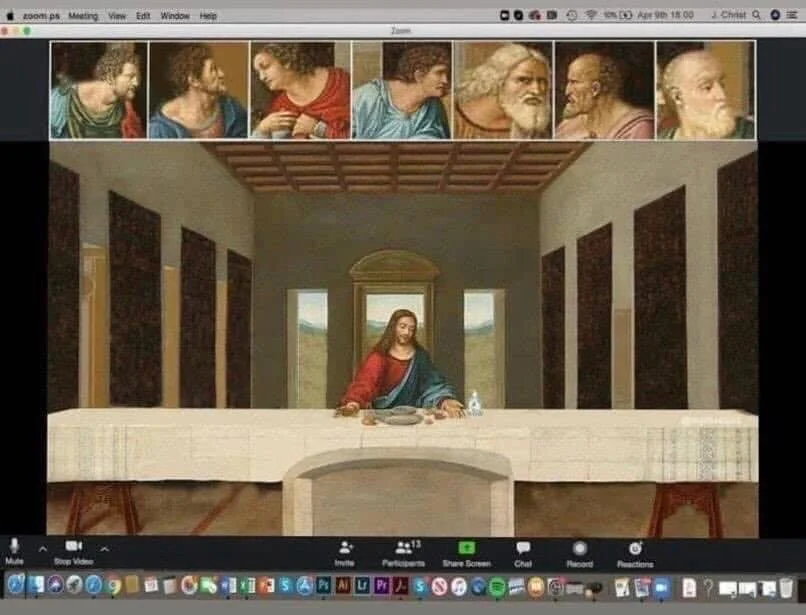
Anglican debate in 2020 crisis: Can clergy consecrate bread and wine over the Internet?

Anglican debate in 2020 crisis: Can clergy consecrate bread and wine over the Internet?

In the late 1970s, the Episcopal Ad Project began releasing spots taking shots at television preachers and other trends in American evangelicalism.

One image showed a television serving as an altar, holding a priest's stole, a chalice and plate of Eucharistic hosts. The headline asked: "With all due regard to TV Christianity, have you ever seen a Sony that gives Holy Communion?"

Now some Anglicans are debating whether it's valid -- during the coronavirus crisis -- to celebrate "virtual Eucharists," with computers linking priests at altars and communicants with their own bread and wine at home.

In a recent House of Bishops meeting -- online, of course -- Episcopal Church leaders backed away from allowing what many call "Virtual Holy Eucharist."

Episcopal News Service said bishops met in private small groups to discuss if it's "theologically sound to allow Episcopalians to gather separately and receive Communion that has been consecrated by a priest remotely during an online service."

Experiments had already begun, in some Zip codes. In April, Bishop Jacob Owensby of the Diocese of Western Louisiana encouraged such rites among "Priests who have the technical know-how, the equipment and the inclination" to proceed.

People at home, he wrote, will "provide for themselves bread and wine (bread alone is also permissible) and place it on a table in front of them. The priest's consecration of elements in front of her or him extends to the bread and wine in each … household. The people will consume the consecrated elements."

Days later, after consulting with America's presiding bishop," Bishop Owensby rescinded those instructions. "I understand that virtual consecration of elements at a physical or geographical distance from the Altar exceeds the recognized bounds set by our rubrics and inscribed in our theology of the Eucharist," he wrote.

However, similar debates were already taking place among other Anglicans. In Australia, for example, Archbishop Glenn Davies of Sydney urged priests to be creative during this pandemic, while churches were being forced to shut their doors.

During a live-streamed rite, he wrote, parishioners "could participate in their own homes via the internet consuming their own bread and wine, in accordance with our Lord's command."