

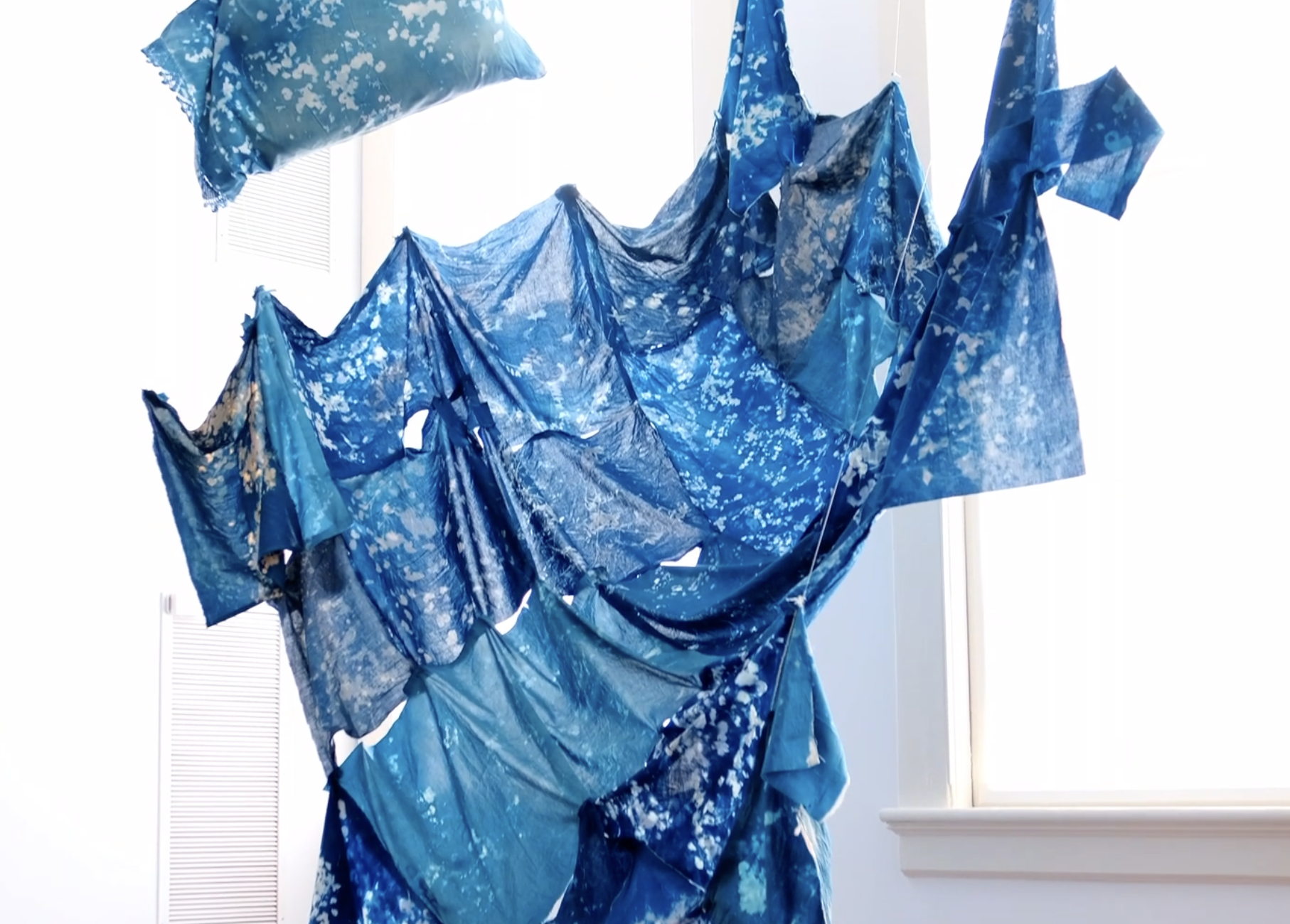
In black-and-white Merriam-Webster Dictionary terms, "sickbed" is defined as "the bed on which one lies sick."
Anyone who has experienced years of chronic illness knows the reality is much more complex. Shortly before her "Para(site)dise" exhibition at the William King Museum of Art in Abington, Virginia, artist Jocelyn Mathewes used a pillowcase and 30 pieces of fabric to create a 7-by-9 floating sculpture called "The Bed (Horizontal Time)."
"Illness often leaves humans bed-bound, horizontal in space. Lying flat, habitating flat, a sick person exists on this plane," she wrote, in a text prepared for the William King Museum of Art in Abington, Virginia. The exhibit opened in August and closes January 10.
"The bed, however, is the center of the universe -- a nest, a resting place. For the chronically ill, it becomes the workspace, the conversation space. All uses are combined into a single whole, bleeding into one another, fragmented yet fundamentally attached."
This experience touches minds and souls, as well as bodies. The sickbed can become a place for confession, penitence, forgiveness and communion. People bring faith and joy with them, as well as fear and worry.
"All of the things that you need can come to you in that bed. … It's a place for the sick, but it is also a place for people who love them," she recently told me. "It can morph and change shape and your feelings about it change with the things that are happening in it, and around it."
In her "the tiny little high five" newsletter, she added: "A bed is a horizontal space that becomes the place of healing, the place of possibility. A bed that takes you to other worlds. A bed that you return to as a refuge. A bed that envelops you kindly, or consumes you, suffocating. It is not static. … It sometimes takes flight."