
Russell Shaw

Another year on the religion beat: The great Russell Shaw on secrecy in Catholic life

Another year on the religion beat: The great Russell Shaw on secrecy in Catholic life

In the spring of 1972, Catholic bishops gathered in Atlanta for an historic event -- their first gathering under a policy that would allow journalists inside the doors of their meetings.

Cardinal John Krol of Philadelphia, the conference president, promised to honor the policy approved by the bishops, which did allow many sensitive topics to be discussed during closed executive sessions.

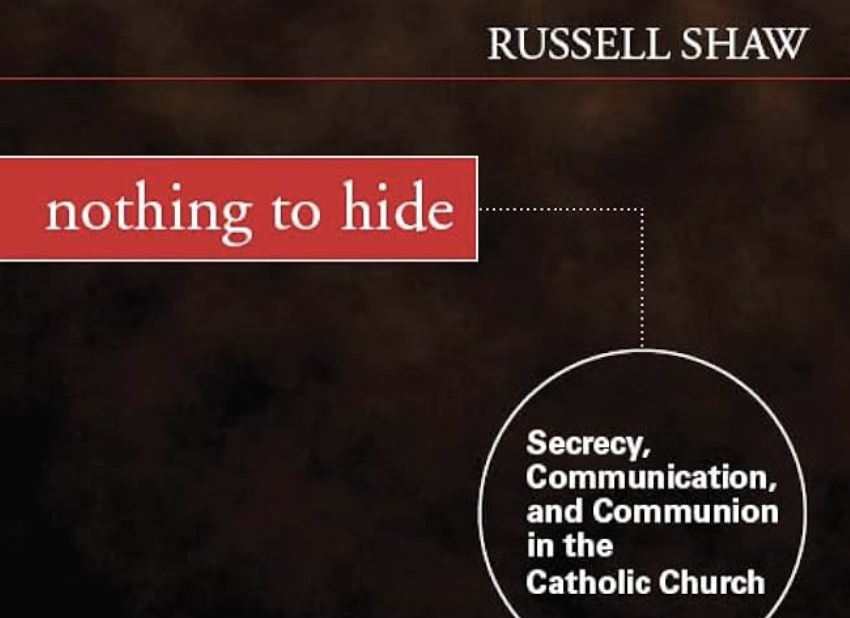
"Cardinal Krol managed to get his own back, after his own fashion," wrote journalist Russell Shaw, in his book "Nothing to Hide: Secrecy, Communication and Communion in the Catholic Church." He served, with different titles, as press aide for the bishops from 1969-1987 and wrote more than 20 books and thousands of articles for Catholic and mainstream publications.

"At the start of the meeting, after the bishops had prayed and taken care of preliminaries, the cardinal rose to speak. He spoke rapidly and at length -- in Latin! Nervous coughing and shuffling of papers could be heard from the press section."

Eventually the cardinal faced the journalists, with what Shaw called a "wicked grin." Krol quipped: "We told you we'd let you in. We didn't tell you what language we'd speak."

Krol was a conservative, but progressives have used similar tactics. I once asked Cardinal Joseph Bernardin of Chicago, after tense debates about the morality of nuclear weapons, if several bishops -- by switching to Latin at key moments -- had "launched a preemptive strike" on newspaper headline writers. He smiled and said, "Yes."

This past week marked the start of my 38th year writing this "On Religion" column, and I spent 20 years leading GetReligion.org, a website that critiqued mainstream coverage of religion news. Over the decades, I had many encounters with Shaw and his January death, at age 90, reminded me that choices made by powerful clergy, as well as newsroom managers, often determine what news makes it into print.

One story loomed over Shaw's career more than any other -- decades of hidden and then public scandals about the sexual abuse of children, teens and adults by Catholic clergy.

What happened to Catholics going to confession? What happened to beliefs about sin?

What happened to Catholics going to confession? What happened to beliefs about sin?

In the movies, the penitent enters a confession booth, kneels, and whispers to a priest behind a lattice screen: "Forgive me father, for I have sinned."

This drama was, for centuries, at the center of Catholic life. But in recent decades, the number of Americans who go to confession has plunged to a shocking degree that church leaders have struggled to explain.

But Father David Michael Moses knows what happened during Holy Week this year, when he spent 65 hours "in the box" at his home parish, Christ the Good Shepherd in Spring, Texas, and at St. Joseph near downtown Houston. In all, heard 1167 confessions.

"We are talking about a lot of sin, and lots of grace," he said. "It's about offering people help and hope. In the end, Jesus wins all the battles that people bring with them into confession. That's what confession is all about."

The 29-year-old priest began hearing confessions at 6 a.m. on April 4, as Catholics made their way to nearby office towers. He continued until midnight, with a parish volunteer noting there were 100 people in line at 8 p.m. Another priest arrived two hours later, and everyone had an opportunity for the Sacrament of Penance.

"You keep thinking: 'Do I go slow and just do my best? Do I try to speed things up?' What you can't do is let anyone feel that they were turned away," said Father Moses, a Houston native who is the son of a Baptist mother and Lutheran father who converted to Catholicism.

Hearing confessions "is hard. It's exhausting. But there is nothing in the world that I would rather be doing, right now. This is what it means to be a priest. This is about salvation and the care of souls."

As recently as the 1950s and 1960s, researchers said about 80% of American Catholics went to confession at least once a year. A clear majority said the went once a month.

Then the numbers began falling -- sharply.

Is this pope Catholic? The debate heats up

With Catholic leaders still sweating after the Extraordinary Synod on the Family firestorm, Pope Francis has once again tried to cool things down -- by publicly affirming core church doctrines.

The question, however, was whether Catholics could balance edgy front-page headlines about sex, divorce, cohabitation, homosexuality and modern families with the pontiff's orthodox sermons, which have received very little ink in the mainstream press.

"We know that today marriage and the family are in crisis," said Pope Francis, opening this week's Vatican conference on "The Complimentarity of Man and Woman in Marriage." It drew 300 leaders from a many world religions, including Islam, Judaism, Hinduism and several branches of Christianity.

Rather than yielding to the "culture of the temporary," the pope said, it's time to stress that "children have a right to grow up in a family with a father and a mother. ... Do not fall into the trap of being swayed by political notion. Family is an anthropological fact -- a socially and culturally related fact. We cannot qualify it based on ideological notions or concepts important only at one time in history. We can't think of conservative or progressive notions."