
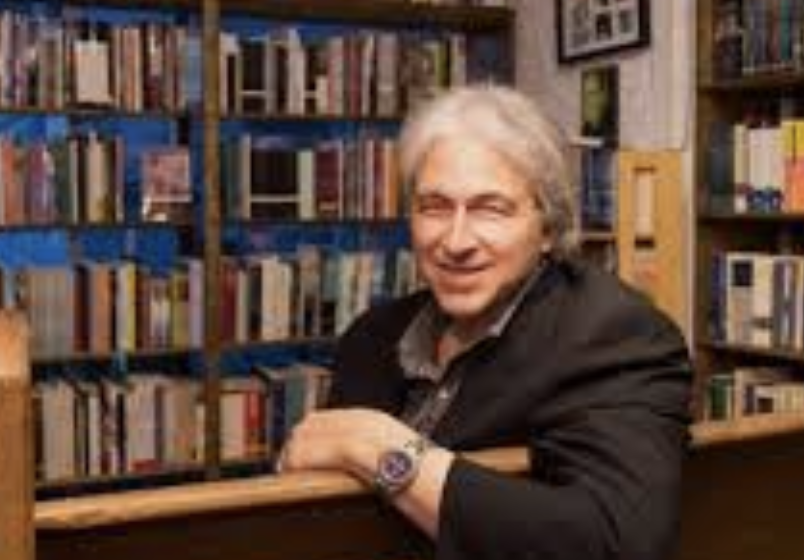
Theologians will travel far and wide searching for the perfect book, but few would think to shop near the Flint Hills of Eastern Kansas.
Metropolitan Saba Esper, leader of the Antiochian Orthodox archdiocese in North America, was searching for a rare book by Oliver Clément of Paris -- the translation of a complex work written in French. While in Wichita two years ago, he went to Eighth Day Books to consult with owner Warren Farha.
"He smiled with his familiar joy, went to a far corner of the bookstore, and brought it to me. I could hardly imagine that he would have it -- yet there it was, in English," said the archbishop, in a letter read to mourners who filled the Cathedral of St. George for the May 26 funeral rites for Farha.
Metropolitan Saba, originally from Syria, first encountered Farha during a 1995 trip to America that included a lengthy stay in Wichita.
"I was struck by his bright and cheerful face, which seemed to tell you that he came to you from a world purer and more radiant than the one in which we live," he added. "His warm smile, his spontaneous innocence, his quiet voice, and his remarkable calm -- these were all signs of God's presence within him and indications of a light descending upon him from on high."
Farha was more than an entrepreneur who built what the New York Times once described as a touchstone that "serves as a secret handshake among Christian book lovers, and its following reaches far beyond the heartland city it serves." It became a hub for conferences and projects with traditional Catholics, Lutherans and the Orthodox.
In an age of cookie-cutter chains and Internet stores, Eighth Day Books only sells books that its team truly wants visitors to read. The shelves are packed and floors stacked with around 46,000 books on its three stories and in the "Hobbit Hole" basement for children.
Farha was constantly asked if he was running a "Christian bookstore."
"We have classics in history, literature, poetry, church history, theology and philosophy," he once told me, in his attic office. "I'm always listening to people who GET the template for what we're doing here. Great books from different traditions are on the shelves right next to each other, even if they clash in ways that we need to discuss."
Eighth Day Books emerged from tragedy. In 1987, Farha's first wife died after her car was hit by a drunk driver. Soon after that, his father died. Stunned, Farha decided to create a business based on his love of books and his college studies in liberal arts and religion. The bookstore's name refers to the timeless day after the resurrection of Jesus.
"When I began to recover from the numbness that goes with grief, I started to ask myself obvious questions. What kind of job could I look forward to going to every day? What kind of work would involve the tendencies, loves, talents and gifts that were part of my particular makeup? The thing I could look forward to was opening a bookstore," wrote Farha, in a 2022 Memoria Press essay.
Soon, there "came a time when I knew that I could not not do this thing. Whether or not I sold a single book, I knew that this was the thing that I had to do."
For many years, Eighth Day Books printed a catalog mailed to 25,000 buyers a year -- including supporters from coast to coast who used it as a tool to develop parish libraries, bookstores and, eventually, schools built on classic literature and ancient languages.
Farha's family and its veteran staff have pledged to carry on with Eighth Day Books and its website and are discussing whether to revive the printed catalogues.
The classic catalogues included this Farha promise: "We hope there is a coherence within this eccentric community of books, an organizing principle of selection: if a book -- be it literary, scientific, historical, or theological -- sheds light on ultimate questions in an excellent way, then it's a worthy candidate for inclusion. … Reality doesn't divide itself into 'religious' or 'literary' or 'secular' spheres, so we don't either; we're convinced that all truths are related, and every truth, if we pay attention rightly, directs our gaze toward God."