
West Virginia

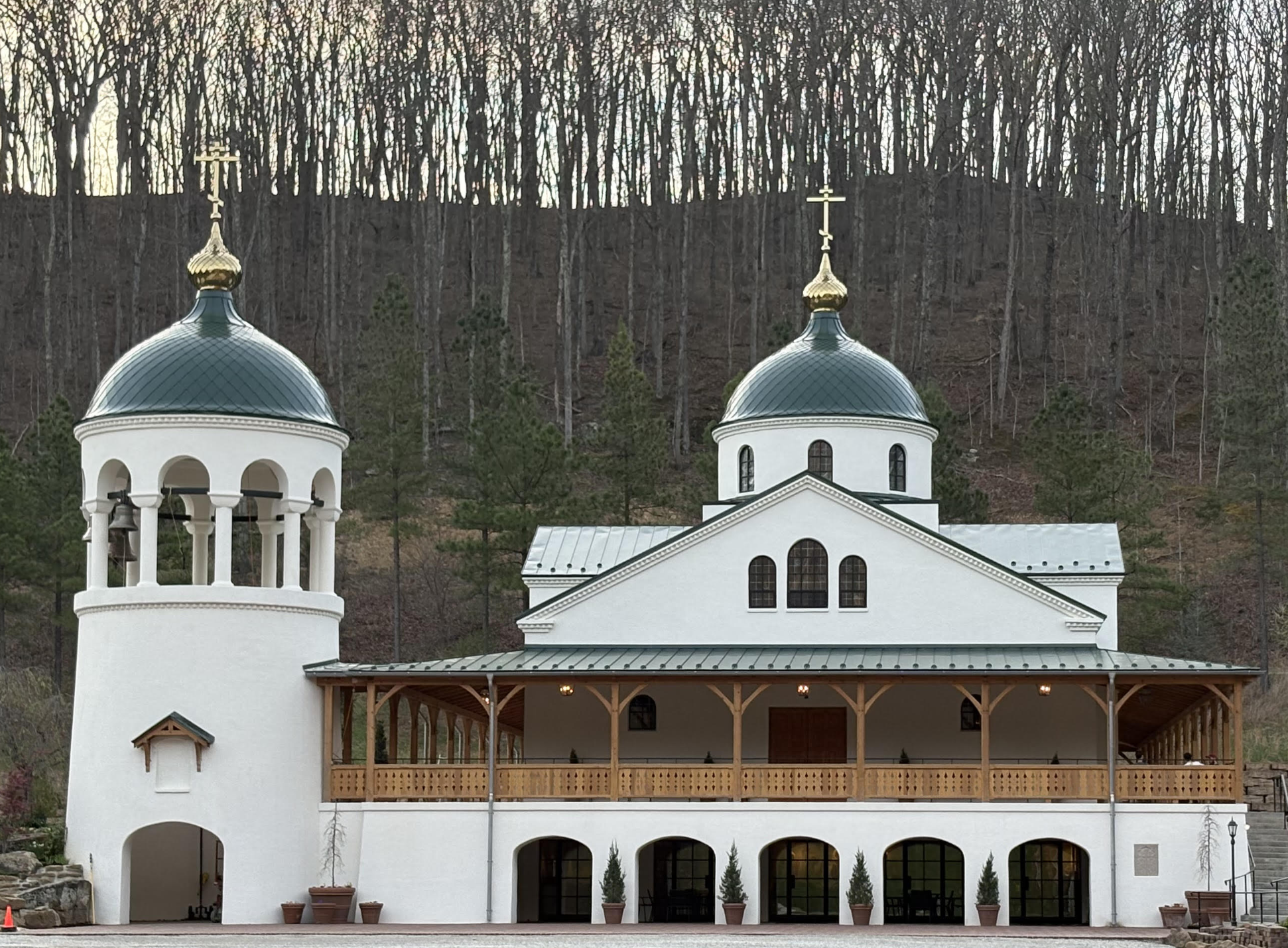
Soaring Orthodox crosses at monastery in a holler in the mountains of West Virginia

Soaring Orthodox crosses at monastery in a holler in the mountains of West Virginia

There is nothing unusual about turning a corner in West Virginia's maze of rough mountain roads and seeing churches with plain white walls and big porches.

But the new sanctuary at the Hermitage of the Holy Cross -- 10 miles of twists and turns into a holler outside the town of Wayne -- offers a variation on that vision. Its green-metal roof has domes resembling medieval Russian helmets, topped with golden cupolas and soaring Slavic crosses.

"When you go to the monastery you begin to think that you're driving off the edge of the world, but then you come around the bend and they've built this whole civilization up there," said Andrew Gould, the Orthodox artist from Charleston, South Carolina, who designed this church for a compound of log-cabins and rustic buildings.

The goal was to blend Orthodox tradition and the simplicity of the local culture.

"We needed people to see this building and immediately say, 'That's a church. That's a beautiful church.' It is always my goal to design churches that are linked to Orthodox traditions but still look like churches to people here in America, even in Appalachia," he said.

The church can hold 50 monks and 150 worshippers -- but the giant, wraparound porch can welcome twice that for feast-day celebrations and special events, especially on rainy mountain days.

"The porch was something we had in the plans, but it is serving a purpose greater than what we intended. It was something God intended," said Abbot Gabriel, 39, a native of Appalachia who converted to Orthodoxy in 2007 and became a novice in 2011.

"The locals have become more and more comfortable with our presence" even if some may not enter the sanctuary, he said. "But gathering on a big porch for food and fellowship, that's different. That's what the locals do. That's mountain hospitality."

Standing on the shoulders of giants: Urban pastor wrestles with his backwoods family roots

Standing on the shoulders of giants: Urban pastor wrestles with his backwoods family roots

Growing up in West Virginia, the Rev. Michael Clary always wondered about some of the archaic language his elders used, words like "yonder" and "reckon."

Then he learned that his grandfather -- a steel-mill worker and country preacher -- had memorized the classic King James Bible by listening to tapes during his long drives to the factory. He had a sixth-grade education and, if he couldn't spell something, he could still quote a verse that contained the word and then find it in his Bible.

All that scripture soaked in -- deep. Thus, "I reckon" wasn't just another way to say "probably." It was New Testament language, such as: "For I reckon that the sufferings of this present time are not worthy to be compared with the glory which shall be revealed in us."

These Appalachian roots caused pangs of shame during graduate school, said Clary, who leads Christ the King Church, a Southern Baptist congregation in Cincinnati.

Soon after that, "I was pastoring a fast growing church in an urban environment, and a spirit of elitism had infected us," he wrote, in a Twitter stream that went viral. "The people we felt free to mock were conservative, uneducated, backwoods fundies. … They lacked the theological sophistication and cultural insight I had acquired while doing campus ministry and studying at seminary."

The bottom line: "I had moved on. I was better than them. I was more learned and cultured. I had 'seen the world' and they hadn't."

Clary said he wrote those "words with tears in my eyes." Reached by telephone, he explained that he was facing the kinds of church tensions that arise while defending traditional doctrines in a flock located a few blocks from the University of Cincinnati. It's hard to be "winsome" -- a buzz word today -- while trying to remain faithful in a bitterly divided culture.

That's precisely why this painful, personal Twitter thread -- republished as one text on several websites in recent weeks -- rang true, noted John Stonestreet, president of the Colson Center for Christian Worldview.